

Top 5 Mistakes New PG Owners Make in Their First 3 Months
Starting a PG business is exciting. The property is ready, rooms are furnished, inquiries are coming in, and the first tenants are moving through the door. For many new owners, this phase feels like proof that everything is working.
But ask any experienced operator, and they’ll tell you the same thing: getting tenants is only one part of the business. The real challenge begins after occupancy starts growing.
The first three months are often where long-term success is decided. During this period, owners establish the habits, processes, and systems that will eventually support 50 tenants, 100 tenants, or even multiple properties. Unfortunately, many first-time operators focus heavily on growth while overlooking the operational foundation needed to support it.
The result is predictable. Occupancy increases, but so do complaints, payment delays, communication issues, and administrative workload.
Let’s look at five mistakes that new PG owners commonly make and how successful operators avoid them.
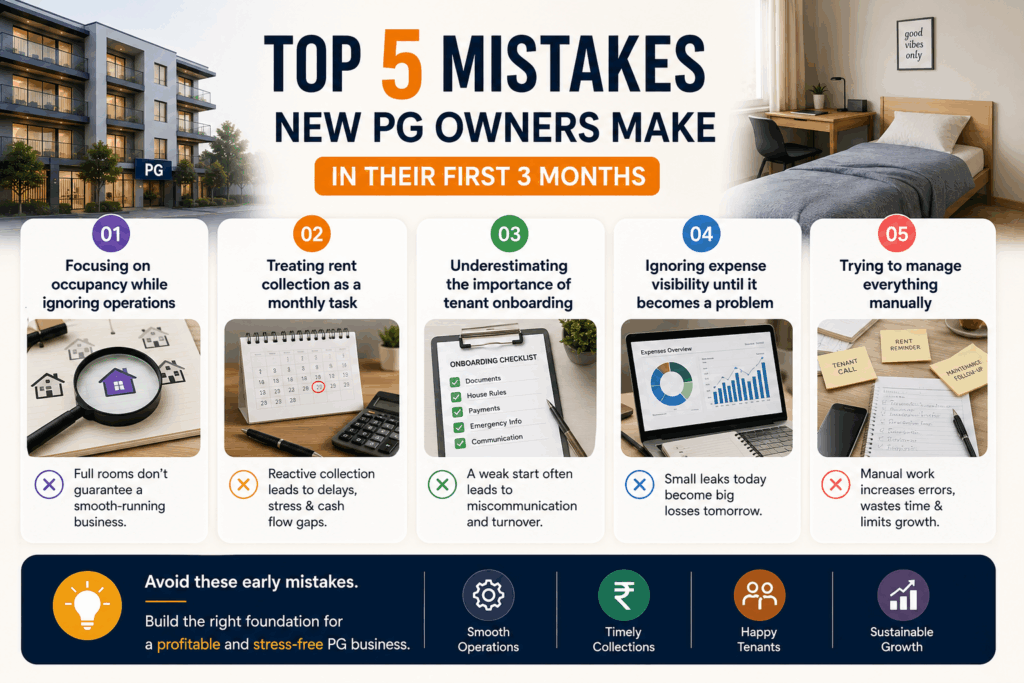
Mistake #1: Focusing on Occupancy While Ignoring Operations
Every new PG owner wants rooms filled as quickly as possible. Empty beds mean lost revenue, so marketing, lead generation, and conversions naturally become the top priority.
The problem isn’t focusing on occupancy. The problem is treating operations as something that can be figured out later.
Many properties reach good occupancy levels within their first few months but struggle operationally because the backend processes never evolved alongside growth. What worked for ten tenants starts breaking down when there are forty.
Some common signs of this include:
- Tenant information being spread across multiple spreadsheets, notebooks, and WhatsApp chats, making it difficult to retrieve accurate information when required.
- Staff members handling similar situations differently because there is no defined process for complaints, maintenance requests, visitor management, or tenant communication.
- Owners becoming involved in every small operational task because responsibilities and workflows have not been clearly structured.
The impact isn’t always visible immediately. Instead, it appears gradually. Owners find themselves spending more time coordinating daily activities and less time focusing on growth, occupancy, and tenant experience.
Experienced operators think differently. They understand that every new tenant increases operational complexity. Instead of waiting for problems to appear, they create basic systems for communication, collections, complaints, and record management early.
Growth becomes much easier when it is built on structure rather than constant firefighting.
Mistake #2: Treating Rent Collection as a Monthly Task
One of the biggest surprises for first-time PG owners is how much effort rent collection can require.
Initially, the process feels simple. Tenants transfer money, payments are received, and records are updated. But as occupancy increases, collection management becomes far more than checking bank statements.
The real challenge is visibility.
Without a proper process, owners often struggle to answer basic operational questions. Who has paid? Who is overdue? How much rent is currently pending? Which tenants repeatedly delay payments?
When answers to these questions require searching through messages, screenshots, and transaction histories, collections quickly become reactive instead of organized.
This creates several operational problems:
- Payment follow-ups happen after delays have already occurred instead of being managed proactively through reminders and tracking systems.
- Cash flow planning becomes difficult because expected collections and actual collections are not clearly visible in one place.
- Tenant disputes become harder to resolve because payment records are spread across multiple channels and often lack proper documentation.
The strongest operators view rent collection as a continuous process rather than a once-a-month activity. They focus on maintaining visibility throughout the month instead of scrambling to understand the financial situation when rent becomes due.
The difference may seem small, but it has a significant impact on profitability, planning, and operational control.
Mistake #3: Underestimating the Importance of Tenant Onboarding
Many owners assume the tenant experience begins after move-in. In reality, the first few days often shape how residents feel about the property for the rest of their stay.
When onboarding is unstructured, confusion becomes almost inevitable.
New residents arrive with dozens of questions. They want to understand property rules, payment schedules, visitor policies, complaint procedures, meal timings, and support contacts. If these details are not communicated clearly, uncertainty quickly turns into frustration.
Good onboarding doesn’t need to be complicated. It simply needs to be consistent.
A strong onboarding process usually ensures that tenants understand:
- How to report maintenance issues and what response timelines they can expect from management.
- The property’s operational policies regarding visitors, payments, amenities, and common-area usage.
- Whom they should contact for different types of support instead of relying on informal communication channels.
When this information is provided clearly from the beginning, tenants feel more confident and self-sufficient. Staff members spend less time answering repetitive questions, and misunderstandings become far less common.
More importantly, onboarding sets the tone for the entire relationship between the tenant and the property.
Properties that create a professional first impression often experience better retention, stronger reviews, and more referrals than properties that leave residents figuring everything out on their own.
Mistake #4: Ignoring Expense Visibility Until It Becomes a Problem
Revenue gets most of the attention in the early stages of a PG business. Expenses rarely do.
This is understandable. When occupancy is growing, collections become the primary focus. As long as money is coming in, many owners assume the business is performing well.
Unfortunately, profitability and collections are not the same thing.
A property can have strong occupancy and still struggle financially if expenses are not being tracked properly. Small costs often go unnoticed because they appear insignificant individually. Over time, however, these expenses accumulate and begin affecting margins.
Common examples include:
- Frequent maintenance purchases that seem minor individually but create a significant monthly expense when viewed collectively.
- Utility costs that continue increasing without owners having enough visibility to identify unusual consumption patterns.
- Vendor payments that are tracked inconsistently, making it difficult to understand actual operating costs and profitability.
The challenge is that poor expense visibility doesn’t create immediate pain. It creates delayed surprises.
Owners often discover issues months later when profits are lower than expected despite healthy occupancy levels. By that point, identifying the source of the problem becomes much harder.
Successful operators track expenses from day one because they understand that financial visibility is just as important as occupancy visibility.
Mistake #5: Trying to Manage Everything Manually
Perhaps the most common mistake among new PG owners is believing they can continue managing operations manually as the business grows.
In the beginning, manual management feels efficient. Occupancy is low, communication is manageable, and daily tasks seem straightforward.
The problem is that manual systems don’t scale.
As more tenants move in, the workload grows exponentially. Owners find themselves spending hours on tasks that previously took minutes.
This usually looks like:
- Sending individual rent reminders every month instead of using automated systems that ensure consistency.
- Managing complaints through calls and WhatsApp conversations, making it difficult to track progress and follow-ups.
- Maintaining tenant records, agreements, deposits, and payment information across multiple disconnected files and documents.
The issue isn’t effort. Most new operators are willing to work hard.
The issue is sustainability.
Businesses that depend entirely on manual effort eventually reach a point where growth becomes difficult because every new tenant adds more administrative work. Instead of improving efficiency, growth increases complexity.
The strongest operators solve this early by introducing systems before they become absolutely necessary.

The Pattern Behind All Five Mistakes
Although these mistakes appear different, they usually come from the same mindset.
Many new owners assume they need systems after they grow.
Experienced operators understand that systems are what allow growth to happen smoothly in the first place.
Whether it is collections, onboarding, expense tracking, communication, or tenant management, the goal is not to eliminate effort. The goal is to create consistency. Consistent operations produce better tenant experiences, better visibility, and ultimately a more profitable business.
How RentOk Helps New PG Owners Build Better Systems From Day One
The first few months of running a PG can feel overwhelming because multiple operational responsibilities are happening simultaneously. Owners need to manage occupancy, collect rent, track expenses, handle complaints, coordinate staff, and maintain tenant records, often with limited resources.
RentOk helps simplify these processes by bringing essential operational workflows into one platform. Instead of relying on spreadsheets, scattered communication, and manual tracking, owners can manage collections, occupancy, expenses, tenant information, complaints, and day-to-day operations through a connected system.
This allows new operators to establish structure early, reduce administrative workload, and focus more on growing the business rather than constantly managing operational chaos.
Conclusion
The first three months of a PG business often determine how easy or difficult the next three years will be. While occupancy growth is important, long-term success usually depends on the systems built during these early stages.
Owners who prioritize operational visibility, structured processes, and tenant experience from day one are far better positioned to scale without creating unnecessary complexity. The goal isn’t simply to fill rooms. It’s to build a property that continues running efficiently as occupancy grows.
Start your free RentOk trial today and discover how smarter property management can help you avoid common mistakes, streamline operations, and build a stronger foundation for long-term growth.