
How High-Growth PGs Maintain Occupancy Year-Round
For a PG business, filling every bed is not the same as maintaining healthy occupancy.
A property may be almost full during admission season, only to see several rooms become vacant a few months later. Another property may have a steady flow of inquiries but still struggle to convert enough of them into move-ins. On paper, both businesses have demand. Operationally, however, they are dealing with very different occupancy problems.
This is why high-growth PG businesses do not treat occupancy as a number that needs to be fixed whenever it falls. They treat it as an ongoing business system influenced by demand generation, lead conversion, tenant retention, pricing, reputation, and day-to-day property management.
As competition increases, tenants also have more ways to compare properties before making a decision. They can check listings, reviews, social media pages, pricing, amenities, and even recommendations from existing residents before visiting a property. RentOk’s own guide on how to improve occupancy rate in a PG highlights the same shift: occupancy improves when operators stop waiting for inquiries and start actively managing the factors that influence demand.
So, how do high-growth operators keep occupancy consistent even when the market naturally changes?
Why Does PG Occupancy Fluctuate?
Occupancy rarely falls because of one isolated problem. More often, several factors work together.
For student housing, academic calendars are a major influence. Admissions can create strong demand, while graduation, examinations, semester breaks, or schedule changes can slow movement. Properties serving working professionals may follow different patterns, influenced by office locations, relocations, job changes, and local employment cycles.
However, seasonality is only part of the picture.
A property can lose occupancy even during periods of strong demand if pricing is poorly positioned, online visibility is weak, inquiries are answered slowly, or tenants are leaving faster than new residents are acquired. Occupancy is therefore shaped by both external demand and internal operations.
Common causes include:
- Seasonal demand changes create predictable periods of high and low inquiry volume, particularly for student-focused properties. Understanding these cycles helps operators prepare inventory and marketing in advance.
- Slow lead response and weak follow-up can turn strong inquiry volumes into poor conversions. Prospects comparing multiple PGs may quickly move to a property that responds faster.
- Poor tenant experience can increase move-outs and create another occupancy challenge. Every early departure creates a room that must be marketed and filled again.
- Weak digital visibility can make a good property difficult to discover. Outdated photos, incomplete listings, poor reviews, or unclear pricing may discourage prospects before they make an inquiry.
- Unstructured operations make it harder to identify the reasons behind vacancies. When occupancy, leads, payments, move-outs, and tenant complaints are tracked separately, management may see the problem without understanding its cause.
A healthy occupancy rate should therefore be viewed alongside the processes that support it. Understanding where demand comes from, how quickly leads are handled, why tenants leave, and how operations are managed gives property owners a clearer path to improving occupancy and reducing repeated vacancies.

How Do Top Operators Maintain Demand?
High-growth PG operators do not wait for vacant rooms before they start thinking about marketing. They build demand continuously so that a vacancy does not automatically become a crisis.
The difference is subtle but important.
A reactive operator asks, “How do I fill this empty bed?”
A growth-focused operator asks, “What should I be doing today so that my next vacancy does not stay empty for long?”
That mindset changes how the business approaches marketing, tenant relationships, and data.
They Build Visibility Before They Need It
A PG that becomes visible only when it has vacant rooms is already playing catch-up. Strong operators maintain their digital presence throughout the year, keeping listings, photographs, pricing, reviews, and property information updated even when occupancy is high.
This matters because tenants do not necessarily start searching only when a room becomes available. They may begin comparing options weeks in advance.
A strong digital presence ensures that when the search begins, the property is already part of the consideration set.
That includes maintaining visibility across relevant listing platforms, Google, social media, referral networks, and direct inquiries. It also means making the property easy to evaluate. Clear information around location, rent, amenities, room types, food, rules, and availability reduces the uncertainty that often prevents a prospect from taking the next step.
They Understand Their Own Occupancy Cycle
One of the simplest ways to improve occupancy consistency is to understand when occupancy usually changes.
Instead of looking only at the current occupancy percentage, operators should examine patterns across previous months and years. Which months bring the most inquiries? When do most tenants move out? Which room types fill fastest? How long does an average vacancy remain open?
These questions turn occupancy from a monthly report into a planning tool.
For example, if a student-focused property consistently sees a rise in move-outs after examinations, the operator does not need to wait until rooms become empty to begin marketing. Campaigns, listings, referrals, and follow-ups can be strengthened before that period.
The same principle applies to high-demand seasons. When operators know demand is coming, they can prepare their team, room inventory, pricing, and lead-handling process rather than trying to manage everything at the last minute.
Which Marketing Channels Work Best?
There is no universal answer because the strongest channel depends on the property’s location, tenant profile, pricing, and positioning.
What high-growth operators generally do better is avoid depending entirely on one channel.
Property Listings and Local Search
Listing platforms continue to matter because they capture people who are already looking for accommodation. However, simply being listed is not enough.
A property competing against dozens of similar PGs needs a listing that answers the questions a tenant is likely to have before making an inquiry. Strong photographs, transparent pricing, accurate amenities, clear location information, and genuine reviews all contribute to that first impression.
Local search is equally important. Someone moving to a new city may search for a PG near a college, metro station, office hub, or specific neighbourhood. Being discoverable for these high-intent searches can bring prospects who are already closer to making a decision.
Social Media and Content
Social media can play a different role. Instead of simply communicating that a room is available, it can show what living at the property actually looks like.
Room tours, common spaces, tenant experiences, community activities, nearby locations, food, amenities, and reviews can help prospects understand the property before they visit.
The objective is not to turn every post into an advertisement. It is to reduce the gap between what a prospect sees online and what they experience during a property visit.
For a broader look at where PG operators can source high-intent prospects, explore Top 5 Sources to Get Tenant Leads in India (2026), which breaks down the role of Google listings, property portals, social media, local communities, referrals, and brokers.
Referrals
Existing tenants can become one of the strongest occupancy channels for a PG because their recommendation carries experience behind it.
A student is more likely to trust a friend who already lives in the property than a generic advertisement promising a “premium living experience.”
Referral programs can make this channel more systematic, but incentives alone are not enough. A tenant recommends a property when they are comfortable attaching their own reputation to it.
For a deeper look at this, RentOk’s guide on building a tenant referral program explores why referrals work and how operators can structure them more effectively.
The Lead Is Not the Same as the Booking
A common occupancy mistake is measuring marketing success by the number of inquiries received.
In reality, inquiries are only the beginning.
A property can generate hundreds of leads and still have vacant beds if those inquiries are not responded to quickly, followed up consistently, and moved through a clear conversion process.
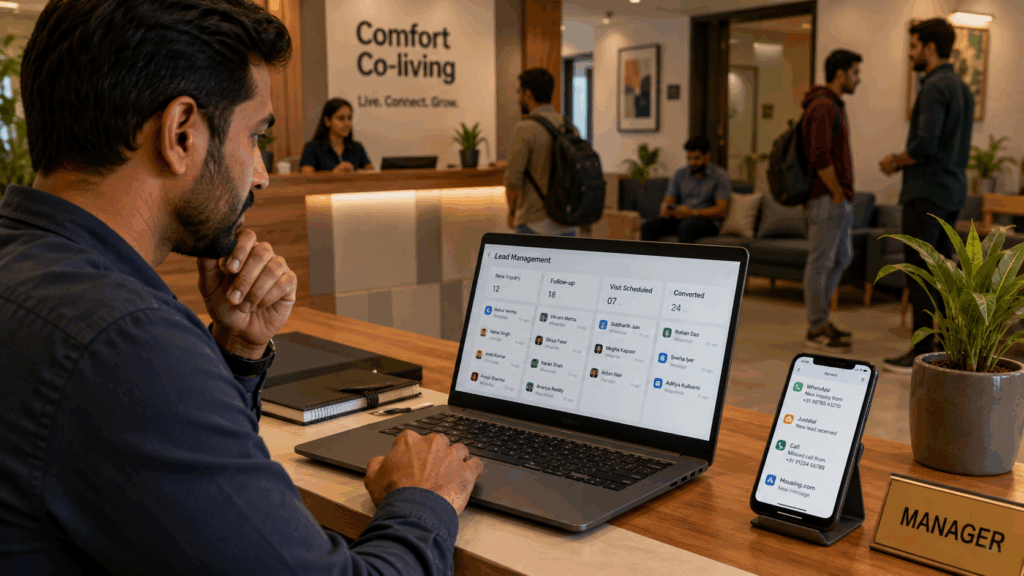
This becomes particularly difficult when leads arrive from several sources. One prospect may call directly, another may message on WhatsApp, another may come through a listing platform, and another may be referred by an existing tenant. If these interactions are managed separately, it becomes easy for prospects to disappear from the pipeline.
A structured lead process should make it possible to see:
- Where each inquiry came from and whether that channel is actually producing meaningful bookings rather than just generating activity.
- Which prospects have been contacted, which are interested in visiting, and which require another follow-up before a decision is likely.
- How long it typically takes to convert an inquiry into a move-in and where prospects are dropping out of the process.
- Which marketing channels are producing higher-quality tenants rather than simply larger numbers of inquiries.
This distinction matters because improving occupancy is not always about generating more leads. Sometimes it is about converting a larger percentage of the leads already coming in.
If you want to understand where your marketing spend is actually translating into occupancy, read Cost Per Lead for PGs: Are Your Ads Worth It? for a closer look at lead quality, conversion tracking, and the real cost of different acquisition channels.
Retention Is Part of Occupancy Management
There is another side of the occupancy equation that operators often underestimate: retention.
If a tenant leaves after a short stay, the property immediately enters another acquisition cycle. The room needs to be prepared, marketed, shown, negotiated, and filled again. The business pays the operational cost of acquiring a tenant twice when it could have retained the first one.
This is why tenant experience is directly connected to occupancy stability.
Communication, maintenance, cleanliness, food, complaint resolution, transparency, and consistency all influence whether a tenant decides to continue living at the property. RentOk’s recent article on why tenants leave PGs in the first 30 days goes deeper into how early churn affects occupancy and why the first month matters so much.
Retention does not mean trying to keep every tenant indefinitely. Some residents will leave because they graduate, relocate, change jobs, or simply need a different arrangement.
The goal is to prevent avoidable churn.
When residents know how complaints are handled, receive timely communication, understand payment and property policies, and experience consistent service, the business creates a stronger foundation for longer stays.
Should PGs Depend on Discounts to Fill Vacancies?
Discounts can be useful, particularly during slower periods, but they should not become the primary solution to an occupancy problem.
If a property constantly relies on discounts, it may fill beds temporarily without fixing why demand is weak in the first place. It can also reduce margins and make pricing harder to manage over time.
A better approach is to understand what is causing the vacancy.
If inquiries are low, the problem may be visibility. A high volume of inquiries with weak conversions, however, can point to pricing, listing quality, response time, or the sales process. Repeated occupancy declines caused by early tenant departures may instead indicate that retention is the bigger problem.
Pricing becomes much more effective when it is used as one part of an occupancy strategy, rather than as an emergency lever.
Operators should also understand the financial side of occupancy. Filling every bed at any price does not necessarily mean the property is performing well. Rent, staffing, utilities, food, maintenance, marketing costs, and other operating expenses all influence whether the occupied beds are actually producing sustainable returns.
Understanding break-even occupancy can help operators look beyond the headline occupancy percentage and understand how much occupancy the property actually needs to cover its operating costs.
What Systems Support Sustainable Growth?
A PG can often be managed manually when it has a small number of tenants.
The problem appears when the business grows.
One spreadsheet tracks tenant details. Another tracks payments. WhatsApp contains maintenance complaints. A notebook records room availability. Team members maintain their own information. Eventually, the operator has plenty of data but very little visibility.
Growth exposes this problem quickly.
A scalable PG operation needs connected visibility across occupancy, tenants, leads, payments, dues, complaints, team activity, and property performance. The objective is not to replace every manual task with technology. It is to make sure that important information does not remain scattered across disconnected systems.
For example, knowing that three rooms are vacant is useful.
Knowing that those three rooms have been vacant for different lengths of time, that one has received five inquiries, another has received none, and the third has had several visits but no conversion is far more actionable.
That is the difference between reporting what happened and understanding what needs to happen next.
For operators looking to take this further, How to Automate PG Management Completely looks at how occupancy tracking, dues, complaints, team management, and reporting can work together as part of a more structured operating system.
This is also where automation becomes valuable. Routine reminders, announcements, tenant communication, payment tracking, reporting, and other recurring activities can be structured so that the property team spends less time chasing information and more time acting on it.
For operators building a larger portfolio, systems are not simply an administrative upgrade. They become part of the growth infrastructure.
A Consistent Occupancy Strategy Needs More Than Marketing
The strongest PG businesses understand that occupancy is the outcome of several systems working together.
Marketing brings attention. Lead management converts that attention into visits and bookings. Tenant experience influences retention and referrals. Data helps operators understand where the process is working and where it is leaking.
If one part breaks, occupancy eventually feels the impact.
A property with excellent marketing but poor retention will constantly have to replace tenants. Meanwhile, properties with happy tenants but weak visibility may struggle to attract enough new residents. Even strong demand can translate into missed opportunities when follow-up is slow, as prospects may turn to competitors before the sales team has a chance to convert them.
This is why high-growth operators think in terms of an occupancy engine, not a single marketing channel.
They keep demand moving, track what happens to every lead, understand their seasonal patterns, protect tenant experience, and use operational data to make decisions before a small vacancy becomes a larger problem.
For operators looking for more practical ways to build a scalable PG operation, RentOk’s PG growth resources cover topics ranging from tenant leads and break-even occupancy to operational systems and property growth.

How RentOk Helps PG Businesses Maintain Better Occupancy
Maintaining consistent occupancy becomes considerably harder when tenant management, lead tracking, payments, dues, communication, and property operations are handled through separate spreadsheets, chats, registers, and manual processes.
RentOk brings these workflows together in one property management platform, giving PG and co-living operators greater visibility into the operations that influence occupancy. Operators can manage tenant information, track check-ins and check-outs, handle payments and dues, manage leads, communicate with residents, coordinate property operations, and access reports that help them understand performance across their properties.
That connected approach helps operators move beyond simply knowing that a room is vacant. It gives them a better view of the operational context around that vacancy, the tenant journey, and the property performance behind the numbers. As a business expands across more rooms or properties, this visibility becomes increasingly important for maintaining consistency without increasing manual work at the same rate.
Conclusion
Consistent PG occupancy is not created by one successful advertisement, one discount, or one peak admission season. It is built through a combination of continuous demand generation, faster lead conversion, strong tenant retention, intelligent pricing, referrals, and systems that allow operators to see what is happening across the business.
The biggest advantage high-growth operators have is not necessarily that they receive more inquiries than everyone else. It is that they are better prepared to turn demand into occupancy and occupancy into long-term stability.
They study their occupancy cycles rather than waiting for vacancies to appear. To diversify demand, they build multiple marketing channels instead of relying on a single source. Move-outs are viewed as more than unavoidable numbers; the tenant experience behind them is examined closely. For sustainable growth, they also replace scattered records with systems that provide clear visibility.
That is what makes year-round occupancy more predictable, and makes growth more sustainable.
Ready to build a more organized and scalable PG business? Start your free RentOk trial and explore smarter ways to manage occupancy, tenants, payments, and property operations from one platform.
FAQ’S
1. What is a good occupancy rate for a PG business?
A healthy PG occupancy rate generally indicates that most available beds are consistently occupied while leaving enough flexibility for regular tenant movement. The ideal rate depends on location, property type, seasonality, pricing, and operating costs.
2. How can PG owners reduce the time a room stays vacant?
Reducing vacancy time requires quick lead follow-ups, updated property listings, clear availability information, and a smooth booking process. Keeping potential tenants engaged even before a room becomes vacant can also help shorten the gap between two occupants.
3. How often should PG occupancy be monitored?
Occupancy should ideally be monitored regularly rather than only at the end of each month. Tracking weekly or even daily changes can help operators identify upcoming vacancies, unusual move-out patterns, and changes in demand early.
4. Does tenant satisfaction affect PG occupancy?
Yes, tenant satisfaction directly influences occupancy through retention, reviews, and referrals. A positive experience can encourage tenants to stay longer and recommend the property, while recurring operational issues can increase avoidable turnover.
5. Should PG businesses change their pricing during low-demand periods?
Pricing can be adjusted during slower periods, but discounts should not be the only response to falling demand. Operators should first understand whether the issue comes from pricing, visibility, lead conversion, tenant experience, or changing market demand.
6. How can PG owners measure whether their marketing is improving occupancy?
Marketing performance should be evaluated beyond the number of inquiries generated. Operators should track metrics such as lead-to-booking conversion, successful booking sources, acquisition costs, and the time taken to fill a vacant room.