

What Licenses Do You Need to Run a PG in India?
Starting a PG business in India involves far more than arranging rooms, deciding the rent, and finding tenants. The moment a property begins functioning as a paying guest accommodation, the owner also takes on responsibilities related to property use, tenant records, safety, local permissions, and business operations.
One of the biggest mistakes new PG operators make is assuming that there is one universal “PG licence” that makes the property legally compliant. In reality, compliance can involve several different registrations, certificates, permissions, and operational requirements. What applies to one PG may not necessarily apply in exactly the same way to another because requirements can vary by state, city, property type, building characteristics, occupancy, and the services being offered.
This makes compliance a little more complicated, but also much easier to understand when it is looked at as a framework rather than a single licence.
Before investing heavily in interiors, marketing, or tenant acquisition, a PG owner should first establish whether the property can legally be used for the intended purpose and identify the approvals that apply to that particular location and operating model.
Understanding PG Compliance in India
There is no single checklist that applies to every PG across India. A property in Delhi may follow a different process from one in Bengaluru, Hyderabad, Pune, or another city. Even within the same city, requirements can vary depending on the building, location, and how the accommodation is classified.
A useful starting point is to break PG compliance into different areas rather than treating it as one registration exercise.
Some of the major areas a PG owner should examine include:
- Business and establishment requirements: Depending on the state, the PG may need registration under the applicable Shops and Establishments framework.
- Police and tenant requirements: Local authorities may require tenant verification, occupant records, or police permissions.
- Fire and life-safety compliance: A Fire NOC or Fire Safety Certificate may be required based on local rules and building factors.
- Building and occupancy documents: Owners should confirm that the property has the required approvals. Its permitted use should also allow PG operations.
- Municipal permissions: Some cities may require additional registrations, licences, or approvals for accommodation businesses.
- Service-specific compliance: Services such as meals, housekeeping, or security may involve additional requirements.
However, not every PG needs every item listed above. The correct checklist depends on the property, location, business structure, and local rules.
For owners still planning their PG, this can prevent costly mistakes. It is better to confirm the property’s suitability before signing a long-term lease or investing heavily in setup.
Compliance also affects the long-term viability of a PG. Once operational, maintaining occupancy requires more than filling vacant beds. RentOk’s How High-Growth PGs Maintain Occupancy Year-Round explores how demand, tenant retention, lead conversion, and daily operations influence occupancy.

1. Shops & Establishments Registration
The Shops and Establishments framework is one of the first areas a PG owner should investigate. However, there is no single process across India. The applicable legislation and registration requirements are administered at the state or Union Territory level, so they can vary by jurisdiction.
For a PG owner, this becomes especially relevant when the property has staff managing daily operations. A larger PG may have a property manager, caretaker, housekeeping staff, security personnel, or other employees. Once a property operates with a team, employment and establishment-related compliance becomes an important part of the overall business structure.
Managing these teams also requires visibility into whether daily responsibilities are actually being completed. RentOk’s Tracking Staff Performance: From Cleaning to Security looks at how property owners can bring greater accountability to routine staff activities across a PG.
The owner should therefore check with the relevant state authority to understand:
- Whether the PG falls within the applicable registration requirements and how the establishment is classified under the state framework.
- What information and documents need to be submitted for registration, including details relating to the business, premises, and employees where applicable.
- What ongoing obligations may apply after registration, such as maintaining prescribed records, displaying information, or completing renewals and updates.
It is also important to distinguish between running a business and having permission to use a particular property for that business. Establishment registration does not automatically address building-use or local-property requirements. Both areas should be examined separately.
For a growing PG, keeping these records organized from the beginning can make future expansion easier. What may seem like a small administrative task for one property can become considerably more complicated when the same owner manages several locations and multiple teams.
2. Police NOC and Tenant Verification Requirements
The phrase “police NOC for PG” is often used as though it represents one standard requirement throughout India. It does not.
Police-related requirements can depend on the jurisdiction, the classification of the accommodation, and the rules applicable to that particular property. Some accommodation businesses may require permissions or registrations involving the police, while tenant verification and occupant-record requirements may operate as separate processes.
This distinction is especially important for PG operators because they deal with a constantly changing resident population. Unlike a conventional residential property where a tenant may stay for years, PGs can experience frequent move-ins and move-outs, making accurate occupant records an ongoing operational responsibility.
RentOk’s guide to tenant police verification in India also explains why the process cannot simply be treated as identical across every state and city. Different jurisdictions can have different procedures and channels for submitting tenant information.
For a PG operator, the practical challenge is therefore twofold: understanding what the local authority requires and ensuring that the property team follows the process consistently.
A well-structured tenant onboarding workflow should make it possible to identify:
- Which tenant documents have been collected and whether the required identity information is complete before the tenant’s stay begins.
- Which verification or registration steps have been completed, submitted, or are still pending according to the applicable local process.
- Where important tenant records are stored so that authorized property staff can retrieve them without searching through multiple spreadsheets, chats, or physical files.
This becomes increasingly important as occupancy grows. Managing verification for 20 residents manually may be manageable, but the same approach becomes much harder to control when a property has hundreds of occupants or an owner operates several PGs.
3. Fire Safety Certificate and Fire NOC
Fire-safety planning is a core part of responsible property management.
However, not every PG in India needs the same Fire NOC or Fire Safety Certificate. Requirements can vary by state, local building bye-laws, property classification, building height, area, and occupancy.
Owners should therefore verify the rules for their specific property. The relevant fire authority is the best source for this. A generic online checklist may not cover every requirement.
Depending on the building and applicable rules, fire-safety provisions may include:
- Fire extinguishers, alarms, emergency lighting, and other equipment appropriate to the building and its risk profile.
- Clearly accessible escape routes and emergency arrangements that allow occupants to leave the premises safely during an incident.
- Additional fire-protection systems such as hydrants, sprinklers, or other installations where required by the applicable building and fire-safety provisions.
- Inspections, certificates, or formal clearances where the building falls within a category requiring approval from the relevant fire authority.
The building itself also needs proper assessment. Simply purchasing fire equipment does not mean the property is fully compliant. A few extinguishers alone may not meet all applicable safety requirements.
Fire safety also continues after the PG opens. Regular maintenance and timely repairs help keep the property safe and well managed. RentOk’s How to Handle Maintenance Requests in Your PG explains how PG operators can organise requests, prioritise issues, and track them through resolution.
For a PG owner, the right question is not just “How do I get a Fire NOC?” It is “What fire-safety requirements apply to this building?” Owners should also confirm which approvals are needed before starting PG operations.
This approach connects compliance with the actual safety needs of the property.
4. Building Safety and Occupancy Approvals
Fire compliance addresses one major area of risk, but it does not answer whether the property itself is approved and suitable for the intended use.
Before starting a PG, owners should review the building’s existing documentation and understand what the local authority has approved for the premises. This becomes particularly important when a property is being converted, leased, renovated, or used differently from its original residential purpose.
Depending on the location and nature of the building, relevant documentation may include sanctioned building plans, completion documentation, occupancy-related approvals, structural safety documents, or other permissions prescribed by the local authority.
The exact terminology and requirements can differ, but the underlying question remains the same:
Is this property legally and structurally suitable for the way I intend to operate it?
That question should be answered before occupancy begins, not after the PG is already full.
For leased properties, this also means the owner should carefully examine the lease agreement. The fact that a landlord owns a building does not automatically mean that every proposed use of the premises is permitted. The operator should understand what the agreement allows and whether additional permissions are needed for the intended PG operation.
This is one reason compliance should be part of the property-selection process itself. If the premises has unresolved approval or usage issues, those problems can become much more expensive once the operator has already invested in furniture, branding, marketing, staff, and tenant acquisition.
Property selection is also closely connected to understanding who is expected to move in and when. RentOk’s How to Track Booking and Upcoming Tenants explains why keeping upcoming tenants visible is important for preparing rooms, setting rent cycles, and managing occupancy before the actual move-in date.
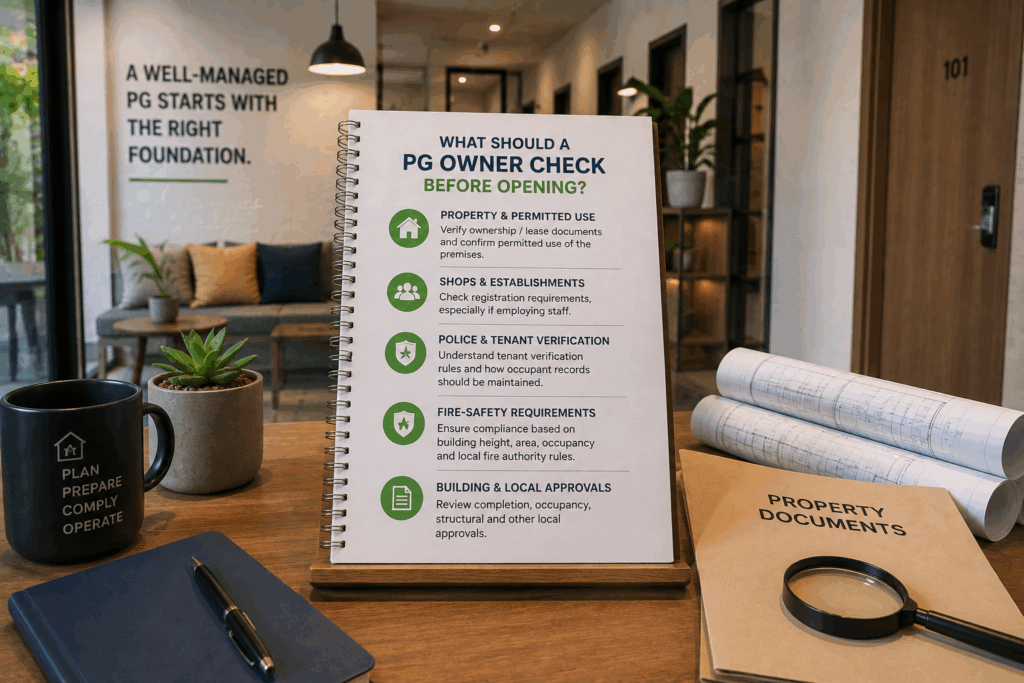
What Should a PG Owner Check Before Opening?
At this stage, the objective should not be to collect every possible certificate without understanding why it exists. Instead, build a property-specific compliance checklist based on the location and operating model.
Before opening, review areas such as:
- Property ownership or lease documentation and the permitted use of the premises, making sure the intended PG operation does not conflict with the property’s approved use.
- Applicable Shops and Establishments requirements, particularly where the PG employs property managers, caretakers, housekeeping staff, security personnel, or other workers.
- Police and tenant-verification requirements applicable to the city and accommodation model, including how occupant information needs to be maintained or submitted.
- Fire-safety requirements based on the building’s height, area, occupancy, classification, and the rules enforced by the relevant fire authority.
- Building, completion, occupancy, structural, and other local approvals that establish whether the premises is appropriate for the intended operation.
The important word here is applicable. A compliance checklist should be built around the actual property rather than copied from another PG owner’s experience in another city.
5. State-Specific and Municipal Requirements
When two operators run similar businesses, their compliance needs may still differ. Municipal rules, building regulations, police procedures, and accommodation requirements vary across India.
RentOk has previously covered specific rules introduced by the Ahmedabad Municipal Corporation for PGs, hostels, lodging facilities, and homestays. This shows why operators cannot create one compliance system and apply it to every property.
When evaluating a new property, owners should check requirements at three levels: state, city or municipal authority, and the individual building.
Depending on the location, additional areas may include:
- Municipal or trade permissions: Local bodies may require specific registrations or permissions based on how the premises is used.
- Sanitation and waste management: High-occupancy properties generate more waste and use common facilities more heavily. Local sanitation rules may therefore apply.
- Water, electricity, signage, and property use: Local rules may affect utilities, commercial signage, property alterations, and permitted building use.
- Local accommodation rules: Some authorities separately regulate PGs, hostels, guest houses, and lodging facilities. The property’s classification can affect the approvals required.
This is also why copying another operator’s compliance file is risky. A licence obtained by a PG owner in another state, or even another municipal jurisdiction, does not automatically establish what your property requires.
Before finalizing a property, identify the authorities that regulate it and confirm the current requirements directly with them. Compliance should begin during property due diligence, not after tenants have already moved in.
If you are building the business from the ground up, RentOk’s complete guide to starting a PG business in India is a useful internal resource to read alongside this compliance checklist. It covers the broader setup process, including property selection, legal requirements, pricing, operations, and tenant management.
6. What If Your PG Also Provides Food?
Meals are a major part of the offering for many PGs, particularly properties catering to students and working professionals. But once food becomes part of the business, owners should examine whether additional food-business requirements apply instead of assuming that property-related licences cover the kitchen as well.
The exact requirements will depend on how the food service is structured and the applicable regulations. A PG preparing meals for residents internally may have a different operating setup from one outsourcing meals to a third-party vendor.
From a management perspective, owners should know who is responsible for the food operation, what registrations apply, and whether the vendor or kitchen maintains the required documentation.
There is also an operational reason to take this seriously. Food is often one of the largest recurring expenses in a PG business. Poorly managed kitchens can create problems around cost, quality, hygiene, wastage, and tenant satisfaction simultaneously.
RentOk’s analysis of PG profitability notes that operators should measure food expenditure and cost per active tenant rather than making decisions based on rough monthly estimates.
That creates two separate responsibilities for the operator: maintaining whatever food-related compliance applies to the setup and building enough operational visibility to ensure the service remains financially sustainable.
7. GST and Other Business-Level Compliance
GST is another area where PG owners should avoid blanket assumptions.
Whether GST registration or a particular GST treatment applies depends on factors such as turnover, the nature of the supply, the services being provided, and the applicable tax rules. It should therefore be assessed separately from building permissions, police requirements, or fire-safety approvals.
RentOk’s existing coverage of GST on residential rent demonstrates why tax treatment can depend heavily on the nature of the transaction rather than simply on the fact that rent is being collected.
For a PG business, this becomes particularly important when revenue comes from more than one source. The operator may collect room rent while also charging for meals, electricity, laundry, housekeeping, parking, or other additional services.
A professional operator should therefore maintain clarity around:
- The different sources of revenue earned by the property, rather than treating every amount received from tenants as one undifferentiated rental collection.
- The turnover and registration position of the business, particularly as occupancy grows or the operator expands from one property to multiple locations.
- Invoices, receipts, and transaction records, so financial information can be reconciled properly instead of being reconstructed from bank statements and WhatsApp conversations at year-end.
- Advice from a qualified tax professional where required, especially when the business structure, services, or turnover makes the tax position more complex.
Tax compliance should not be treated as an afterthought that begins only when the business becomes large. The records needed to establish the correct position are much easier to maintain when financial processes are structured from the beginning.
Compliance Does Not End When You Open the PG
One of the most common misconceptions about PG business legal requirements is that compliance is primarily a pre-opening exercise.
The owner collects the required certificates, completes registrations, opens the property, and assumes the legal work is finished.
In practice, a PG is constantly changing. Tenants move in and out. Employees change. Agreements expire. Certificates may require renewal. Occupancy increases. New services are introduced. A second property may be added to the business.
Every one of these changes can create new documentation and monitoring responsibilities.
This means compliance should function as an ongoing management process.
For example, imagine a 100-bed PG experiencing regular tenant turnover. Even if all property-level approvals are in place, the operator still needs a reliable system for tenant KYC, agreements, verification records, payment information, move-in dates, and move-out documentation.
RentOk’s guide on maintaining tenant KYC records digitally explains why storing documents digitally should mean more than uploading random scans into folders. Records are more useful when they are structured, searchable, and linked to the relevant tenant profile.
This distinction becomes increasingly important as the business scales. Compliance failures are not always caused by an owner deliberately ignoring a requirement. They can also happen because the business has grown beyond the systems being used to manage it.
This problem is not limited to compliance. As a PG expands, the same lack of structure can affect payments, occupancy, maintenance, tenant communication, and staff coordination. RentOk’s The Hidden Cost of Chaos in PG Operations explores how small operational gaps can gradually turn into larger management problems as a property grows.
A property that relied comfortably on one register and a spreadsheet at 15 tenants may find the same setup increasingly unreliable at 150 tenants.
Build a Compliance System, Not a Compliance Folder
There is a significant difference between possessing documents and being able to manage them.
A PG may have every required certificate somewhere in an office cupboard, yet the owner may still struggle to answer basic questions: When does a particular approval expire?
Which tenants have incomplete KYC? Are any agreements due for renewal? Do you know which property each certificate belongs to? Has the latest tenant verification been completed?
That is not a documentation problem. It is a visibility problem.
A stronger compliance system should make it possible to establish, without lengthy manual checking:
- What has already been completed: Every important registration, property approval, tenant document, and operational record should have a clearly identifiable status rather than simply existing somewhere in storage.
- What still requires action: Pending tenant documents, incomplete verification, renewals, or property-level requirements should be visible early enough for the team to act on them.
- Who owns the responsibility: Where multiple managers or staff members are involved, responsibilities should be assigned clearly so compliance tasks do not remain incomplete because everyone assumed someone else was handling them.
- Where the supporting information is stored: A document should be connected to the relevant tenant, property, agreement, or operational record instead of depending on one employee remembering which folder contains it.
This becomes particularly important for multi-property operators. Once the business expands, the owner should be able to understand the compliance and documentation position of each property without physically visiting every location.
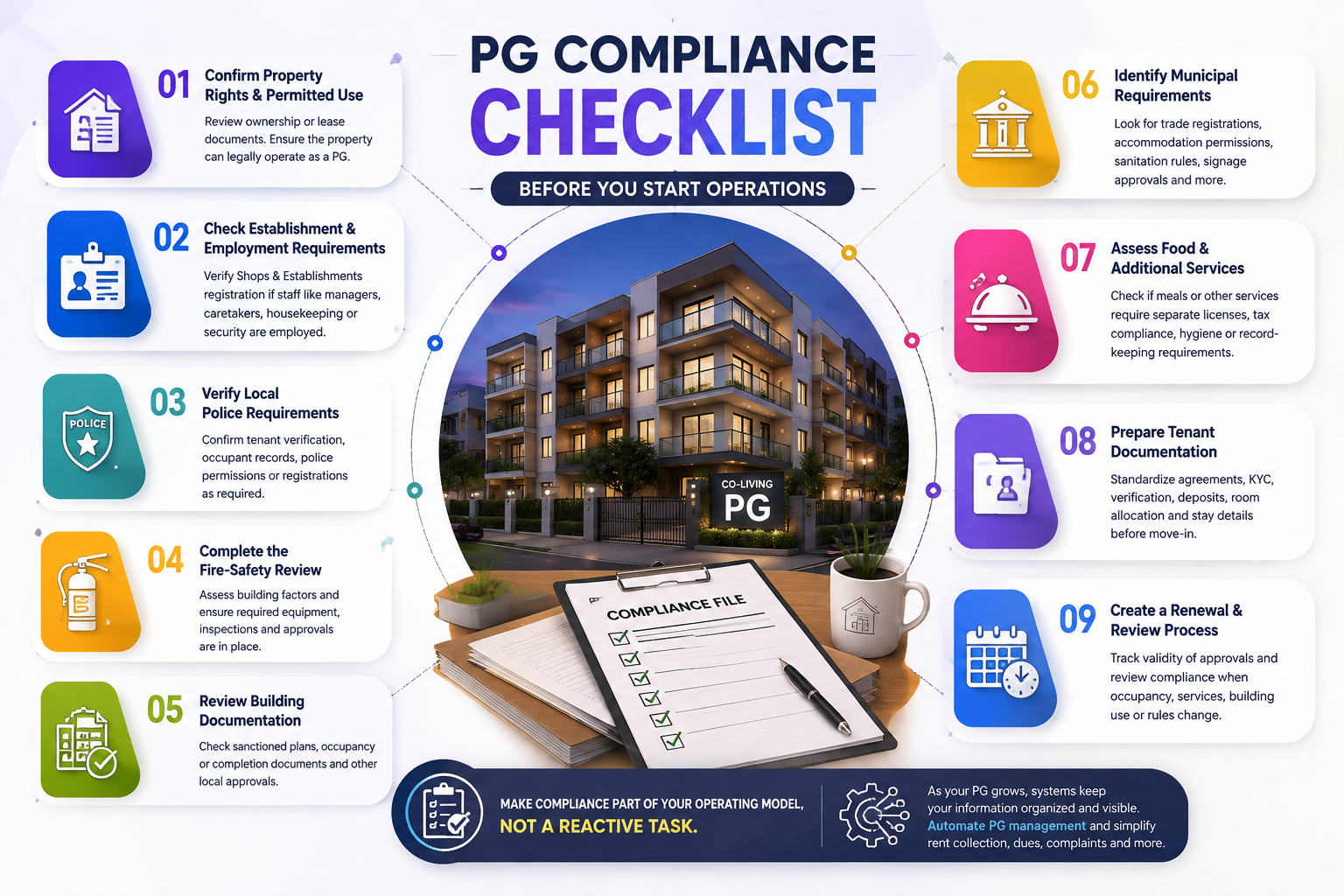
A Practical PG Compliance Checklist Before You Start Operations
A good compliance checklist should not simply contain the names of licences. It should tell the operator what needs to be verified and why.
Before launching a PG, the following framework can help organize the process:
- Confirm property rights and permitted use. Review ownership or lease documents. Make sure the property can legally be used as a PG. If leased, confirm that the agreement permits the intended use.
- Check establishment and employment requirements. Determine whether Shops & Establishments registration applies. This is especially important if the PG has managers, caretakers, housekeeping staff, or security personnel.
- Verify local police requirements. Check whether tenant verification, occupant records, police permissions, or other registrations are required.
- Complete the fire-safety review. Assess the building’s height, occupancy, layout, area, and classification. Confirm the required equipment, inspections, and approvals.
- Review building documentation. Confirm that the property has the necessary sanctioned plans, occupancy or completion documents, and other local approvals.
- Identify municipal requirements. Check for trade registrations, accommodation permissions, sanitation rules, signage approvals, or other local requirements.
- Assess food and additional services. If meals or other services are provided, check whether they create separate licensing, tax, hygiene, or record-keeping requirements.
- Prepare tenant documentation. Standardize agreements, KYC records, verification, deposits, room allocation, and stay details before the first move-in.
- Create a renewal and review process. Track approval validity periods. Review compliance when occupancy, services, building use, or local rules change.
This approach makes compliance part of the operating model rather than a reactive task.
As the PG grows, owners need systems to keep important information organized and visible.
The same applies beyond compliance. RentOk’s guide to automating PG management explains how structured systems can simplify rent collection, dues, complaints, occupancy, expenses, and reporting.
How RentOk Helps You Manage PG Compliance More Systematically
RentOk does not replace government registrations, professional legal advice, fire approvals, municipal permissions, or any certificate that must be issued by an authorized body. What it can help with is the operational layer that sits underneath a professionally managed PG: keeping tenant and property information organized instead of allowing it to become fragmented as occupancy grows.
This is particularly relevant because compliance depends heavily on good records. RentOk helps operators centralize tenant details, KYC information, agreements, occupancy records, payments, dues, move-ins, move-outs, and other day-to-day property information within a connected system. Rather than checking separate spreadsheets, registers, folders, and staff conversations to understand what happened with a tenant, operators can maintain clearer operational visibility.
That structure becomes even more valuable across multiple properties. As RentOk’s existing material on PG dashboards explains, centralized visibility helps operators compare and monitor different properties without manually checking each location independently.
For a PG owner, this means compliance-related administration becomes part of a broader professional management system. Tenant onboarding can be more consistent, records can remain connected to the relevant resident, and the business becomes less dependent on information being remembered by one manager or stored on one device.
You can also explore the RentOk YouTube channel to see more property-management workflows and product guidance in practice.
Conclusion
Understanding PG business legal requirements in India starts with recognizing that there is no universal licence that solves every compliance requirement for every property.
Shops & Establishments registration, police requirements, fire-safety approvals, building documentation, municipal permissions, tenant verification, food-related requirements, and tax compliance can all become relevant depending on where and how the PG operates. The strongest approach is therefore to verify requirements property by property, maintain clear documentation, and review compliance as the business changes.
More importantly, do not wait until an inspection, tenant dispute, expansion, or missing document exposes gaps in your system. Build the operational discipline while the property is still manageable.
Ready to make your PG operations more structured? Start your free trial with RentOk and manage tenant records, payments, occupancy, agreements, and everyday property workflows from one place.
FAQs
1. Is a rental agreement enough to legally operate a PG?
A rental or lease agreement establishes your right to occupy the property, but it does not automatically cover every requirement for running a PG. You may still need to meet applicable business, safety, municipal, and local compliance requirements.
2. Can I start taking tenants while my PG registrations are still pending?
It is safer to complete the approvals and registrations that are required before beginning operations. Starting first and trying to regularize the property later can create avoidable legal and operational complications.
3. Does the number of beds in a PG affect its compliance requirements?
It can. Factors such as occupancy, building size, height, classification, and the way the property is used may influence which safety or local requirements apply. Owners should assess the specific property rather than rely on a fixed bed-count rule.
4. Do PG owners need to maintain tenant records after the tenant moves in?
Yes, tenant information and supporting documentation should be maintained as part of organized property operations. The exact records and verification process can depend on the applicable local requirements and the nature of the accommodation.
5. What happens if a PG adds new services after it starts operating?
Adding services such as meals or other facilities can introduce additional compliance or record-keeping requirements. Owners should review the applicable rules whenever there is a significant change to the property’s services or operating model.
6. How often should a PG’s compliance documents be reviewed?
Compliance should be reviewed periodically rather than only when a certificate is about to expire. Changes in occupancy, building use, services, staff, or local regulations can make an earlier review necessary.