

What Is Rent Control Law in India, and Which Cities Are Still Covered?
Renting a property in India can look simple from the outside. A landlord gives a property on rent, a tenant pays every month, and both parties follow the terms of their agreement. In reality, rental relationships can become complicated very quickly. Questions around rent increases, security deposits, eviction, maintenance, and renewal often lead to disagreements.
One reason is that India does not have one single rent-control law that applies to every rental property. Different states have their own laws. Some cities also continue to have older rent-control legislation. At the same time, newer tenancy reforms are changing how rental housing is being discussed and regulated.
This makes rent control law in India an important topic for both tenants and property owners. A tenant needs to know when a rent increase may be regulated. A landlord needs to understand the rules before changing rent or ending a tenancy. Property managers also need accurate records because rental operations can involve hundreds of agreements at the same time.
The bigger question, therefore, is not simply whether rent control exists in India. The real question is: which law applies to a particular property and tenancy?
That distinction becomes especially important in major rental markets such as Delhi and Mumbai. It also matters in modern accommodation models such as PGs, hostels, and co-living spaces, where the relationship may involve rent, services, utilities, food, and shared facilities.
This guide breaks down the rent control law in India, its history, major provisions, important rental markets, and the changes being introduced through newer tenancy frameworks.
What Is Rent Control in India?
Rent control refers to laws that regulate certain parts of the relationship between landlords and tenants. Depending on the legislation, these rules may cover rent, rent increases, eviction, maintenance, subletting, and other tenancy-related matters.
Traditional rent-control laws were introduced mainly to protect tenants from sharp rent increases and arbitrary eviction. These concerns became particularly important during periods when cities faced housing shortages and rental demand was high.
However, rent control does not automatically apply to every rental property. The scope of a law depends on its specific provisions. Factors such as the type of property, location, rent, age of the building, and nature of the tenancy can affect whether particular protections apply.
This is why saying that an entire city is simply “under rent control” can be misleading.
A tenant living in an older property under a protected tenancy may have a very different legal position from someone renting a newly constructed apartment. Similarly, a modern PG or co-living arrangement may involve contractual terms that differ from a traditional residential tenancy.
A rent agreement and a rent-control law also serve different purposes. The agreement records what the landlord and tenant have agreed to. The applicable law determines the legal framework within which that agreement operates.
If you are comparing different rental arrangements, it is useful to first understand the document itself. RentOk’s guide to creating a legally valid rent agreement in India explains the important elements that should be considered before an agreement is finalised.

Why Was Rent Control Introduced in India?
The roots of rent control in India go back to the housing pressures of the 1940s. Cities experienced shortages of accommodation during and after the Second World War. Partition also created significant migration and increased pressure on urban housing.
When demand for housing rises sharply while supply remains limited, rents can increase quickly. Existing tenants can then face uncertainty about whether they will be able to continue living in their homes.
Governments responded by introducing rent-control measures in different jurisdictions. The intention was to provide greater stability to tenants and prevent landlords from using housing shortages to impose unreasonable rental terms.
Over time, individual states developed their own legislation. As a result, there is no single historical model of rent control across India.
Some laws placed strong restrictions on rent increases. Others established specific grounds for eviction. Several also created mechanisms for determining standard rent or resolving disputes between landlords and tenants.
The rental market, however, has changed considerably since these laws were first introduced.
Modern Indian cities have a much wider variety of rental arrangements. Students rent rooms near universities. Professionals move between cities for work. Families rent apartments for several years. PG operators provide furnished rooms with food and housekeeping. Co-living companies combine accommodation with multiple services.
These arrangements create a different set of operational requirements.
The challenge today is not only protecting tenants. It is also creating a rental environment where property owners have enough clarity to participate in the formal rental market.
This is one reason newer tenancy reforms focus on documentation, responsibilities, dispute resolution, and transparency alongside tenant protection.
What Are the Key Provisions of Rent-Control Laws?
There is no universal list of rules that applies identically across India. Each state legislation has its own structure. Still, certain areas appear repeatedly in rent-control frameworks.
Understanding these areas helps tenants and landlords identify what they need to check before making decisions about a tenancy.
1. Standard Rent and Rent Regulation
One of the central ideas behind traditional rent control is the regulation of rent.
Certain rent-control laws provide mechanisms for determining or controlling what may be charged for covered premises. The concept of “standard rent” is particularly important under some older laws.
Standard rent should not automatically be treated as the same thing as the current market rent. It can be determined through the mechanism provided by the applicable legislation.
The important point is that the rules apply only where the relevant law covers the tenancy. A property being located in a city that has rent-control legislation does not, by itself, answer whether that specific tenancy is covered.
2. Rent Increases
Rent increases are another major area of confusion.
There is no single percentage that landlords across India can use when increasing rent. The applicable position can depend on the rental agreement, the state law, the type of tenancy, and whether the property falls within a rent-control framework.
For example, the Delhi Rent Control Act contains provisions relating to rent increases. Section 6A provides for a 10% increase in certain covered tenancies every three years. This should not be interpreted as a universal rule for every rental property in Delhi.
Maharashtra has its own provisions. The Maharashtra Rent Control Act, 1999 provides for specific rent increases in covered premises, including an annual increase framework.
The difference shows why a simple “10% rule” or “4% rule” cannot be applied across the country.
Before disputing or implementing a rent increase, parties should examine:
- The rental agreement: Check whether the agreement contains an escalation or renewal clause. The timing and conditions of the increase matter.
- The applicable legislation: Determine whether the property and tenancy fall under a rent-control or tenancy law. Exemptions can change the position.
- The timing of the increase: An increase during an existing tenancy may be different from a revised rent agreed during renewal.
- The required notice: The agreement or applicable law may specify how much notice must be provided before a change takes effect.
- The nature of the property: Residential, commercial, PG, and other arrangements may be treated differently under applicable rules.
For a deeper explanation of this issue, see RentOk’s guide on how rent increases work in India and when they may be illegal.
3. Grounds for Eviction
Rent-control laws may also place restrictions on eviction.
In traditional rent-control systems, a landlord generally cannot treat the end of a personal preference as sufficient reason to remove a protected tenant. The applicable law may identify specific grounds on which eviction can be sought.
Depending on the legislation, these can include non-payment of rent, unauthorised subletting, misuse of the premises, damage to the property, or genuine requirements recognised by law.
The existence of these protections does not mean that tenants can remain in a property indefinitely regardless of their conduct. It means that eviction may need to follow the procedure and grounds established by the applicable legal framework.
This is an area where assumptions can become risky. A landlord should not rely on informal methods simply because a tenant has violated a term. The relevant agreement and applicable law should be checked before action is taken.
4. Maintenance and Essential Services
Rental laws can also address maintenance responsibilities and essential services.
These issues may include repairs, water supply, electricity, sanitation, structural problems, and other conditions affecting the use of the property.
The agreement should make responsibilities clear wherever possible. Routine maintenance may be treated differently from major structural repairs. Damage caused by normal use may also be different from damage caused by negligence.
This distinction becomes even more important in PGs and co-living spaces.
A tenant may not simply be paying for a room. Their monthly payment could include food, electricity, housekeeping, internet, laundry, or access to shared facilities. The agreement should make the scope of these services clear.
For property managers, this is where legal clarity and operational management begin to overlap.
Which Cities and States in India Still Have Rent-Control Laws?
Rent-control legislation continues to exist across several parts of India. However, it is better to think about specific laws and their scope than to label an entire city as completely rent-controlled.
The rules can depend on the property and the tenancy.
Delhi
Delhi continues to have the Delhi Rent Control Act, 1958. The legislation contains provisions relating to rent, standard rent, rent increases, eviction, and other aspects of landlord-tenant relationships.
However, not every rental property in Delhi should automatically be assumed to fall under the Act.
The legislation contains provisions defining its scope and circumstances in which certain premises may be exempt. This makes the details of the particular property important.
Delhi also has an extremely diverse rental market. It includes old residential properties, apartments, builder floors, student accommodation, PGs, hostels, and co-living spaces.
A tenant renting an older property under a protected arrangement may therefore have a different legal position from a tenant entering into a contemporary rental agreement for a newer property.
Mumbai and Maharashtra
Mumbai operates within the framework of the Maharashtra Rent Control Act, 1999.
The legislation covers several aspects of landlord-tenant relationships. These include rent, increases, eviction, and other tenancy-related matters.
Mumbai’s rental market is also diverse. Traditional residential tenancies exist alongside modern apartments, leave-and-licence arrangements, PG accommodation, and professionally managed rental properties.
This makes it important to identify the exact nature of the arrangement.
The term “Mumbai rent control” can therefore refer to a broader legal framework, but it does not mean every person renting a property in Mumbai has identical rights or obligations.
Other Rental Markets
Rent-control and tenancy laws also exist in other parts of India. Their provisions differ because states have developed their own approaches to rental housing.
For landlords and tenants, the practical lesson is straightforward. Do not copy a rule from another city and assume that it applies to your property.
Before relying on a specific provision, check:
- State and local jurisdiction: Identify where the property is located and which legislation governs it.
- Type of occupancy: Establish whether the arrangement is a tenancy, lease, leave and licence arrangement, PG stay, or another form of occupancy.
- Property category: Some laws contain exemptions based on the nature, age, or value of the premises.
- Agreement terms: Review the written contract alongside the applicable law.
- Current amendments: Rental legislation can change, so older information should not be treated as automatically current.
This state-by-state approach is particularly important for operators with properties in multiple cities.
A rule that works for one property may not work for another simply because both properties are used as rental accommodation.
How Is the Model Tenancy Act Changing Rental Housing?
India’s rental housing policy has also been moving towards greater formalisation.
The Model Tenancy Act, 2021 was approved by the Union Cabinet and circulated to states and Union Territories for adoption. It provides a model framework rather than automatically becoming the law for every rental property across India.
This distinction matters.
States and Union Territories can adopt the framework through their own legislation or amendments. Therefore, the Model Tenancy Act should not be treated as though it automatically replaced every existing state rent-control law.
The proposed framework focuses on creating clearer rental relationships. It includes provisions relating to written agreements, security deposits, rent authorities, dispute resolution, and responsibilities of landlords and tenants.
The approach is different from simply asking how much rent can be charged.
It attempts to create clearer rules around the entire rental relationship.
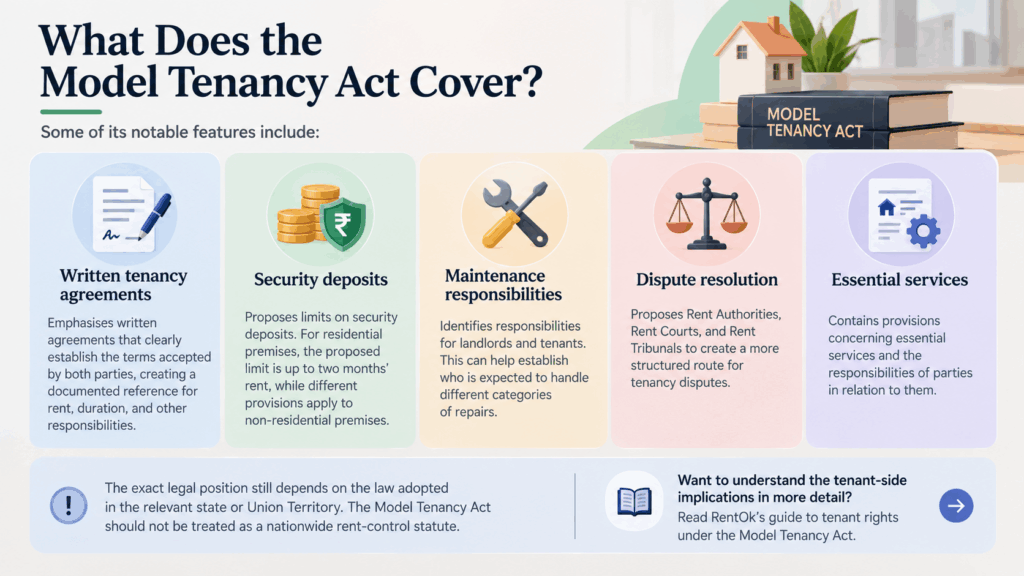
What Does the Model Tenancy Act Cover?
Some of its notable features include:
- Written tenancy agreements: The framework emphasises written agreements that clearly establish the terms accepted by both parties. This creates a documented reference for rent, duration, and other responsibilities.
- Security deposits: The Model Act proposes limits on security deposits. For residential premises, the proposed limit is up to two months’ rent, while different provisions apply to non-residential premises.
- Maintenance responsibilities: The framework identifies responsibilities for landlords and tenants. This can help establish who is expected to handle different categories of repairs.
- Dispute resolution: The framework proposes Rent Authorities, Rent Courts, and Rent Tribunals to create a more structured route for tenancy disputes.
- Essential services: It contains provisions concerning essential services and the responsibilities of parties in relation to them.
The exact legal position still depends on the law adopted in the relevant state or Union Territory.
This is why tenants and property owners should avoid treating the Model Tenancy Act as a nationwide rent-control statute.
If you want to understand the tenant-side implications in more detail, RentOk’s guide to tenant rights under the Model Tenancy Act provides a useful starting point.
What Should Tenants Check Before Signing a Rental Agreement?
Knowing about rent-control laws is useful, but it is only one part of protecting yourself as a tenant.
The rental agreement remains one of the most important documents in the relationship. It records the terms that both parties have accepted and can become an important reference if a disagreement arises later.
Before signing, tenants should read beyond the rent amount and move-in date.
The following clauses deserve particular attention:
- Monthly rent and additional charges: Check the exact rent and payment date. Also identify electricity, maintenance, food, internet, parking, housekeeping, or other recurring charges.
- Security deposit: Understand how much must be paid. Check the conditions for deductions and the expected refund process at the time of exit.
- Lock-in period: A lock-in period can restrict early termination under the agreement. Understand the financial consequences before accepting it.
- Notice period: Check how much notice must be given before leaving. Also understand whether the same requirement applies to the landlord.
- Rent revision: Look for clauses explaining when rent can change. Check whether the agreement specifies a percentage, date, or renewal condition.
- Maintenance: Establish who handles different types of repairs. This is particularly important for furnished properties and managed accommodation.
- House rules: PGs and co-living properties may have additional rules. These can cover visitors, food, common areas, room changes, and property usage.
- Renewal and termination: Understand what happens when the agreement expires. The renewal process should not be left entirely to verbal discussions.
RentOk’s rent agreement checklist covering 15 important clauses for owners is also useful for understanding what a well-structured agreement should contain.
Tenants should also remember that not every dispute is automatically a rent-control dispute. A disagreement over a deposit, repair, notice period, or service charge may depend heavily on the agreement and the applicable local rules.
Why Rental Documentation Matters for Property Managers
For an individual landlord with one property, keeping track of agreements may seem manageable.
The situation changes when a PG or co-living operator manages several properties and hundreds of tenants.
Every tenant can have a different joining date, rent amount, deposit, notice period, agreement duration, and renewal date. Some may leave early. Others may renew. New tenants may arrive every week.
When these details are spread across spreadsheets, paper documents, WhatsApp conversations, and individual staff members, important information becomes difficult to track.
Documentation therefore becomes an operational system, not just a legal formality.
A property manager should be able to identify the agreement connected to a tenant without searching through multiple folders. They should know when an agreement began, what terms apply, and when an important action is due.
This becomes even more important when an operator expands into multiple cities.
Different properties may fall under different local rules. Their agreements may also have different commercial structures.
That is why rental businesses need consistent documentation while still allowing property-specific terms.
Digital property management can help create this structure. RentOk’s guide to rental management systems and tools for property owners explains how technology can bring different parts of rental operations into one workflow.
What Does Rent Control Mean for Modern PG and Co-Living Businesses?
Traditional rent-control discussions often focus on landlords and tenants occupying conventional residential properties.
Modern rental businesses can be more complicated.
A PG may provide a bed, food, housekeeping, electricity, internet, security, and access to common facilities. A co-living property may operate with shared spaces and additional services. The occupant’s monthly payment may therefore cover several components.
This makes clear documentation even more important.
A property operator should be able to distinguish between rent and service charges. It should also be clear when a charge can change and what the tenant has agreed to.
The same principle applies to deposits and exit deductions.
Suppose a tenant leaves with unpaid dues. Another tenant causes damage to a room. A third tenant leaves before completing an agreed notice period.
Each situation may require a different response.
The operator needs accurate records to understand what happened and which contractual terms apply.
This is where good rental management becomes less about reacting to individual disputes and more about building a consistent operating process.
For operators looking to reduce manual work, RentOk’s guide to choosing the right PG management software covers the operational areas that become difficult to manage as PG businesses grow.
Common Mistakes Around Rent Control in India
Many rental disputes begin with assumptions rather than complicated legal questions.
A landlord may assume that a percentage used in one city applies everywhere. A tenant may assume that living in a particular city automatically means they are protected by an older rent-control law.
Neither assumption is enough.
Some of the most common mistakes include:
- Treating rent control as a nationwide rule: India has multiple state-level rental frameworks. The applicable law depends on the property and tenancy.
- Ignoring exemptions: A rent-control law may not cover every property within its geographical area. Scope provisions must be checked.
- Relying only on verbal agreements: Verbal discussions can create confusion when rent, deposits, repairs, or exit conditions are later disputed.
- Copying agreements from another property: An agreement suitable for one city or property model may not reflect another property’s legal and operational requirements.
- Assuming the Model Tenancy Act applies everywhere: The Model Act was created as a framework for adoption. Its provisions do not automatically replace state tenancy laws.
- Ignoring documentation after move-in: An agreement is not useful if the actual payments, changes, and tenant records are not maintained properly.
These mistakes are avoidable when landlords and tenants treat rental documentation as an ongoing record rather than a one-time formality.

How RentOk Helps You Manage Rental Operations with Greater Clarity
Understanding rental law is only one part of managing a property. The next challenge is keeping the information organised after the tenant moves in.
RentOk helps PG, hostel, and co-living operators manage key rental operations through a centralised platform. Tenant information, rent and payment tracking, occupancy, agreements, deposits, complaints, and day-to-day property operations can be managed in a more structured workflow.
This matters because legal and operational clarity go hand in hand. A properly drafted agreement can define the relationship, but property managers still need accurate records throughout the tenancy. They need visibility into payments, dues, occupancy, complaints, and tenant activity.
As the number of properties grows, managing these details manually becomes harder. RentOk helps reduce dependence on scattered spreadsheets, paper records, and repeated follow-ups. This gives property operators a clearer view of their rental operations while creating a more organised experience for tenants.
For operators looking to automate more of their day-to-day processes, RentOk’s practical guide to automating PG management explores how structured systems can reduce operational dependency as a PG business grows.
Conclusion: Understand the Rental Laws That Apply to Your Property
Rent control law in India is not one single set of rules. Different states and jurisdictions have developed their own rental frameworks. Older rent-control laws continue to apply in certain circumstances, while newer tenancy reforms are pushing rental housing towards clearer agreements and more structured dispute resolution.
For tenants, the key is to understand the agreement and determine which law applies to the property. For landlords and property managers, the focus should be on accurate documentation, transparent terms, and consistent processes.
The rental market is becoming more organised. Understanding the legal framework is the first step. Managing that information properly is what makes the process scalable.
Understand Your Rental Market with RentOk, Explore Tenant Rights, Rental Laws, and Smarter Property Management.
FAQs
1. Can rent control laws apply to commercial properties?
Yes, some state tenancy laws cover both residential and commercial properties. However, the applicable provisions depend on the state, property type, and specific legislation.
2. Does rent control protect tenants from sudden utility disconnections?
Certain tenancy frameworks address essential services and their restoration. However, the available protection depends on the applicable law and circumstances of the dispute.
3. Can a tenant legally sublet a rented property?
Subletting is not automatically permitted. Some laws require the landlord’s prior written consent, while the agreement may also contain specific restrictions.
4. Is registering a rental agreement the same as stamping it?
No, registration and stamp duty are separate legal requirements. Their applicability depends on the state, agreement type, duration, and relevant regulations.
5. What happens when a tenant stops paying rent?
The landlord may have legal remedies for recovering unpaid rent or seeking eviction. The available process depends on the applicable law, agreement, and facts of the case.
6. Can a landlord enter the rented property whenever they want?
Landlords generally need to follow the access terms in the agreement and applicable legal requirements. Tenants should check whether notice or reasonable grounds are required before entry.