

India’s Rental Market Grows 16%: What Owners Should Know
India’s rental housing market is experiencing renewed momentum, creating new opportunities and operational challenges for property owners, landlords, PG operators, and co-living businesses. As employment opportunities expand, students move between cities, and more professionals seek flexible accommodation, rental housing continues to remain an essential part of India’s urban ecosystem.
According to reporting on the Magicbricks Rental Index for April–June 2026, rental demand increased by 16% quarter-on-quarter, while rental supply grew by 4.5%. Rental values also increased by 2.2% during the same period. These figures indicate that demand expanded faster than the supply measured in the report, although rental performance continues to vary across locations, property categories, and tenant segments.
For property owners, the significance of this growth extends beyond rising demand. A growing market creates opportunities only when owners can understand tenant preferences, manage inventory effectively, maintain competitive pricing, and deliver a consistent rental experience.
The real question is not simply whether India’s rental market is growing. It is whether property owners are equipped to respond to that growth without allowing operational inefficiencies to affect occupancy, revenue, and tenant satisfaction.
The Numbers Behind India’s 16% Quarter-on-Quarter Rental Demand Growth
The reported 16% quarter-on-quarter increase in rental demand during Q2 2026 offers an important indication of activity within India’s residential rental market. At the same time, the 4.5% increase in supply and 2.2% growth in rental values provide additional context for understanding how demand and availability are moving together.
| Market Indicator | Reported Q2 2026 Change |
|---|---|
| Rental demand | +16% QoQ |
| Rental supply | +4.5% QoQ |
| Rental values | +2.2% QoQ |
These figures should not be interpreted as a uniform growth rate for every Indian city or rental category. A property in a major employment corridor may experience a different demand pattern from one located near a university, industrial area, or transportation hub. Similarly, demand for a furnished apartment cannot automatically be compared with demand for shared PG accommodation.
However, the broader trend offers a useful reason for owners to review their current operations. If tenant interest is increasing faster than available inventory in certain markets, properties that are well-positioned, professionally managed, and appropriately priced may have more opportunities to attract prospective residents.
This does not mean that every property can increase rent or expect immediate full occupancy. Rental performance depends on several connected factors, including location, affordability, room configuration, property condition, service quality, and the availability of competing accommodation.
Market growth creates an opportunity, but property-level performance depends on how effectively an owner responds to local demand.
What does the growth figure mean for property owners?
The 16% increase is a market-level indicator rather than a guarantee of individual property performance. Owners should use it as a reason to investigate their own market instead of making decisions based only on a national headline.
A practical review should include:
- Local demand patterns: Examine whether inquiries are increasing in the specific neighbourhood where the property operates, rather than assuming that city-wide or national growth applies equally to every locality.
- Occupancy performance: Compare current occupancy with previous months to understand whether increased tenant interest is translating into actual bookings.
- Tenant affordability: Review whether the property’s rental prices match the budgets and expectations of the audience being targeted.
- Competitive positioning: Study similar properties to identify differences in pricing, furnishing, facilities, maintenance, and tenant experience.
This approach allows owners to interpret market growth through the realities of their own rental business.

Which Cities and Rental Configurations Are Driving Demand?
Rental demand in India is influenced by employment opportunities, educational institutions, migration, connectivity, and affordability. These factors determine where tenants choose to live and what kind of accommodation they consider practical.
The reported figures also highlight the importance of affordable rental segments. According to coverage of the Magicbricks Rental Index, properties in the ₹10,000–₹20,000 monthly rental range accounted for 35% of rental demand, while the ₹20,000–₹30,000 segment represented 21%.
These figures provide useful insight into rental budgets, but they should not be treated as a complete representation of PG, hostel, or co-living demand. Owners operating in these segments need to examine more specific information, including sharing preferences, room sizes, included services, and the location of their properties.
Affordability and convenience work together
Tenants rarely make rental decisions based on monthly rent alone. Location, travel time, furnishing, cleanliness, maintenance, security arrangements, and available facilities can significantly influence their final choice.
For instance, a student may prefer a slightly more expensive PG if it is located close to their college and includes essential services. Similarly, a working professional may be willing to pay more for a co-living space that offers better connectivity, reliable internet, housekeeping, and a smoother rental experience.
This means property owners must understand the complete value proposition they are offering.
A lower price may attract inquiries, but it does not guarantee long-term occupancy if the property fails to meet tenant expectations. On the other hand, a higher price can be justified only when the property provides services and facilities that tenants genuinely value.
Why room configuration matters for PG operators
PG and co-living operators often manage multiple room and bed configurations, such as single, double, and triple sharing. Each configuration can appeal to a different tenant group and affordability range.
For example, a student-focused property may receive higher demand for shared rooms, while working professionals may show greater interest in single or double occupancy. These preferences can also change depending on the locality, academic calendar, employment cycle, and availability of competing properties.
Owners should therefore monitor their own booking and inquiry data instead of relying only on general market reports.
Understanding which configurations receive the most inquiries, which rooms remain vacant for longer, and which categories generate repeat bookings can help operators make more informed decisions about pricing and inventory.
For more guidance on improving occupancy during periods of fluctuating demand, property owners can explore RentOk’s blog on How to Increase PG Occupancy During Off-Season Months.
Supply Is Not Keeping Pace: What Does This Mean for Rental Pricing?
When rental demand grows faster than supply, property owners may gain more flexibility in reviewing their pricing strategy. However, pricing decisions should be based on local market conditions and property-level performance rather than broad growth figures alone.
The reported Q2 2026 figures show rental demand increasing by 16%, compared with 4.5% growth in supply. This difference suggests that demand expanded more rapidly than the supply measured in the index. However, the impact on individual properties will depend on location, competition, tenant budgets, and the type of accommodation being offered.
A property owner cannot assume that a national demand increase automatically supports a similar increase in monthly rent.
Should owners increase rent when demand rises?
Before changing rental prices, owners should evaluate whether the property is delivering sufficient value compared with similar accommodation nearby.
A sound pricing review should include:
- Comparable rental rates: Examine properties offering similar room configurations, furnishing, facilities, and location advantages to understand the alternatives available to tenants.
- Occupancy and vacancy patterns: Review how quickly vacant rooms are booked and whether certain configurations remain unoccupied for longer periods.
- Operating costs: Consider maintenance, utilities, staffing, housekeeping, marketing, and other expenses before making a pricing decision.
- Tenant expectations: Evaluate whether the property’s facilities and services support the proposed price and whether the increase could affect tenant satisfaction or retention.
For a more practical approach to pricing decisions, owners can refer to How to Price Your PG for Maximum Occupancy. Pricing should balance revenue objectives with the need to maintain sustainable occupancy.
A rent increase that appears profitable in isolation may not produce the expected results if it leads to higher vacancy, reduced inquiries, or increased tenant turnover. In contrast, a carefully planned pricing strategy can help an owner protect revenue while remaining competitive.
Demand growth does not eliminate competition
Even when rental demand increases, tenants continue to compare properties before making a decision. They may review online listings, visit multiple locations, speak with existing residents, and evaluate the facilities included in the rent.
As a result, owners must focus on both visibility and delivery. Marketing should communicate the property’s strengths accurately, while day-to-day operations should ensure that the actual experience matches what was promised.
A strong rental market may create more inquiries, but converting those inquiries into stable occupancy requires a reliable management process.
The Opportunity for Owners Entering the Rental Market
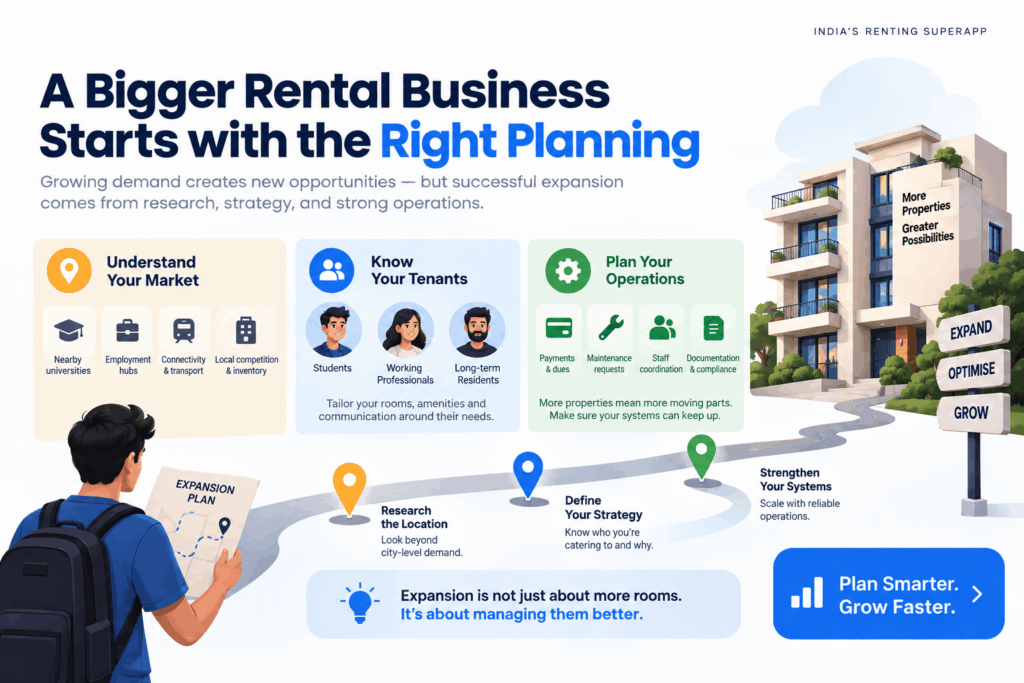
Growing rental demand may encourage property owners to enter new markets, improve existing properties, or expand their rental inventory. However, expansion should be approached with a clear understanding of the tenant segment, operating expenses, competition, and management requirements.
A rental business is not built simply by adding rooms or acquiring another property. It depends on how effectively the property is marketed, occupied, maintained, and managed throughout the tenant lifecycle.
Before entering a new location, owners should study the factors that influence local demand. A property near a university may experience seasonal changes connected to admissions and academic schedules. Accommodation near an employment hub may be influenced by recruitment cycles, office locations, and workforce movement.
These differences affect pricing, marketing, staffing, and occupancy planning.
Location research should go beyond city-level demand
A city may show strong rental growth, but individual neighbourhoods can perform differently. Connectivity, nearby institutions, public transportation, commercial activity, and competing inventory can all influence tenant decisions.
Owners should ask:
Who is most likely to rent this property, and why would they choose it over nearby alternatives?
This question helps establish a more focused business strategy. Instead of offering generic accommodation to everyone, operators can design their services and marketing around a specific tenant profile.
For PG and co-living businesses, this could mean selecting suitable room configurations, offering relevant amenities, creating clear property policies, and building a communication system that supports tenants throughout their stay.
Expansion must include operational planning
One of the most common challenges in rental businesses is expanding inventory without improving the systems used to manage it.
Adding another property also adds tenants, payments, vacancies, maintenance requests, staff coordination, and documentation. If these processes continue to depend on disconnected spreadsheets and informal communication, operational pressure can increase rapidly.
Owners should therefore evaluate management capacity alongside expansion plans. A larger portfolio requires more than physical space; it requires reliable systems that can support daily operations without making every task dependent on manual follow-ups.
For a detailed understanding of the financial planning involved, How to Calculate Your PG’s Break-Even Occupancy can help owners think beyond occupancy percentages and evaluate the relationship between revenue, expenses, and operating sustainability.
Positioning Your Property to Capture Growing Rental Demand
Capturing rental demand requires more than listing a property online and waiting for inquiries. Owners need to communicate their property’s value clearly while ensuring that the living experience remains consistent after the tenant moves in.
Tenants often evaluate several factors before making a decision, including rental price, location, room quality, cleanliness, communication, maintenance, and the reliability of property management.
This makes positioning an operational responsibility as much as a marketing activity.
Define the experience your property provides
A property should communicate its strengths in a way that reflects the expectations of its target audience. A student-focused PG may highlight proximity to educational institutions, affordable sharing options, and included facilities. A co-living property for professionals may focus on convenience, connectivity, furnishings, and service quality.
The right positioning depends on the property’s actual advantages and the needs of the intended tenant segment.
However, effective marketing cannot compensate for weak service delivery over time. If a property promises timely maintenance, clean common areas, or reliable communication, the management team must have processes in place to deliver those commitments consistently.
Focus on four operational areas
1. Clear property information
Prospective tenants should be able to understand room types, rental charges, included facilities, deposit requirements, and relevant policies before booking. Clear information reduces confusion and helps establish realistic expectations from the beginning.
2. Consistent maintenance
The condition of rooms and common areas directly affects the tenant experience. A structured maintenance process helps teams identify issues, assign responsibility, track progress, and prevent recurring problems from being ignored.
For practical guidance, owners can read How to Handle Maintenance Requests in Your PG, which explains why complaint management should be treated as a structured operational workflow rather than a series of isolated repairs.
3. Organised tenant communication
Information about rent, move-in requirements, maintenance updates, and property policies should be communicated through reliable channels. As occupancy grows, organised communication becomes essential for reducing repeated questions and administrative delays.
4. Occupancy and vacancy visibility
Owners need to know which rooms are occupied, vacant, reserved, or likely to become available soon. This information supports marketing, onboarding preparation, and revenue planning.
These areas are interconnected. A property may generate strong inquiries, but delays in responding to prospects, preparing rooms, or updating availability can prevent that demand from converting into actual occupancy.
Turning Rental Demand Into Sustainable Occupancy
Occupancy is one of the most important metrics in a rental business, but it should not be evaluated independently of the costs and processes required to maintain it.
A property with high occupancy may still face challenges if rent collection is inconsistent, maintenance costs are poorly tracked, or frequent tenant turnover creates additional preparation expenses. Similarly, a property with lower occupancy may have opportunities to improve through better positioning, pricing, marketing, or service delivery.
The key is to understand what is happening behind the occupancy number.
Manage the complete tenant lifecycle
The rental process begins before a tenant moves in and continues throughout the resident’s stay. Each stage creates responsibilities that can influence the overall performance of the property.
During inquiry and booking, teams need to manage availability and provide accurate information. During onboarding, they must coordinate documentation, payments, room allocation, and move-in requirements. Once the tenant moves in, the focus shifts to rent collection, maintenance, communication, and service delivery.
At move-out, the property needs to manage settlements, vacancy updates, room preparation, and future bookings.
A structured booking process can reduce last-minute confusion. RentOk’s guide on How to Track Booking and Upcoming Tenants explains how visibility into upcoming move-ins can help operators prepare rooms, coordinate staff, and configure rent cycles more effectively.
Tenant retention also influences occupancy
Attracting a new tenant requires time, marketing effort, and administrative work. If tenants leave frequently because of unresolved complaints, poor communication, or unmet expectations, the business may need to repeat the acquisition and onboarding process more often.
Not every move-out can be prevented. Tenants may relocate because of education, employment, personal circumstances, or changes in their plans. However, organised property management can help owners identify recurring issues and improve the experience where improvements are possible.
Tenant retention is therefore not only a relationship-building activity. It is also connected to occupancy stability, operating costs, and the overall efficiency of the rental business.
Why Data and Operational Visibility Matter as the Market Expands
As rental businesses grow, owners often discover that the biggest problem is not the absence of information but the difficulty of accessing accurate information at the right time.
Tenant details may be stored in one location, rent records in another, and vacancy updates in a separate spreadsheet. Maintenance requests may be managed through WhatsApp, while staff coordination takes place through phone calls or verbal instructions.
This approach can become increasingly difficult when multiple properties and teams are involved.
A centralised management system can help connect key workflows and reduce the fragmentation created by scattered records. The benefit is not simply that information becomes digital. It is that owners and managers can access relevant information more consistently while making operational decisions.
Useful areas to monitor include:
- Occupancy performance: Track occupied, vacant, reserved, and upcoming available inventory to understand how the property is performing over time.
- Payment collection: Monitor received payments, pending dues, and collection patterns to improve financial visibility and reduce avoidable follow-ups.
- Tenant turnover: Review move-in and move-out activity to identify recurring vacancy patterns and onboarding requirements.
- Maintenance activity: Examine complaint volumes, resolution timelines, and repeated issues to understand where service improvements may be needed.
- Property-level performance: For owners managing multiple locations, compare relevant metrics across properties instead of relying only on a combined portfolio figure.
The purpose of tracking these metrics is not to create additional reporting work. It is to help owners identify where operational pressure is increasing and which improvements should receive attention first.
As discussed in All-in-One Property Management Software: Is It Worth It?, connecting tenant management, rent tracking, occupancy, maintenance, and reporting can reduce the need to switch between multiple tools and create a more organised operating environment.

How RentOk Helps Owners Respond to Growing Rental Demand
As India’s rental market evolves, owners need systems that can support the daily responsibilities involved in managing tenants, payments, occupancy, maintenance, and property operations.
RentOk brings essential rental management workflows into a centralised platform, helping PG, hostel, co-living, and rental property operators reduce their dependence on scattered records and manual coordination.
With RentOk, operators can manage important areas such as:
- Tenant management: Organise tenant information and maintain relevant records within a structured system that supports daily property operations.
- Rent and payment management: Track rental payments, pending dues, and payment-related workflows to improve financial visibility and simplify follow-ups.
- Occupancy management: Monitor property occupancy, room availability, and relevant property-level information to support better planning.
- Complaint management: Organise maintenance requests and improve visibility into pending, assigned, and completed tasks.
- Operational coordination: Support more consistent communication and coordination between property managers, staff members, and tenants.
These capabilities help address a central challenge for growing rental businesses: ensuring that increased occupancy does not create unnecessary operational confusion.
RentOk does not replace the need for local market research, competitive pricing, property maintenance, or quality tenant service. Instead, it provides a structured management layer that helps operators coordinate these responsibilities more efficiently as their business expands.
The objective is to move beyond simply filling rooms and build a rental operation with better visibility, consistent processes, and the ability to manage growth sustainably.
Conclusion
India’s rental market recorded a reported 16% quarter-on-quarter increase in demand during April–June 2026, alongside 4.5% growth in supply and 2.2% growth in rental values. While these figures highlight changing market activity, they should be interpreted alongside local demand patterns, property categories, tenant budgets, and individual operating conditions.
For property owners, the opportunity lies in understanding how broader market trends connect with the performance of their own properties. Location, affordability, room configuration, service quality, tenant retention, and operational efficiency all influence the ability to convert rental demand into sustainable occupancy.
A growing market can create opportunities for expansion, but long-term performance depends on more than attracting new tenants. Owners must also maintain reliable processes for onboarding, rent collection, maintenance, communication, and occupancy planning.
Ready to manage your rental business with greater visibility and efficiency? Start your free trial on RentOk and explore smarter rental property management today.
FAQ’S
1. What factors influence rental demand in Indian cities?
Rental demand is influenced by employment opportunities, educational institutions, connectivity, affordability, and migration patterns. The availability of essential facilities and suitable accommodation also affects tenant preferences in different locations.
2. How can property owners reduce vacancy periods?
Owners can reduce vacancy periods by tracking upcoming move-outs, preparing rooms in advance, maintaining accurate listings, and responding promptly to inquiries. Reviewing local pricing and tenant preferences can also help improve booking conversions.
3. Why is tenant retention important for rental businesses?
Tenant retention helps reduce repeated marketing, onboarding, and room-preparation expenses. Consistent maintenance, clear communication, and timely resolution of tenant concerns can contribute to a more stable rental operation.
4. What data should owners review before expanding their rental business?
Owners should review occupancy rates, rental income, operating expenses, tenant turnover, maintenance costs, and local demand patterns. These insights help assess whether expansion is financially and operationally practical.
5. How can technology improve rental property management?
Technology can bring tenant records, payment tracking, occupancy information, and maintenance workflows into one organised system. This helps reduce dependence on scattered spreadsheets and makes important property information easier to access.
6. What should owners consider when choosing a rental property management system?
Owners should evaluate whether the system supports their property size, tenant requirements, payment processes, reporting needs, and daily workflows. Ease of use, scalability, and the ability to manage multiple properties are also important considerations.