

When Do I Need to Deduct TDS on Rent I’m Receiving?
Rental income involves more than receiving the agreed amount every month. When rent exceeds ₹50,000 per month, Tax Deducted at Source (TDS) becomes important for eligible rental arrangements. It affects the amount landlords receive and the tax responsibilities of their tenants.
One important distinction is that the tenant generally deducts TDS, while the landlord receives the corresponding tax credit. For eligible transactions from 1 April 2026, Section 393(1) of the Income-tax Act, 2025 applies. Form 141, Schedule A, replaces the earlier Form 26QC for this category.
Understanding these rules helps landlords reconcile rental receipts, avoid filing confusion, and maintain accurate financial records.
Who Must Deduct TDS on Rent Above ₹50,000?
Under the Income-tax Act, 1961, Section 194-IB covered specified rent payments made by individuals and Hindu Undivided Families (HUFs) to resident landlords. For eligible transactions from 1 April 2026, the corresponding provision is Section 393(1), Table Serial No. 2(i), of the Income-tax Act, 2025.
The responsibility generally lies with the tenant, not the landlord receiving the rent. However, the tenant must first determine whether the transaction falls within the relevant provision. The payer’s status and the landlord’s residential status can affect the applicable rules.
Consider these common situations:
- Individual or HUF renting a property: The individual/HUF provision may apply when monthly rent exceeds the prescribed threshold and the other statutory conditions are satisfied.
- Company or business renting premises: The applicable provision depends on the payer’s category and transaction. The individual/HUF filing procedure should not automatically be used.
- Rent paid to a non-resident landlord: Different provisions may apply. The tenant should verify the relevant tax treatment before deducting or depositing TDS.
For landlords managing multiple properties, identifying the correct provision is the first step towards accurate rental records. The monthly rent alone does not determine every compliance requirement.
How Much TDS Will Be Deducted From Your Rent?
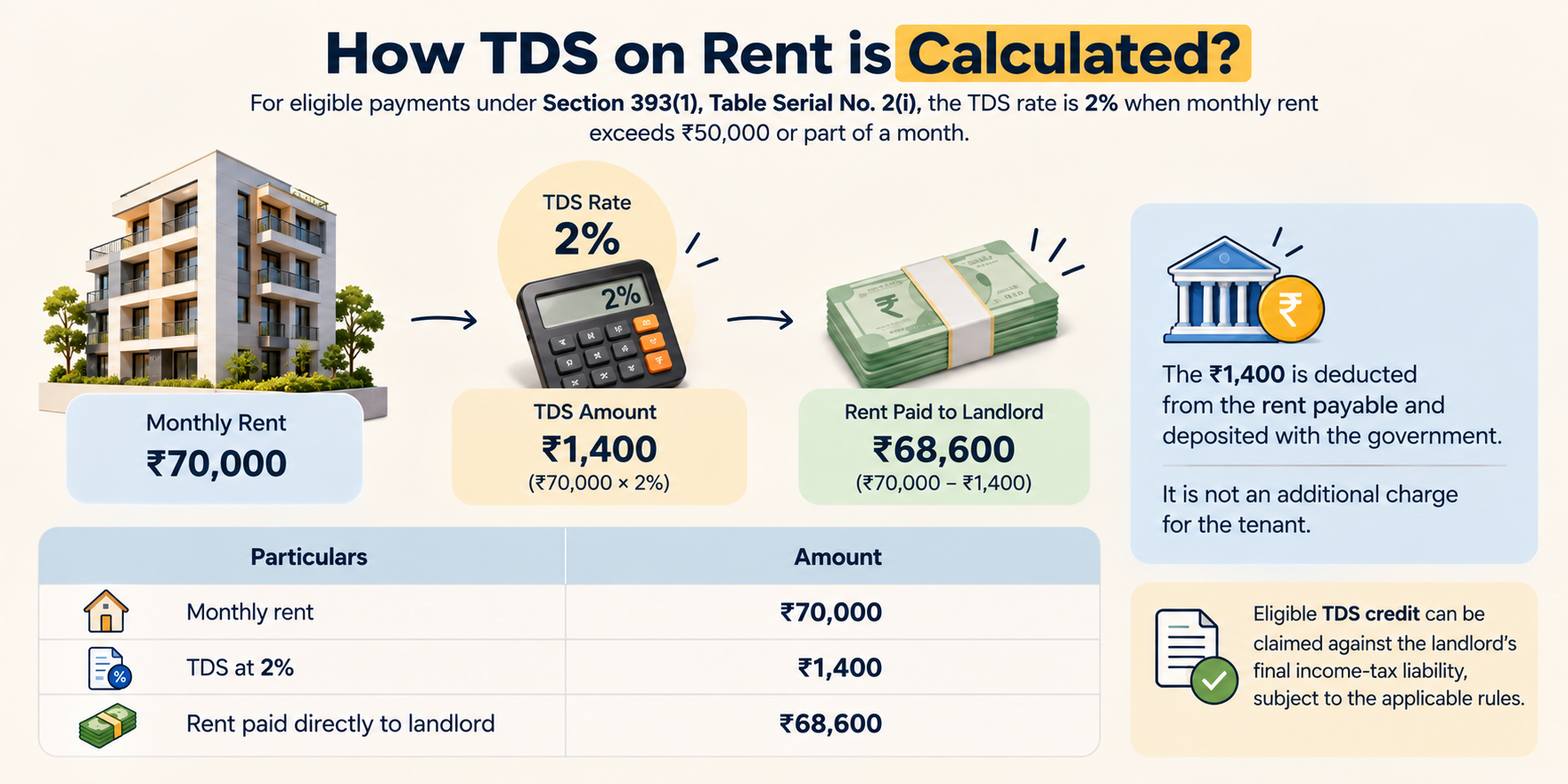
For eligible payments under Section 393(1), Table Serial No. 2(i), TDS is deducted at 2% when monthly rent exceeds ₹50,000 or part of a month.
Let’s understand this with an example. Suppose the monthly rent for a property is ₹70,000. The tenant calculates TDS at 2%, which comes to ₹1,400. This amount is deducted from the rent payable, and the remaining ₹68,600 is paid directly to the landlord.
| Particulars | Amount |
|---|---|
| Monthly rent | ₹70,000 |
| TDS at 2% (₹70,000 × 2%) | ₹1,400 |
| Rent paid directly to the landlord | ₹68,600 |
The ₹1,400 deducted as TDS is deposited with the government. It is not an additional charge for the tenant; it is part of the rent withheld for tax purposes. The landlord may claim eligible TDS credit against their final income-tax liability, subject to the applicable rules.
Does Rent of Exactly ₹50,000 Attract TDS?
The threshold applies when rent exceeds ₹50,000 per month or part of a month. Exactly ₹50,000 does not cross this threshold under the individual/HUF provision. Other TDS provisions may still apply, depending on the transaction.
Landlords should also distinguish between the monthly threshold and the timing of deduction. Under this provision, TDS is generally deducted when rent for the final month of the financial year or tenancy is paid or credited, whichever occurs earlier. It is not automatically deducted from every monthly payment.
When Should TDS on Rent Be Deducted and Deposited?
The timing of deduction matters as much as the calculation. Under the earlier Section 194-IB framework, TDS was generally deducted when rent for the last month of the financial year or tenancy was paid or credited, whichever occurred earlier. The corresponding provision under Section 393(1) follows a similar principle for eligible transactions.
Suppose a tenant occupies a flat throughout the tax year. The deduction generally arises when rent for the final month is paid or credited. If the tenancy ends earlier, the deduction is generally linked to the last month of the tenancy.
The tenant must then complete the prescribed payment and reporting process. Under the earlier framework, Form 26QC was generally due within 30 days from the end of the month in which TDS was deducted. Under the current framework, tenants must follow the applicable Form 141 instructions and deadlines.
Keep the deduction date, payment acknowledgement, and tax certificate together. These records help landlords verify their tax credit and reconcile rental receipts.
For additional guidance on rental payments, read RentOk’s guide to collecting rent on time with property management software. It explains how structured payment tracking improves visibility and reduces manual follow-ups.
How to File Form 141 for TDS on Rent
For eligible individual/HUF rent payments from 1 April 2026, Form 141, Schedule A, is the prescribed challan-cum-statement under Section 393(1), Table Serial No. 2(i). It replaces Form 26QC for this category. The Income Tax Department provides the filing process through its official e-filing portal.
Before filing, collect the landlord’s PAN, contact details, property address, tenancy period, and relevant rent calculations. Checking these details beforehand reduces the risk of reporting errors.
The process generally involves these steps:
- Access the e-filing portal: Log in and open the e-Pay Tax service. Select Form 141 and choose Schedule A for eligible individual/HUF rent payments.
- Enter transaction details: Provide the property address, tenancy period, rent information, landlord details, and other particulars required by the form.
- Verify the TDS calculation: Check the applicable rate, deduction amount, landlord’s PAN, and payment details before proceeding.
- Complete payment and retain proof: Submit the statement, complete the tax payment, and save the acknowledgement and challan receipt.
- Check the tax certificate: The landlord should retain the applicable certificate and verify that the tax credit appears correctly in their records.
Under the earlier framework, Form 16C served as the TDS certificate for Section 194-IB. For transactions governed by the new Act, follow the current certificate and reporting procedure.
For the official filing instructions, consult the Income Tax Department’s Form 141 filing guide.
What Happens If You Miss a TDS Deadline?
Missing a TDS deadline can create financial and administrative problems. The consequences depend on whether the tenant failed to deduct tax, failed to deposit it, filed late, or did not provide the required certificate.
Under the earlier framework, interest generally applied at 1% per month for failure to deduct tax. Failure to deposit deducted tax generally attracted interest at 1.5% per month. Late filing could attract a fee under Section 234E, subject to the statutory limit. Failure to issue the prescribed certificate could attract a penalty under Section 272A.
The applicable provisions and consequences should be checked for transactions governed by the Income-tax Act, 2025.
A reliable compliance process should include:
- Tracking deadlines: Record when TDS is deducted and calculate the filing and payment deadline under the applicable rules.
- Reconciling amounts: Check that the deduction matches the relevant rental amount and prescribed rate before filing.
- Maintaining evidence: Save the challan, filing acknowledgement, and tax certificate for future verification.
If a deadline has already been missed, identify the outstanding requirement and address it promptly. A qualified tax professional can help determine the appropriate corrective action.
How Can Landlords Keep Rent and TDS Records Organised?
Rental records become harder to manage when a landlord has multiple properties, different rent amounts, or tenancies starting and ending throughout the year. A bank statement may show the amount received, but it may not explain the difference between contractual rent and the net payment after TDS.
A reliable record-keeping process should connect the rental agreement, rent due, payment received, TDS deducted, and supporting tax documents. This helps landlords reconcile receipts accurately instead of treating every bank credit as the complete transaction.
For each tenancy, maintain the agreed rent, rental period, amount received, tax deducted, and relevant filing acknowledgement. These records are especially useful during income-tax return preparation.
Security deposits also require careful tracking. Although deposits and TDS serve different purposes, both involve amounts that must be documented and reconciled. RentOk’s guide on how to track security deposits in a PG explains how organised records help prevent confusion over deductions and refunds.
Rental documentation should also remain consistent with the tenancy agreement. Landlords who need guidance on deposit policies can read Security Deposits in India: Everything You Need to Know.
As portfolios grow, rent collection, tenant information, pending dues, and financial reporting increasingly overlap. A centralised system can help reduce the need to reconcile information across separate spreadsheets and documents. RentOk’s article on all-in-one property management software explores how connected workflows can simplify rental operations.

How RentOk Helps You Organise Rent and TDS Records
When rent payments, tenant information, and financial documents are scattered across spreadsheets, bank statements, and conversations, maintaining a clear picture of rental income becomes difficult.
RentOk helps landlords and property managers organise rental operations through tenant management, rent tracking, payment visibility, and centralised property records. This makes it easier to compare rent due with amounts received and identify entries requiring reconciliation.
A structured process also supports better communication and more consistent documentation across properties. RentOk helps with the operational side of record management. However, tenants must still complete the applicable TDS filing and payment process, while landlords should verify their tax credits.
Conclusion
TDS on rent becomes easier to manage when landlords and tenants understand who is responsible for deduction, when the threshold applies, and how the transaction should be documented. The ₹50,000 monthly threshold remains an important starting point for eligible individual/HUF rent payments.
For transactions from 1 April 2026, eligible payments fall under Section 393(1) of the Income-tax Act, 2025, with Form 141, Schedule A, replacing the earlier Form 26QC. Accurate records and timely filing help prevent unnecessary confusion during tax season.
Automate Rent & TDS Records with RentOk to organise rental payments, tenant records, and day-to-day property management more efficiently.
FAQ’S
1. How much rental income is TDS-free?
Under the applicable individual/HUF rent-payment provision, TDS generally applies when monthly rent exceeds ₹50,000 or part of a month. Exactly ₹50,000 does not cross this threshold, although other TDS provisions may apply.
2. What is the threshold limit for TDS on rent for FY 2025–26?
For FY 2025–26, under Section 194-IB, TDS generally applies when rent exceeds ₹50,000 per month or part of a month. The applicable rate is 2%, effective from 1 October 2024.
3. What is the new TDS limit?
From 1 April 2026, the corresponding provision under Section 393(1), Table Serial No. 2(i) of the Income-tax Act, 2025, applies to eligible payments. The threshold remains rent exceeding ₹50,000 per month or part of a month.
4. How much amount is TDS-free?
For the specified individual/HUF rent provision, monthly rent of ₹50,000 or less does not cross the threshold for TDS. This is a TDS threshold, not a tax exemption on rental income, which may still be taxable under applicable income-tax rules.
5. Does a tenant need a TAN to deduct TDS on rent?
Under Section 194-IB, an eligible individual or HUF tenant generally does not need to obtain a TAN to deduct TDS on rent. The tenant uses their PAN and the prescribed filing process to report and deposit the tax.
6. Which form is used to report TDS on rent?
For eligible transactions under the old provisions up to 31 March 2026, Form 26QC was used. For applicable transactions from 1 April 2026, Form 141, Schedule A, is used under the Income-tax Act, 2025.