
Property Tax on a PG: Residential or Commercial Rate?
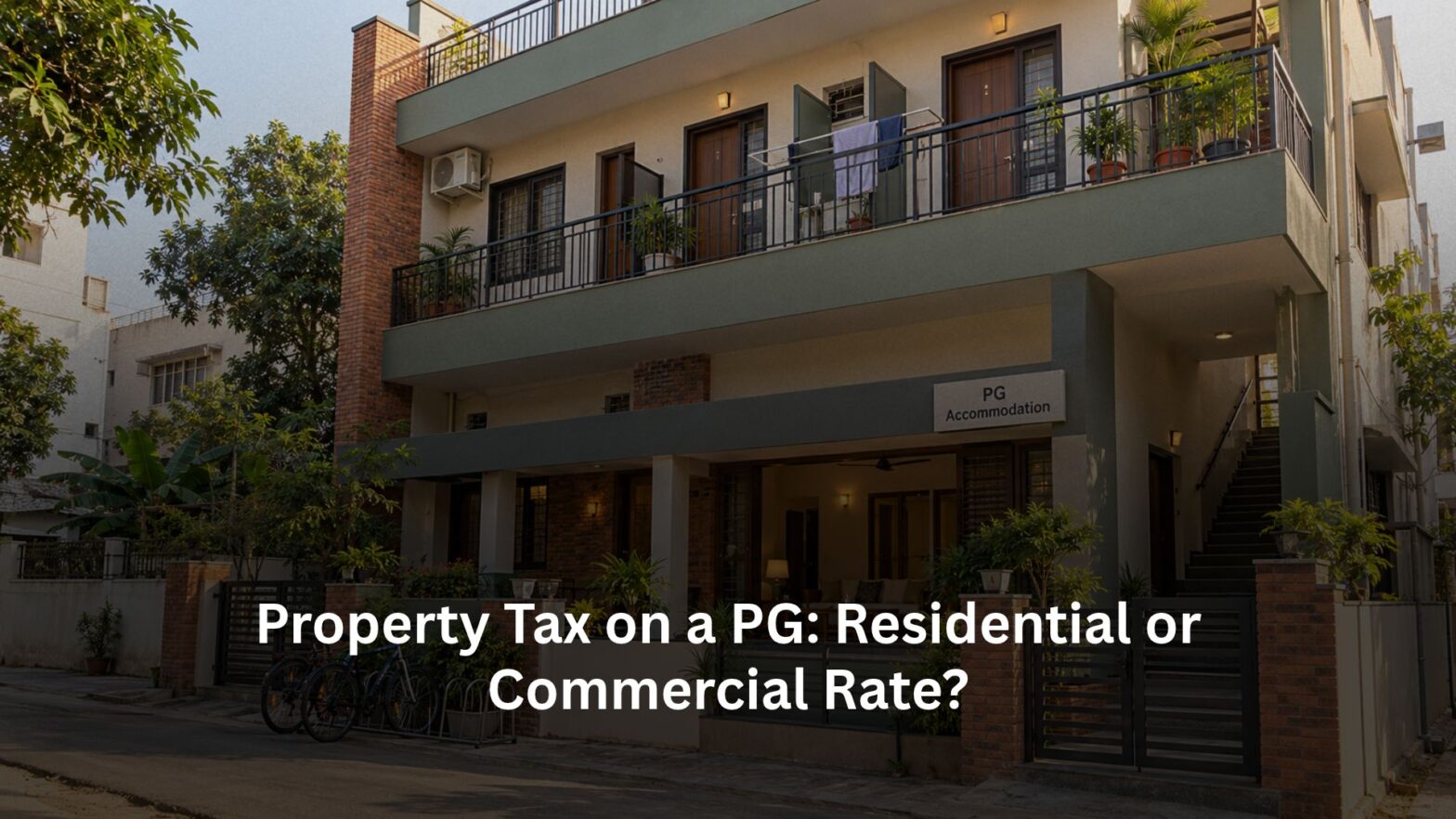
The building may still look like the family home it once was, but its property-tax record might need to change after you start a PG. An assessment that describes every floor as self-occupied housing can become difficult to defend when you advertise beds, collect accommodation fees and use most of the building for paying guests. The residential address alone does not settle the tax category.
Property tax for a PG depends on the local municipal rules, the actual use and the relevant assessment period. A civic body may apply a non-residential category, a specific PG or hostel entry, or different treatment to identifiable portions. This guide explains the city differences, the effect of registration and reassessment, rebates worth checking and the separate rules for claiming municipal taxes against rental income.
Does running a PG automatically mean commercial property tax?
Not under one nationwide rule. Municipal authorities use their own legislation, valuation schedules and assessment categories. The useful question is which entry covers your operation, rather than whether all PGs are commercial everywhere. A specialised PG category may differ from both an ordinary residence and a hotel.
The assessment can depend on:
- Actual activity: Ordinary residential letting, a managed PG, a hostel and a guest house may fall under different entries. Explain the accommodation and services accurately.
- Area and occupancy: Identify which rooms or floors the family occupies, which serve paying guests and which remain common. Check whether the local system distinguishes self-occupied and rented portions.
- Valuation inputs: Covered area, locality, building age, use factors, annual rental value or capital value can affect the calculation. A higher use factor is only one possible change.
- Applicable year: An older receipt or online rate chart may reflect a previous schedule. Check the effective date of any revision and the period covered by your demand.
Keep property-tax assessment, permission to operate and income-tax treatment separate. Paying a non-residential bill does not, by itself, authorise a prohibited building use. Equally, a municipal commercial label does not automatically decide the income-tax head for your receipts.
Mixed-use buildings need an area record
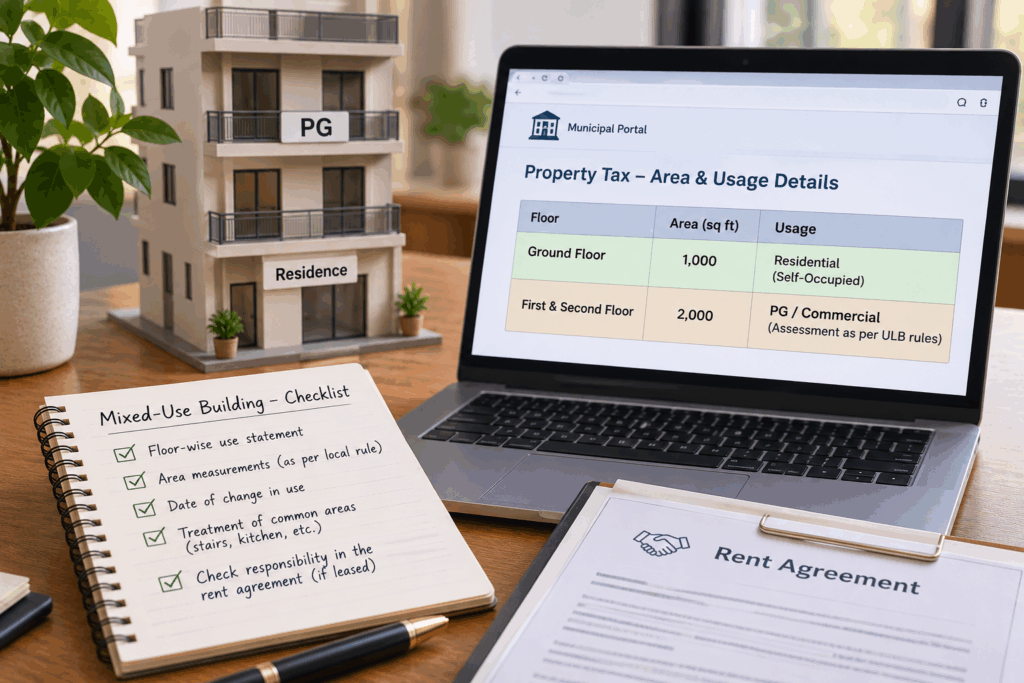
If you live on the ground floor and run a PG upstairs, prepare a floor-wise use statement before completing the return. Record the relevant area measurements, the date each portion changed use and the treatment of stairs, kitchens and other shared facilities. Ask the assessing office how its rules allocate common areas.
For example, a building with 1,000 sq ft of family accommodation and 2,000 sq ft of PG space does not justify declaring the full 3,000 sq ft as self-occupied. It also does not establish a universal formula for taxing every floor commercially. The municipal rules determine the category and allocation for each eligible portion.
Use the locally prescribed measurement basis; carpet area, covered area and built-up area are not interchangeable. The Haryana ULB calculator, for instance, provides floor and usage breakdowns and addresses allocation of common areas. That illustrates why a single whole-building label can miss important details.
If you lease the building, establish who must handle assessments, notices and reimbursement. A clear rent agreement covering responsibilities and additional charges helps avoid an owner-operator dispute, but it cannot override the municipality’s statutory recovery rights.
Delhi and Bengaluru require category-specific checks
Does Delhi always apply use factor 4 to a PG?
For MCD property tax on a PG, avoid relying solely on an old table that combines paying guest houses with guest houses at use factor 4. MCD’s Fifth Municipal Valuation Committee final report specifically recommends retaining use factor 2 for PG accommodation. Its later interim valuation report also discusses retaining factor 2 for PGs and recommending it for hostels.
These documents explain why the blanket statement “every Delhi PG attracts factor 4” is unreliable. Check the adopted schedule, your assessment year and the category recorded against your UPIC through the MCD property-tax portal. A committee recommendation alone is not a substitute for the operative order applicable to your property.
Bengaluru: check the current assessment rather than a fixed multiplier
The BBMP circular archive lists a PG-specific tax revision, while the current Bengaluru property-tax portal identifies itself with the Greater Bengaluru Authority and city corporations. Owners searching for BBMP property tax for a PG should use the current assessment route and jurisdiction.
Do not budget on an assumed 1.5-times or two-times residential rate. Ask the revenue office to confirm the PG entry, valuation basis, area treatment and effective year. Keep its written response with your return, especially when an older record still describes the building as self-occupied residential premises.
Pune and Hyderabad: the assessment basis matters
Pune: change of use and residential concessions
PMC’s property-tax FAQ says it assesses an authorised change from residential to non-residential use at the prevailing non-residential rate. Its portal separately offers a 40% concession application for self-occupied residential property.
A PG operator should therefore verify the recorded use and concession eligibility, rather than carrying forward a family home’s benefit automatically. Ask PMC for the applicable PG or hostel classification and the assessment calculation. The FAQ’s general change-of-use rule does not establish one universal per-bed tariff for every Pune PG.
Hyderabad: confirm the corporation serving the property
The official Centre for Good Governance describes CURE-1 property-tax services for GHMC, Cyberabad and Malkajgiri municipal corporations. Check which corporation now holds your property record before using an older GHMC calculation guide.
Obtain the current demand, recorded use and applicable valuation notification through the authorised route. Older GHMC material describes annual-rental-value calculations; do not assume an old percentage remains the complete answer during changes to the regional framework. Confirm any revised valuation basis, commencement date and transition protection with the assessing authority rather than applying a reported new rate independently.
Gurugram and Mumbai follow different valuation systems
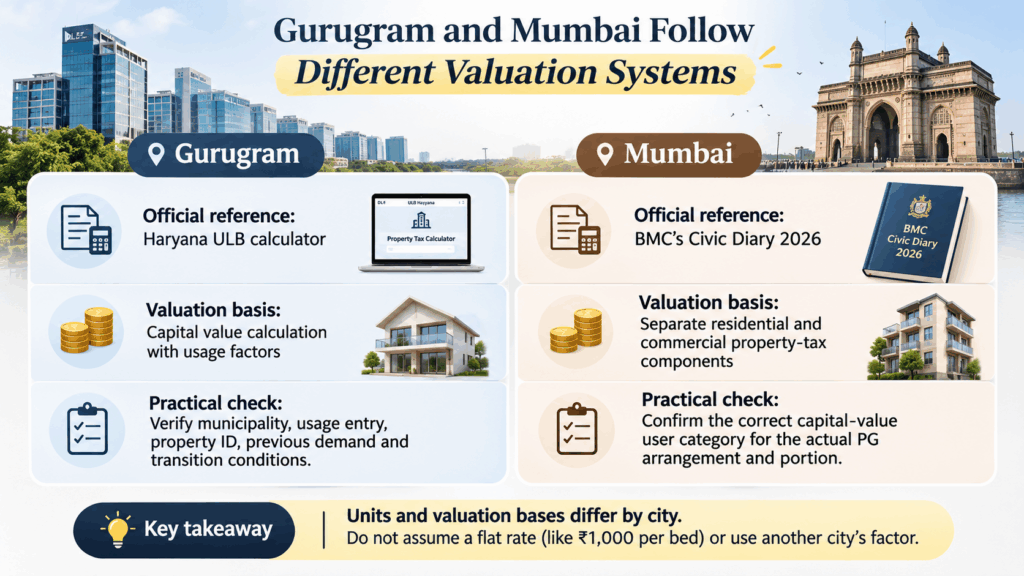
The supplied examples from these cities are useful reminders that units and valuation bases matter. A charge per square yard, a percentage of capital value and a levy linked to beds cannot substitute for one another in a PG budget.
| City | Relevant official reference | Practical check for a PG owner |
|---|---|---|
| Gurugram | The Haryana ULB calculator describes a capital-value calculation, usage factors and a policy dated 30 July 2026. | Check the municipality, usage entry, property ID, previous demand and transition conditions. Do not assume ₹1,000 per bed applies. |
| Mumbai | BMC’s Civic Diary 2026 publishes separate residential and commercial property-tax components. | Ask the assessment department which capital-value user category covers the actual PG arrangement and portion. Do not import Delhi’s use factor. |
For Gurugram, the official calculator also contains conditions for properties that already paid tax and for old arrears. Check these before treating a newly calculated amount as your final payable demand. In Mumbai, confirm the complete assessment and applicable components rather than comparing only one headline percentage.
Registration can expose an outdated assessment
A registration or licensing exercise may reveal a mismatch between declared use and actual activity. For example, an owner may disclose multiple PG floors during licensing while the property-tax return still describes the entire house as self-occupied. The issue is the inaccurate assessment record; registration itself is not a nationwide tax surcharge.
An inspection or scrutiny can lead the authority to review the category, area, effective change date or a concession that no longer applies. Depending on the local law and facts, a revised demand may include differential tax, interest or penalties. Do not assume a uniform monthly penalty of 1.5% or 2% across cities, or that every tax mismatch automatically results in sealing.
When a notice arrives, check the property ID, assessment period, area, use entry and calculation. Compare them with your plans, earlier returns and evidence of when the PG began operating. File a correction, objection or appeal through the prescribed route within its deadline; do not assume an objection automatically suspends payment or recovery.
Where an operator manages the property for someone else, explain any revised liability separately from routine expenditure. RentOK’s guide to owner reporting shows why clearly described expenses help owners understand a lower payout instead of questioning an unexplained deduction.
Are there rebates specifically for compliant PGs?
There is no single nationwide PG compliance rebate. A licence, police-verification record or safety certificate does not automatically reduce the property-tax bill. Look for an express municipal provision covering your property category, payment date and other eligibility conditions.
Separate three kinds of benefit:
- Early-payment relief: MCD’s portal guidance lists an advance-payment rebate. Confirm the current year’s order, eligible category and deadline before claiming it; an expired payment window is not an ongoing discount.
- Use-specific concessions: PMC distinguishes self-occupied residential relief from other assessments. Its rebate FAQ also restricts certain environmental benefits to residential properties. Installing a qualifying system does not automatically make a non-residential PG eligible.
- Temporary arrears settlements: An amnesty or one-time settlement may reduce specified interest or penalties under conditions. It is different from a permanent reduction in annual tax or permission to understate the use.
Retain the scheme order, eligibility evidence and final receipt showing the benefit. Budget using the payable assessment you can substantiate, rather than subtracting a discount that belongs to another category or an earlier financial year.
Claiming property tax against rental income
Municipal property tax and income tax are different calculations. First establish whether the receipts fall under income from house property or a business computation. The municipal category alone does not answer that question. RentOK’s rental-income reporting guide explains why payment records and property-wise income details matter when preparing a return.
For Tax Year 2026–27, Section 21(3) of the Income-tax Act, 2025 permits reduction of annual value by local-authority taxes actually paid by the owner during the tax year. Section 22(1)(a) then provides the 30% deduction on the annual value determined under Section 21. See the Department’s annual-value provision and deduction provision.
For an earlier income year, use the applicable law and forms. Do not treat a demand notice as proof of payment or assume a tax deduction refunds the municipal payment rupee for rupee.
A worked example under the house-property head
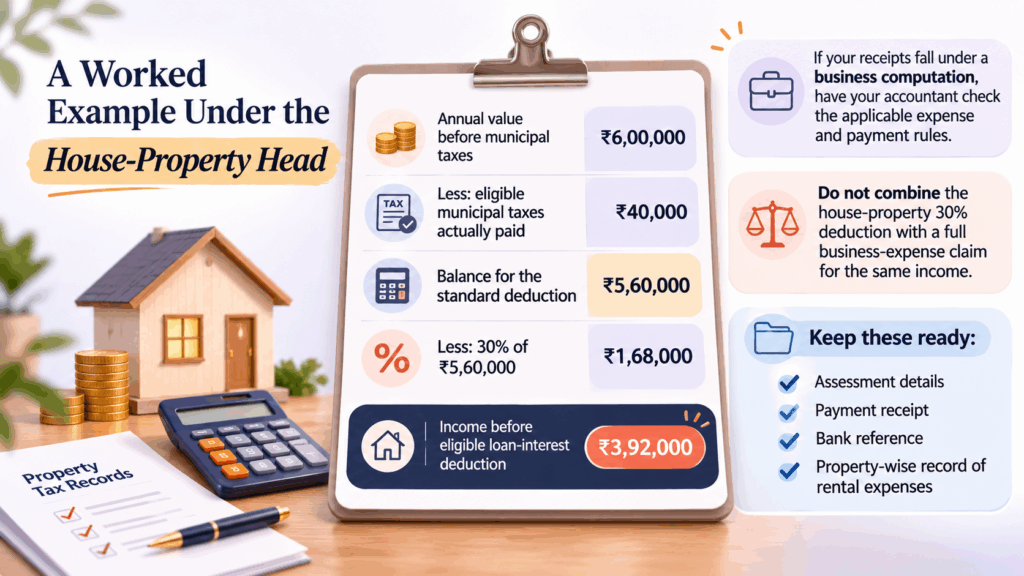
Assume the owner has ₹6,00,000 annual value before municipal taxes, pays ₹40,000 eligible municipal taxes, and qualifies for the house-property computation. Ignore loan interest and other adjustments solely to illustrate the sequence.
| Calculation | Amount |
|---|---|
| Annual value before municipal taxes | ₹6,00,000 |
| Less: eligible municipal taxes actually paid | ₹40,000 |
| Balance for the standard deduction | ₹5,60,000 |
| Less: 30% of ₹5,60,000 | ₹1,68,000 |
| Income before eligible loan-interest deduction | ₹3,92,000 |
If your receipts fall under a business computation, have your accountant check the applicable expense and payment rules instead. Do not combine the house-property 30% deduction with a full business-expense claim for the same income. Allocate mixed personal and business expenditure appropriately.
Keep the assessment, payment receipt and bank reference together. A property-wise system for tracking rental expenses makes it easier to distinguish the annual demand, actual payment, arrears and adjustments before the accountant prepares the return.
How RentOK helps you track PG property-tax expenses
A tax payment can disappear inside a general bank statement, while the annual demand remains in a separate folder. RentOK’s property-wise accounting approach connects recorded expenditure with the relevant property, helping you review the cost alongside PG collections.
- Record the payment against the correct property: Enter the actual expense with a clear description and retain the municipal receipt and bank reference. Keep penalties, interest and the underlying tax identifiable for your accountant’s review.
- Review the relevant period: RentOK’s expense filters support custom date ranges. Use the payment period when reconciling cash outflows, while noting separately which assessment years the payment covers.
- See the impact on property finances: Its money reports show monthly income, expenses and profit, with property filters and report downloads. That helps you explain a large annual tax payment and plan cash reserves.
- Prepare a clearer accountant handover: Share the financial report alongside original assessments, receipts and any objections. Separate a budgeting provision from a completed payment so the report does not imply you have already discharged the liability.
RentOK organises financial records; the municipality determines the assessment, and your tax adviser determines the appropriate deduction. Keep official notices and payment evidence available even when the software report shows the expense.
Conclusion
The correct property tax for a PG starts with its local category, actual use, area and assessment year. A residential address does not guarantee residential treatment, but a commercial operation also does not justify borrowing a rate from another city. Check mixed-use portions, update inaccurate records and claim only the concessions that expressly cover your assessment.
Once you establish the liability, make it part of your regular financial planning. Track PG expenses on RentOK to review tax payments alongside income and other costs, and keep the municipal documents ready for the next assessment or income-tax return.
FAQ
1. Is every PG taxed at a commercial rate?
No. Municipal rules may prescribe non-residential treatment, a specific PG or hostel category, or different entries for separate portions. Check the actual operation, assessment year and recorded category instead of relying on a nationwide commercial-rate assumption.
2. Can I keep residential treatment for the floor where my family lives?
Possibly, if the local assessment rules recognise the separate residential portion. Prepare a floor-wise area and use record, then confirm the treatment of shared spaces; living in part of the building does not make every PG floor self-occupied.
3. Does a PG licence automatically increase my property tax?
A licence application does not create a universal tax surcharge. It may reveal that your declared use or area needs correction, so compare the licensing details with the property-tax return and ask about any resulting reassessment.
4. Can a registered PG claim an automatic tax rebate?
No. Rebates depend on a specific municipal scheme and its conditions, including use category, payment timing and arrears. A PG licence alone does not establish eligibility, and self-occupied residential concessions may not extend to the PG portion.
5. Can I deduct an unpaid property-tax demand from rental income?
Under the house-property computation, a demand alone is insufficient: eligible municipal taxes require actual payment by the owner in the relevant year. Keep the receipt and bank reference, and ask your accountant to handle mixed-use allocations correctly.
6. Does commercial property tax mean my PG income is business income?
No. Municipal classification and income-tax treatment answer different questions. Your accountant should assess the letting arrangement and operations under the applicable income-tax law; a commercial municipal bill alone does not settle the head of income or permitted deductions.