

Bengaluru PG Rules: 7 Things Every Owner Must Know
A trade licence does not settle every question about a Bengaluru PG. The building must support the use, the resident count must fit its permitted capacity, and the safety arrangements must work every day. A camera that cannot retrieve last month’s footage or a night shift without security can leave serious gaps even when the operator keeps a licence on display.
The Bengaluru PG rules combine the earlier BBMP licensing conditions with later court directions on building use, safety, records and enforcement. For owners, the practical task is to connect each requirement with something they can check: a measured room, retrievable recordings, the correct food approval, a security roster and current resident records. This guide explains those checks and how to respond if an inspection leads to a notice.
What the rules require from every PG
Start with the licence and the building
The earlier BBMP PG guidelines, issued under Section 305 of the BBMP Act, 2020, set conditions for new and renewed trade licences. The February 2026 court reporting reproduces those ten conditions, including space, CCTV, water, food safety and security requirements.
Bengaluru now has the Greater Bengaluru Authority and five city corporations. If you search for a “GBA PG licence” or “PG trade licence Bengaluru,” use the official GBA services to identify your corporation and current application or renewal route. Check the premises address, approved activity and capacity against the actual property.
The High Court’s 10 September 2026 order expressly separates a trade licence from building legality. A licence does not regularise unauthorised construction. Check the sanctioned plan, permitted use, additional floors and conversions before counting beds. RentOK’s guide to licences needed to run a PG explains why these approvals serve different purposes.
Check the daily safety requirements
Use this as an operational overview alongside the conditions and approvals for your particular premises:
| Area | What the operator should check |
|---|---|
| Space and occupancy | At least 70 sq ft per occupant under the licensing framework, without exceeding permitted capacity. |
| CCTV | Coverage of entries, exits and corridors, with 90-day footage storage for each camera. |
| Water and sanitation | Potable drinking water, 135 litres per person per day of water availability under the earlier conditions, and hygienic washrooms. |
| Food service | Appropriate FSSAI registration or licence for the actual food activity. |
| Security | Continuous security coverage and verified personnel under the applicable requirements. |
| Fire and basic readiness | Applicable fire clearance, accessible equipment and escape routes, first aid, emergency contacts and waste segregation. |
The 135 LPCD figure concerns daily water availability; it does not mean each resident needs 135 litres of drinking water. Keep tanks, washrooms and waste areas on a cleaning schedule, and check the first-aid kit’s contents rather than only its presence.
For the notice board, verify every number. 112 is the integrated emergency number; 101 is Fire and Rescue, not the police number. The GBA website lists 1533 as its helpline. Add current local police and property contacts so residents know whom to call.
How to calculate 70 sq ft per resident (with an example)
Start with the area that the authority accepts for occupancy calculations. Do not divide the building’s total saleable area by 70 and treat the result as permission to add beds. Corridors, staircases, parking areas and other spaces without approval for habitation cannot become sleeping accommodation.
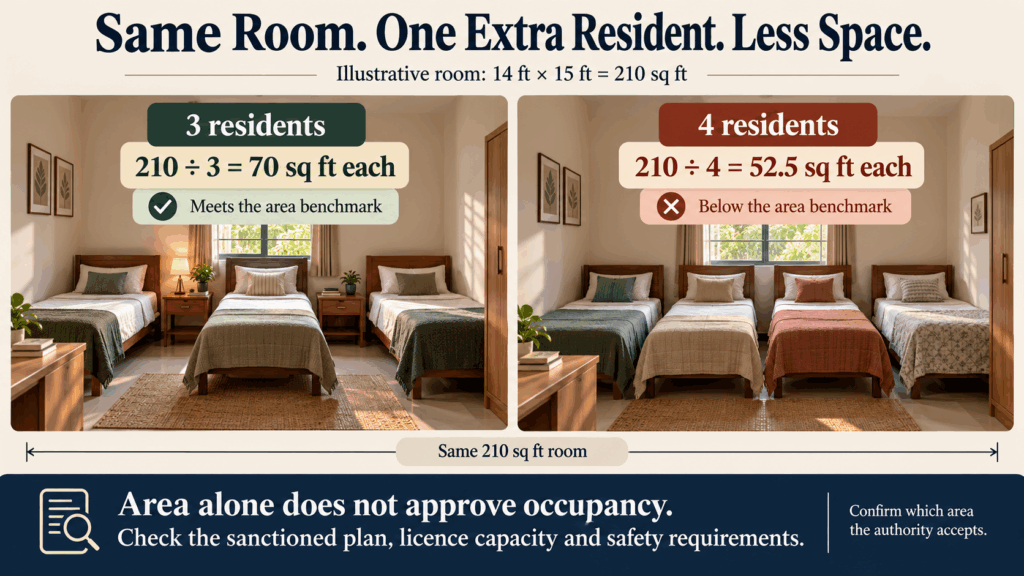
For an illustrative area check, assume a room has 210 sq ft of qualifying area:
| Calculation | Result |
|---|---|
| Room dimensions: 14 ft × 15 ft | 210 sq ft |
| Area per resident with three occupants | 210 ÷ 3 = 70 sq ft |
| Area per resident with four occupants | 210 ÷ 4 = 52.5 sq ft |
| Area benchmark for two occupants | 2 × 70 = 140 sq ft |
Three occupants meet the numerical benchmark in this example; four do not. However, a 210 sq ft measurement alone does not approve triple sharing. The sanctioned plan, fire and access requirements, licence conditions and accepted measurement method can impose a lower capacity. Confirm whether bathrooms or other areas count before finalising your calculation.
Keep a room-wise sheet showing dimensions, approved capacity, installed beds and actual residents. Compare it with move-in and move-out records whenever occupancy changes. A bunk bed changes the furniture arrangement; it does not reduce the area requirement for each person.

CCTV at every entry and 3 months of footage
The PG CCTV rule in Bengaluru covers every entry, exit and common corridor. The earlier licensing condition specifies 90 days of footage from each camera. Use 90 days when sizing storage; three calendar months do not always contain exactly 90 days.
A live picture on a screen proves only that a camera currently works. Check whether staff can retrieve an older recording, whether the recorder overwrites footage too early, and whether a power interruption stops recording. Ask the installer to size storage for the actual number of cameras, recording settings and retention requirement.
Build these checks into routine maintenance:
- Coverage: Review each entrance, exit and corridor for blind spots, including access routes that residents use at night.
- Recording and retrieval: Test date and time accuracy, power backup, oldest available footage and export capability. Record faults and repairs.
- Access and preservation: Restrict access to authorised personnel and preserve relevant footage after a serious incident or lawful direction.
The September order prohibits cameras in bedrooms, bathrooms, toilets, changing areas and other private spaces. Position corridor cameras so they do not intrude into rooms. Safety does not give management unrestricted permission to record residents’ private lives or circulate clips in informal groups.
Do you need FSSAI for your kitchen?
If your PG prepares or supplies meals, assess the food activity separately from accommodation. The earlier BBMP condition refers to obtaining an FSSAI licence within three months of the trade licence for a facility with its own mass kitchen. Do not treat that wording as a general exemption from food-law requirements while you wait.
The current FoSCoS eligibility document, updated on 1 April 2026, includes boarding houses serving food. It lists Registration for annual turnover up to ₹1.5 crore and a State Licence above ₹1.5 crore for that category. Select the correct Kind of Business and confirm the applicable approval for your actual operation; a PG, caterer and canteen may involve different classifications.
If an outside caterer provides meals, check the supplier’s approval and your own receiving, storage and serving responsibilities. Outsourcing cooking does not answer every food-compliance question. RentOK’s guide to FSSAI approval for a hostel mess or canteen explains how to assess the food model before applying.
During daily checks, examine food-handler hygiene, refrigeration, expiry dates, pest control, potable water and separation of raw and cooked food. Keep cleaning chemicals away from ingredients. A certificate cannot compensate for unsafe food handling, and a clean dining room cannot prove that the kitchen meets its obligations.

The security guard rule owners are fighting
The framework requires at least one security guard with established character credentials on a 24-hour basis. Treat this as continuous coverage, not an instruction to make one employee work around the clock. Plan shifts, weekly relief, breaks and a replacement procedure so the entrance does not lose coverage when someone leaves duty.
Owners have challenged the cost and practicality. October 2024 reporting on the association’s objections records concerns about mandatory personnel, the space rule and CCTV storage. Some owners argued for alternatives such as biometric entry. Those objections do not themselves create an exemption; do not replace personnel with cameras or access technology without a valid applicable relaxation.
The September order also addresses staff verification, controlled entry and visitor records. Do not assume that any available caretaker automatically satisfies the security requirement. Confirm the person’s role, credentials, training and coverage arrangement with the competent authority.
Make the desk procedure specific: identify the visitor, confirm the resident they intend to meet, record arrival and departure, and explain who handles an exception or incident. RentOK’s article on tracking staff performance from cleaning to security connects shift attendance, visitor logs and incident reporting. Its guide to clear visitor policies also explains why residents and guards should follow the same instructions.
What happens if you ignore a closure notice
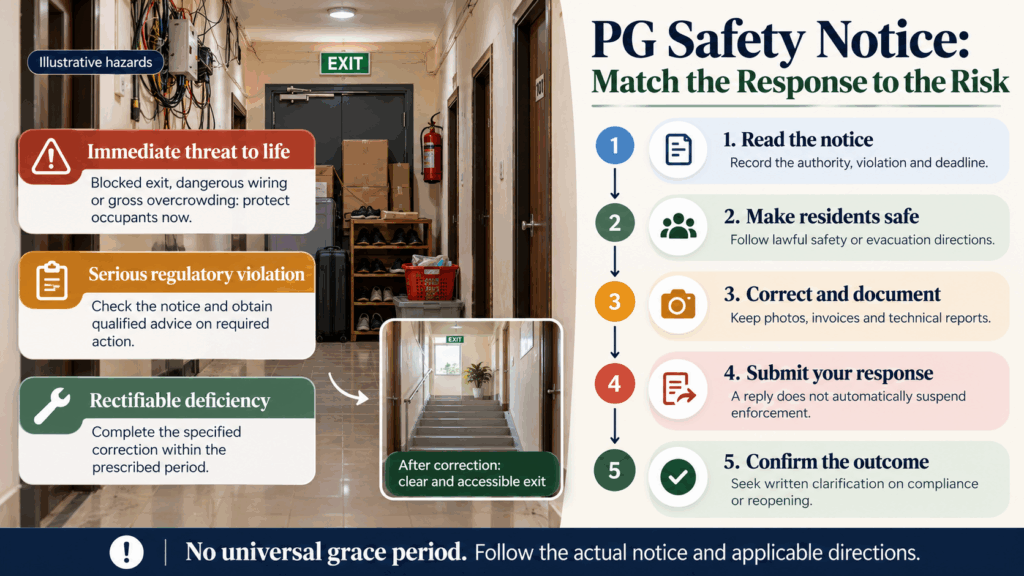
Ignoring a notice can expose the PG to closure, sealing, licence action or other lawful enforcement, depending on the violation. Unauthorised construction can also trigger building-related action. The September order distinguishes immediate threats to life, serious regulatory violations and deficiencies that an operator can rectify within the prescribed period.
That distinction matters. A blocked fire exit or dangerous electrical installation calls for urgent action. A routine compliance timetable cannot justify leaving occupants exposed to immediate danger. The court directs authorities to follow the relevant statutory procedure; it does not give every PG the same grace period.
Respond to the violation and protect residents
Keep the notice and record its service date, issuing authority, cited violation and deadline. Then:
- Make occupants safe: Address immediate hazards and follow any lawful evacuation or closure direction.
- Document corrections: Keep photographs, invoices, technical reports and correspondence showing what you corrected and when.
- Respond formally: Submit the required reply and seek legal advice promptly if you dispute the notice. Do not assume a representation automatically suspends enforcement.
- Confirm the outcome: Obtain written clarification about reinspection, compliance acceptance or reopening before treating the matter as closed.
LiveLaw’s 29 September 2026 report describes relocation time discussed in court and proposed utility disconnections after the specified period. That report does not establish a universal deadline for every property. Read your actual notice and any later directions.
Tell residents what the notice means, preserve their records and explain arrangements for belongings, relocation and financial settlement where necessary. Prevention remains preferable: RentOK’s PG fire-safety guide explains why clear escape routes and maintained equipment need continuing attention.
How RentOK helps manage visitors and attendance
Safety arrangements need accurate daily records as well as equipment and approvals. RentOK supports the operational side through resident information, occupancy visibility and attendance tools, helping managers connect the person at the entrance with the resident and bed records they maintain.
- Organise resident details: Keep identity documents and stay information connected to resident profiles. RentOK’s guide to maintaining tenant KYC records digitally explains this workflow. Follow the separate local verification procedure and retain its acknowledgement where required.
- Track attendance: RentOK Smart Attendance supports a mobile-first approach without dedicated biometric machines. Use attendance information to follow up on absences and support staff checks; do not treat it as a guaranteed emergency headcount.
- Support visitor and leave workflows: RentOK describes entry-exit logs, guest invitations and leave information in its tenant-app offering. Use the supported features in your setup alongside the guard’s visitor-verification process and your published access rules.
- Review bed allocation: Compare room and bed status with your approved occupancy sheet. Software helps you organise allocations; the authority’s permissions determine how many residents you may accommodate.
These tools support administration. They do not replace security personnel, CCTV storage, fire clearance, food approval or an authority’s inspection. Your team must still verify records, maintain equipment and act on safety problems.
Conclusion
Treat Bengaluru PG compliance as a working system: measure capacity before adding residents, test CCTV retrieval, match food approval to the kitchen, and maintain security coverage through every shift. Keep the licence, building permissions and daily records consistent with the property you actually operate. A document on the wall offers limited reassurance when the arrangement on the ground tells a different story.
Start with the gaps that affect life and safety, then assign responsibility for the remaining corrections and records. Manage visitors and attendance on RentOK to keep routine resident information organised while your team maintains the physical safeguards and permissions the PG requires.
FAQ
1. Does a trade licence make the PG building legal?
No. A trade licence does not regularise unauthorised construction. Check the sanctioned plan, permitted PG use and applicable building approvals separately; additional floors, terrace rooms or converted parking areas can create violations despite a licence.
2. Can I put three residents in a 210 sq ft room?
That meets the 70 sq ft arithmetic only if the authority accepts the full area for the calculation. The sanctioned plan, licence capacity and safety requirements still apply, so confirm those before offering triple sharing.
3. Do CCTV cameras remove the need for a security guard?
No. CCTV and security personnel serve different functions under the framework. Owners’ requests for relaxation do not create an exemption; maintain the required coverage unless a valid applicable direction expressly permits a different arrangement.
4. Can I keep CCTV footage for only 30 days?
The earlier BBMP licensing condition requires 90 days of footage from each camera. Size storage accordingly and test retrieval; a recorder that overwrites footage after 30 days does not meet that requirement.
5. Does an outside caterer remove all FSSAI obligations?
No. Check the caterer’s FSSAI approval and the responsibilities arising from your own food-service activity. Receiving, storing and serving meals still need attention, and the correct registration or licence depends on the actual operating model.
6. Does replying to a closure notice let me keep operating?
A reply does not automatically suspend enforcement. Follow the notice and any competent authority or court direction, address immediate hazards, and seek written clarification about compliance acceptance or reopening rather than assuming continued operation is lawful.