
Do You Need GST Registration for Your PG Business? A Decision Tree
Running a PG (Paying Guest) business involves much more than managing tenants and collecting rent. As your occupancy grows and revenue starts increasing, compliance becomes equally important. One of the first questions that almost every new PG owner asks is:
“Do I need GST registration for my PG business?”
The answer isn’t always straightforward.
Whether GST registration is mandatory depends on several factors, including the nature of your accommodation, the services you provide, your annual turnover, and whether your business qualifies for exemptions under the GST law. Many property owners either register unnecessarily or delay registration because they are unsure about the applicable rules. Both situations can create avoidable compliance issues in the future.
This guide simplifies the decision-making process through an easy-to-follow framework while explaining the Entry 12AA exemption, turnover thresholds, and situations where GST registration becomes necessary. By the end, you’ll have a much clearer understanding of where your PG business stands from a GST perspective.
Why GST Registration Matters for PG Owners
Many first-time property owners assume GST registration only applies to hotels or commercial accommodation providers. In reality, GST applicability depends on how your property operates, not simply how you describe it.
Making the right decision early helps you avoid unnecessary compliance costs, prevent future notices, and prepare your business for growth.
GST compliance is just one part of running a successful rental business. If you’re planning to scale beyond a single property, our guide on Complete Guide to Running a Profitable Hostel in India explains how occupancy, operational systems, and financial discipline drive long-term profitability.
A clear understanding of GST also becomes increasingly important if you plan to:
- Expand into multiple properties, where overall turnover and operational complexity increase, making compliance much more important than it was during the initial stages.
- Partner with companies or educational institutions, as many corporate clients prefer working with properly registered businesses that maintain organized documentation and invoicing practices.
- Introduce additional paid services, such as meals, housekeeping, laundry, transportation, or other amenities that may influence the overall tax treatment of your business.
- Build a professionally managed rental business, where financial records, invoices, tenant agreements, and regulatory compliance are handled systematically rather than manually.
As your business grows, compliance becomes much easier when your tenant records, payments, agreements, and financial reports are already organized. That’s why many growing operators move towards structured rental management systems instead of relying on spreadsheets. Learn more in our blog on What is Rental Management? Tools to Manage Your Property Efficiently.
In other words, GST registration is not just about taxation. It is part of building a business that is operationally structured and ready for long-term growth.
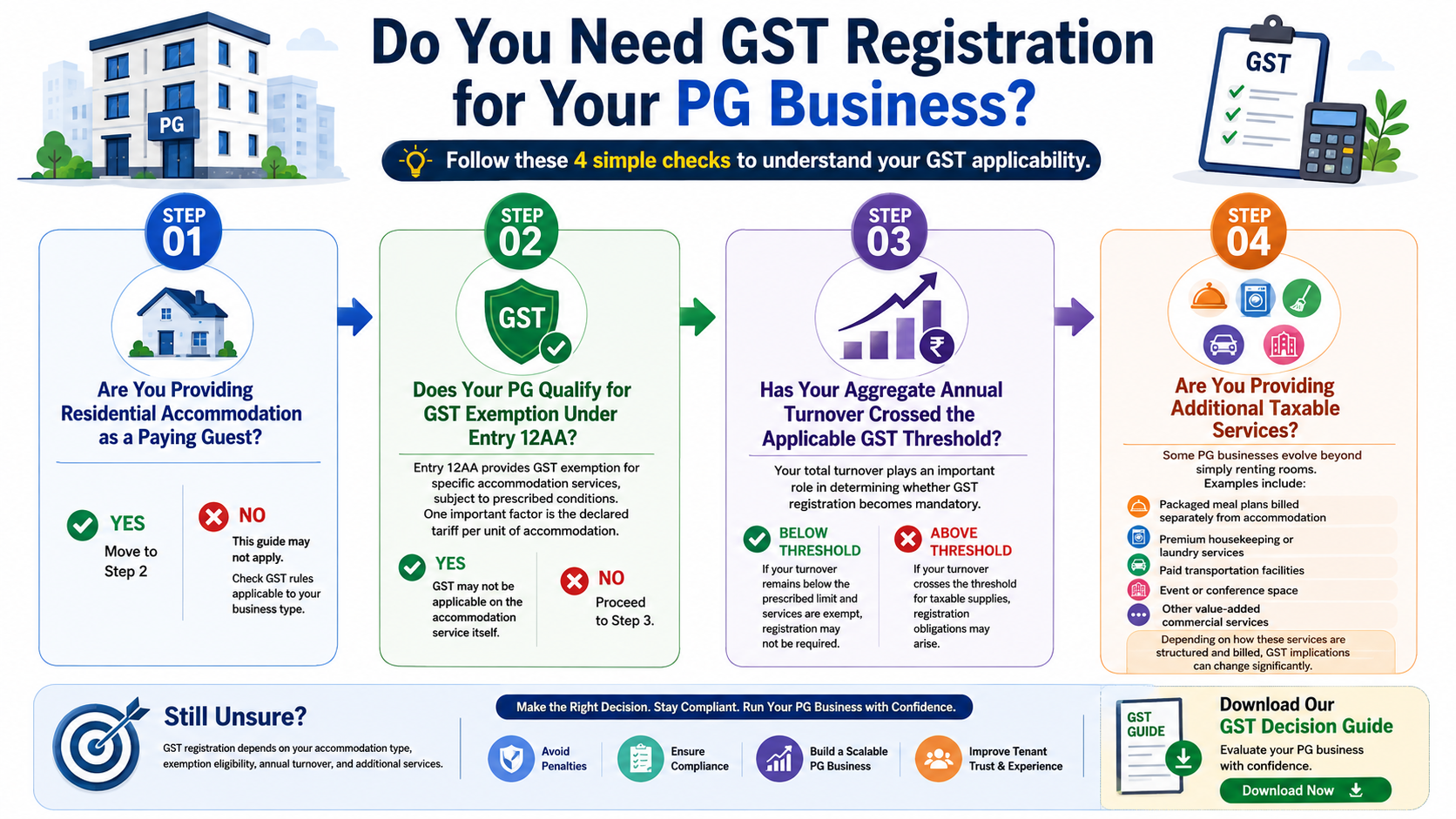
Start Here: A Simple GST Decision Tree for PG Owners
Instead of reading lengthy legal provisions, begin by answering the following questions.
Step 1: Are You Providing Residential Accommodation as a Paying Guest?
If No, this guide may not apply because your business could fall under different GST provisions.
If Yes, move to the next question.
Step 2: Does Your PG Qualify for GST Exemption Under Entry 12AA?
Entry 12AA provides GST exemption for specific accommodation services, subject to prescribed conditions. One of the most important factors considered is the declared tariff per unit of accommodation.
If your accommodation satisfies the exemption criteria, GST may not be applicable on the accommodation service itself.
If it does not qualify, proceed further.
Step 3: Has Your Aggregate Annual Turnover Crossed the Applicable GST Threshold?
Your total turnover plays an important role in determining whether GST registration becomes mandatory.
If your turnover remains below the prescribed limit and your services are exempt, registration may not be required.
If your turnover crosses the threshold for taxable supplies, registration obligations may arise.
Step 4: Are You Providing Additional Taxable Services?
Some PG businesses gradually evolve beyond simply renting rooms.
For example, you may start offering:
- packaged meal plans billed separately from accommodation,
- premium housekeeping or laundry services,
- paid transportation facilities,
- event or conference space,
- other value-added commercial services.
Depending on how these services are structured and billed, GST implications can change significantly.

Understanding Entry 12AA: The Exemption Every PG Owner Should Know
One of the biggest reasons for confusion among PG owners is Entry 12AA under GST exemptions.
Many landlords hear about it through consultants, online forums, or fellow property owners but never fully understand how it works.
In simple terms, Entry 12AA provides GST exemption for certain accommodation services, provided the prescribed conditions are satisfied. However, this exemption is not universal. It depends on factors such as the nature of the accommodation being provided and the applicable tariff conditions under the notification.
This is why two seemingly similar PGs may end up with different GST obligations.
For example, consider these situations:
- A property primarily offering long-term residential accommodation to students or working professionals may qualify differently from accommodation that operates more like a hotel with short-duration stays.
- A PG charging within the prescribed exemption limits may have different GST implications compared to another property charging significantly higher room tariffs.
- Additional commercial services bundled into the accommodation package may also influence how the overall service is treated from a GST perspective.
The key takeaway is that Entry 12AA should never be interpreted in isolation. It must always be evaluated alongside your pricing model, occupancy pattern, and the services your business actually provides.
Legal compliance doesn’t stop at GST. Tenant verification, agreements, and documentation are equally important for protecting your business. If you’re reviewing your compliance processes, you may also find our guide on How to Spot a Fake ID During Tenant Verification useful.
Common GST Myths That Often Confuse PG Owners
GST is one of those topics where misinformation spreads quickly. Many operators make business decisions based on assumptions rather than the actual provisions.
Here are some of the most common misconceptions.
Myth 1: Every PG Business Must Register for GST
This is probably the biggest misconception.
Simply operating a PG does not automatically mean GST registration becomes mandatory. The applicability depends on exemption eligibility, turnover, and the nature of services offered.
Myth 2: Crossing a Certain Number of Rooms Means GST Is Applicable
The number of rooms has no direct relationship with GST registration.
A property with fewer rooms may still require registration depending on its operations, while a much larger property could qualify differently under the exemption provisions.
Myth 3: GST and Income Tax Are the Same Thing
Many new business owners confuse these two.
Income Tax is based on your profits and taxable income, whereas GST is an indirect tax applicable to specific supplies of goods or services. Compliance requirements for both are entirely different and should never be mixed.
What Happens If You Register for GST Even When It Isn’t Mandatory?
Some PG owners believe that registering for GST early is always a good idea because it makes the business appear more professional. While voluntary registration is permitted in certain situations, it also comes with additional compliance responsibilities that shouldn’t be ignored.
Once you’re registered under GST, you’ll generally need to comply with ongoing filing and record-keeping requirements, even during periods when your business activity is low. For a small or newly established PG, this may create administrative work that wasn’t necessary in the first place.
Before opting for voluntary registration, consider factors such as:
- Your current business model, including whether you’re primarily providing exempt residential accommodation or offering multiple taxable services that may require GST compliance as the business grows.
- Your future expansion plans, because operators planning to add more properties, serve corporate clients, or diversify into commercial accommodation may find registration more relevant in the long run.
- Your ability to manage compliance consistently, as GST registration brings recurring responsibilities related to invoicing, documentation, and return filing that should not be overlooked.
The right decision depends on your business’s present requirements, not just where you expect it to be a few years from now.
Practical Scenarios: Does This PG Need GST Registration?
Understanding the law becomes much easier when you apply it to real-world situations. While every business should evaluate its own circumstances, the following examples illustrate how GST applicability can vary.
Scenario 1: A Student PG Offering Long-Term Accommodation
A PG primarily housing students on a long-term basis, with room tariffs falling within the prescribed exemption limits and no separately charged commercial services, may qualify for GST exemption under the relevant provisions.
In such cases, GST registration may not become mandatory solely because the property is operating as a PG.
Scenario 2: A Premium Co-living Space with High Tariffs
Now consider a professionally managed co-living property offering premium rooms, housekeeping, meal plans, and hotel-like services at higher tariffs.
Here, GST implications can differ significantly because the pricing structure and nature of services are no longer comparable to a traditional long-term residential PG.
This is why premium accommodation providers should evaluate their GST position carefully instead of assuming that the same exemption automatically applies.
Scenario 3: A Growing PG Business Expanding Across Multiple Properties
Imagine a landlord who starts with one property and gradually expands to three or four locations over the next few years.
Initially, GST registration may not have been required. However, as occupancy increases, turnover grows, and additional services are introduced, the compliance position may change.
This is a common stage where operators should reassess their GST obligations rather than relying on assumptions made when the business was much smaller.
Documents Every PG Owner Should Keep Ready
Whether GST registration is applicable today or not, maintaining proper documentation is a good business practice. Organized records make compliance easier, simplify financial management, and reduce stress during audits or professional consultations.
Some of the most important documents include:
- Property ownership or lease-related documents, as these establish the legal basis for operating the accommodation and may be required during registration or verification processes.
- Tenant agreements and KYC records, which help maintain transparent occupancy records while supporting other compliance and operational requirements.
- Income and expense records, including rent collections, maintenance expenses, vendor payments, and other financial transactions that contribute to overall business reporting.
- Invoices and supporting bills, particularly if you’re providing additional paid services or purchasing goods and services for business operations.
Good documentation doesn’t just support GST compliance, it also makes everyday property management much more organized.
Proper documentation becomes even more valuable when your property starts handling dozens, or even hundreds, of tenants. If you’re still managing records manually, our article on Property Management Apps to Replace Manual Registers explores how digital systems simplify tenant records, agreements, and day-to-day operations.
Common GST Mistakes New PG Owners Should Avoid
Many compliance issues don’t arise because the GST law is complicated. They happen because business owners make decisions based on incomplete information or verbal advice.
Some of the most common mistakes include:
- Assuming every PG business automatically attracts GST, without first checking whether the accommodation qualifies for available exemptions or whether turnover thresholds have actually been crossed.
- Ignoring additional taxable services, believing that only room rent matters while overlooking separately charged services that could influence GST applicability.
- Waiting until the business has grown significantly before reviewing compliance requirements, making it more difficult to organize historical records and documentation later.
- Maintaining incomplete financial records, which often creates confusion when calculating turnover or preparing information required by tax professionals.
Avoiding these mistakes early can save both time and unnecessary compliance challenges as your business expands.
Many first-time operators make compliance mistakes simply because they’re trying to manage everything manually. Our blog on Top 5 Mistakes New PG Owners Make in Their First 3 Months covers several operational mistakes that often become expensive as the business grows.


Why Compliance Becomes More Important as Your PG Business Grows
When a PG operates with a handful of tenants, compliance often feels manageable. However, as occupancy increases and operations become more structured, maintaining proper financial records and regulatory compliance becomes an essential part of running the business professionally.
Growth usually brings new operational responsibilities, such as managing multiple properties, hiring staff, working with vendors, and serving different categories of tenants. At this stage, maintaining accurate documentation isn’t just about meeting legal requirements, it supports better financial planning and smoother day-to-day operations.
Many successful operators eventually discover that compliance, documentation, and technology go hand in hand. Organized businesses find it easier to scale because critical information is available whenever it’s needed.
If you’re looking to build stronger operational systems beyond compliance, you can also explore RentOk’s YouTube channel for practical videos on property management, tenant operations, and business growth strategies.
How RentOk Helps Simplify Property Management
Understanding GST is only one aspect of running a successful PG business. As occupancy grows, operators also need efficient systems to manage tenants, payments, documentation, agreements, maintenance requests, and daily operations from a single platform.
RentOk helps property owners streamline these workflows by centralizing tenant management, rent collection, digital records, occupancy tracking, and operational reporting. Instead of relying on multiple spreadsheets, handwritten registers, and scattered WhatsApp conversations, property managers gain better visibility into their business through one connected platform.
While GST registration decisions should always be made based on the applicable legal provisions and professional advice where required, having organized business records and structured operational processes makes compliance significantly easier as your rental business scales.
Conclusion
Whether your PG business requires GST registration depends on several factors, not just the fact that you’re renting out rooms. The type of accommodation you provide, your annual turnover, the services you offer, and the applicability of exemptions such as Entry 12AA all play an important role in determining your compliance obligations.
Rather than making assumptions or relying on incomplete information, evaluate your business carefully and review your compliance position whenever your operations expand. A proactive approach today can help you avoid unnecessary complications tomorrow while laying a stronger foundation for sustainable growth.
Ready to manage your PG business more efficiently? Book a free RentOk demo and discover how a centralized property management platform can simplify tenant management, documentation, rent collection, and day-to-day operations as your business grows.
FAQ’S
1. Is GST applicable for a PG business?
GST is not automatically applicable to every PG business. Whether GST applies depends on factors such as the type of accommodation provided, applicable exemptions, the services offered, and your business turnover.
2. Which businesses do not require GST registration?
Businesses dealing exclusively in exempt supplies or those whose turnover remains below the prescribed GST registration threshold may not be required to register. However, eligibility should always be assessed based on the nature of the business and applicable GST provisions.
3. In which case is GST registration not compulsory?
GST registration is generally not compulsory when a business qualifies for GST exemptions or its aggregate turnover remains below the applicable registration threshold. Certain accommodation services may also be exempt if they satisfy the prescribed conditions.
4. Can a PG owner voluntarily register for GST?
Yes. Even if GST registration is not mandatory, a PG owner can opt for voluntary registration. However, doing so also brings ongoing compliance responsibilities such as GST return filing, invoicing, and record maintenance.
5. Does charging separately for meals or laundry affect GST applicability?
It can. If a PG charges separately for additional services such as meals, laundry, or housekeeping, the GST treatment may differ depending on how these services are structured and billed. It’s advisable to review the tax implications before introducing such services.
6. Should I consult a tax professional before registering for GST?
Yes. Since GST applicability varies based on your business model and the services you provide, consulting a qualified tax professional can help you make the right registration decision and avoid future compliance issues.
7. What records should a PG owner maintain for GST compliance?
Even if GST registration isn’t currently required, maintaining tenant agreements, rent receipts, invoices, expense records, and financial statements helps ensure smoother compliance if your business grows or registration becomes necessary later.