
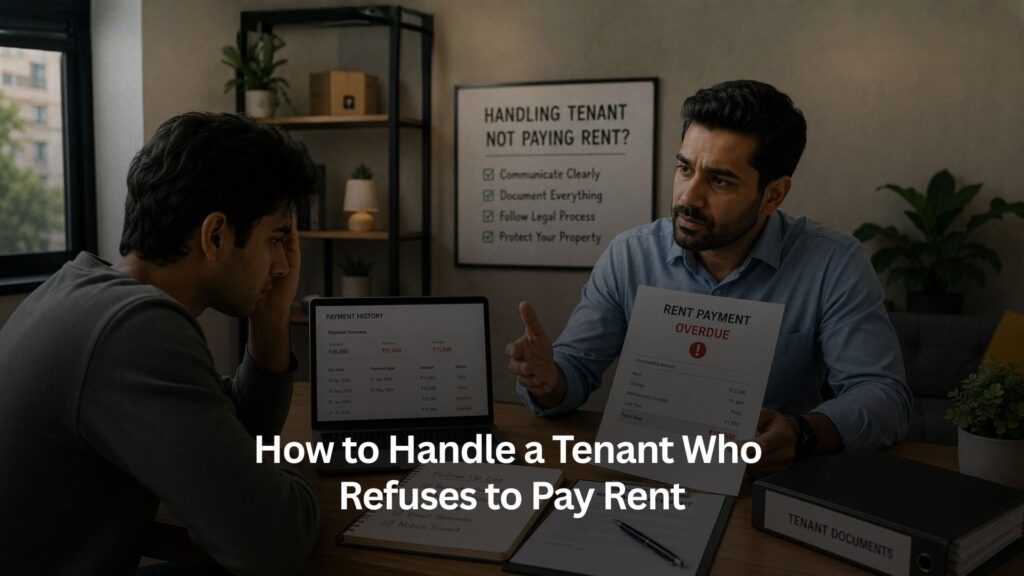
How to Handle a Tenant Who Refuses to Pay Rent
Rent collection is the backbone of every rental business. Whether you manage a single property, a growing PG, or multiple co-living spaces, timely rent payments are what keep daily operations running smoothly. They cover everything from staff salaries and maintenance costs to utility bills and property upgrades. So when a tenant refuses to pay rent, the issue goes beyond a missed payment, it can disrupt your entire business.
However, one of the biggest mistakes landlords make is assuming that every unpaid rent case is the same. Some tenants face genuine financial hardships, while others delay payments due to unresolved disputes or poor communication. Then there are situations where tenants intentionally avoid paying rent despite repeated reminders.
The way you respond during the first few days often determines whether the issue is resolved quickly or turns into a lengthy legal dispute. Reacting emotionally may damage the relationship further, while delaying action can encourage continued non-payment.
Instead of treating rent defaults as isolated incidents, professional property managers follow a structured process. They identify the reason behind the missed payment, document every interaction, communicate clearly, and escalate only when necessary. This approach not only improves the chances of recovering rent but also protects the landlord’s legal position if formal action becomes unavoidable.
Why Do Tenants Stop Paying Rent?
Before deciding on the next course of action, it is important to understand why the tenant has stopped paying rent. Assuming that every delayed payment is intentional often leads to unnecessary conflict, while ignoring repeated defaults can create larger operational problems over time.
In our experience, rent defaults generally fall into a few common categories.
- Temporary financial setbacks such as job loss, delayed salaries, unexpected medical expenses, or business losses may prevent tenants from paying on time. In these situations, many tenants are willing to cooperate if approached professionally.
- Disagreements with the landlord or property management can also lead to delayed payments. Unresolved maintenance requests, security deposit concerns, or dissatisfaction with promised amenities sometimes cause tenants to withhold rent until their concerns are addressed.
- Poor communication and inconsistent follow-ups often contribute to payment delays. When reminder systems are manual or irregular, tenants may postpone payments simply because there is no structured accountability.
- Intentional refusal to pay rent is perhaps the most challenging situation. Some tenants continue occupying the property despite having the financial ability to pay, hoping that delayed action from the landlord will allow them to stay longer without consequences.
Understanding which category your tenant falls into helps you choose an appropriate response. Not every case requires legal intervention, but every case requires a structured approach.


Should You Take Legal Action Immediately?
When a tenant refuses to pay rent, many landlords instinctively think about sending legal notices or initiating eviction proceedings. While legal remedies are available, jumping directly to legal action is rarely the most effective first step.
Most payment disputes can be resolved much earlier through professional communication and proper documentation. Legal proceedings often require time, paperwork, and expenses, making them a last resort rather than the starting point.
Instead, focus on gathering facts before making assumptions.
Ask yourself:
- Has the tenant always paid rent on time until now, or is this a recurring issue that has been developing over several months?
- Have you already sent clear payment reminders and followed up through documented communication channels?
- Is there an ongoing maintenance or service dispute that could be influencing the tenant’s decision to withhold payment?
- Does your rental agreement clearly define due dates, late payment clauses, notice periods, and the consequences of non-payment?
Taking a few hours to answer these questions provides much greater clarity than reacting immediately out of frustration.
Professional operators understand that resolving payment disputes is not just about collecting outstanding rent. It is also about protecting occupancy, maintaining documentation, and ensuring that every step taken can be justified if the matter eventually reaches a legal authority.
Start With a Professional Conversation
The first conversation after a missed payment often sets the tone for everything that follows.
Avoid accusatory language or emotional confrontations. Instead, contact the tenant politely and ask whether there is a specific reason for the delayed payment. Sometimes, a simple conversation uncovers issues that can be resolved without escalating the situation.
For example, a tenant may be waiting for a salary credit, facing a temporary emergency, or simply misunderstanding the due date. Addressing these situations early can prevent unnecessary disputes.
During the conversation, make sure to:
- Maintain a professional tone throughout the discussion. The objective is to understand the situation and encourage cooperation, not to create an argument that makes future communication more difficult.
- Clearly communicate the outstanding amount, payment deadline, and expectations. Avoid vague statements and provide precise information so there is no confusion regarding dues.
- Listen carefully to the tenant’s explanation before deciding the next step. Understanding the reason behind the delay helps determine whether flexibility or stricter action is appropriate.
- Document the discussion immediately after it takes place. Record the date, communication channel, and any commitments made by the tenant regarding future payment.
Even if the tenant refuses to cooperate, maintaining professionalism strengthens your position later because it demonstrates that reasonable efforts were made to resolve the matter amicably.
Every Interaction Should Be Properly Documented
Documentation is one of the most overlooked aspects of rent recovery, yet it becomes one of the strongest assets if the dispute escalates.
Many landlords rely on phone calls or verbal conversations without maintaining proper records. Weeks later, disagreements arise over what was promised, when reminders were sent, or whether adequate notice was provided.
Maintaining complete records protects both operationally and legally.
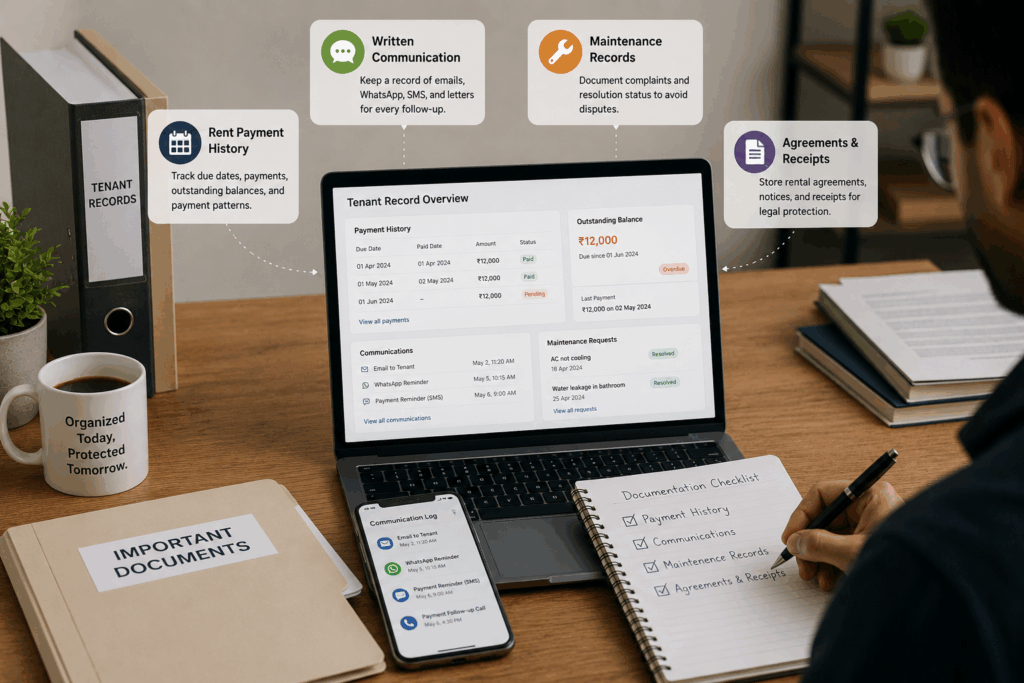
Keep track of:
- Rent payment history including due dates, payment dates, outstanding balances, and previous instances of delayed payments to identify recurring patterns.
- Written communication such as emails, WhatsApp messages, SMS reminders, or letters requesting payment, ensuring every follow-up has a documented trail.
- Maintenance complaints or service requests raised by the tenant, along with their resolution status, as these may become relevant if the tenant claims they withheld rent due to unresolved issues.
- Copies of the rental agreement, notices, and payment receipts so that all important documents remain easily accessible if formal legal proceedings become necessary.
Well-maintained records not only simplify rent recovery but also demonstrate professionalism. More importantly, they help avoid situations where disputes become one person’s word against another’s.

Create a Structured Escalation Process Instead of Repeated Follow-ups
One of the biggest operational mistakes landlords make is relying on random follow-up calls whenever they remember. This creates inconsistency and often encourages tenants to continue delaying payments because there is no clear escalation process.
Successful rental businesses follow a structured timeline where every stage has a defined purpose.
Stage 1: Friendly Reminder
Begin with a polite reminder soon after the due date passes. Many late payments are resolved at this stage because tenants simply need a timely prompt.
Stage 2: Formal Payment Reminder
If the tenant continues delaying payment, send a written reminder clearly mentioning the pending amount, original due date, and a reasonable deadline for clearing the dues.
Stage 3: Final Notice Before Legal Escalation
When repeated reminders fail, communicate that continued non-payment may lead to formal legal action as permitted under the rental agreement and applicable laws. This should remain factual and professional rather than threatening.
Following a structured process offers several advantages:
- It demonstrates fairness and consistency, showing that the tenant was given multiple opportunities to resolve the matter before legal escalation.
- It creates a complete communication timeline, which becomes valuable evidence if legal proceedings become necessary.
- It improves operational discipline, ensuring staff members follow the same recovery process instead of handling each case differently.
Most importantly, structured escalation prevents payment recovery from becoming an emotional exercise. Instead, it becomes a documented operational workflow that protects both the landlord’s interests and the integrity of the rental business.
When Should You Send a Legal Notice?
If repeated reminders and conversations fail to produce any response, the next logical step is to issue a formal legal notice. This is often the point where landlords begin searching for legal remedies, but it is important to remember that a legal notice is not simply a warning, it is a documented communication that demonstrates your intent to resolve the dispute through the proper legal process.
Many tenants respond once they receive a professionally drafted legal notice because it signals that the landlord has moved beyond informal follow-ups. At the same time, sending a notice too early without attempting reasonable communication can make the situation unnecessarily adversarial.
Before sending a legal notice, make sure you have:
- Maintained a complete record of payment reminders, emails, messages, and conversations so you can establish that sufficient opportunities were given to the tenant before escalating the matter.
- Verified the rental agreement carefully to ensure clauses relating to rent payment, late fees, notice periods, and default are clearly defined and support your next course of action.
- Calculated the outstanding amount accurately, including pending rent, utility charges, maintenance dues, or any other recoverable payments that are contractually applicable.
- Given the tenant a reasonable opportunity to respond because demonstrating fairness often strengthens your position if the dispute progresses further.
Most importantly, avoid sending informal messages claiming legal action unless you genuinely intend to proceed. Professional communication always carries more credibility than repeated threats that are never acted upon.
Common Mistakes Landlords Make During Rent Disputes
When rent stops coming in, it is understandable for landlords to feel frustrated. However, emotional decisions often make recovery more difficult than the original payment delay itself.
Over the years, some mistakes continue to appear across rental businesses regardless of property size. Avoiding these mistakes can significantly improve both your recovery rate and your ability to resolve disputes professionally.
Delaying Action for Too Long
Many landlords continue waiting month after month, hoping the tenant will eventually clear the dues voluntarily. Unfortunately, prolonged inaction often increases outstanding balances and weakens the landlord’s negotiating position.
A structured follow-up process should begin immediately after the payment due date passes instead of several weeks later.
Relying Only on Phone Calls
Verbal conversations may resolve small misunderstandings, but they rarely provide evidence if disagreements escalate. Every important discussion should eventually be followed by written communication confirming what was discussed and the timeline agreed upon.
Allowing Emotions to Take Over
Arguments, threats, or public confrontations rarely improve rent recovery. Instead, they often damage communication completely and make future negotiations significantly harder.
Professional landlords focus on facts rather than emotions. They communicate clearly, document every step, and allow the process, not frustration, to guide their decisions.
Ignoring the Rental Agreement
The rental agreement is the foundation of every tenancy. Failing to refer back to its clauses regarding payment obligations, penalties, notice periods, and default procedures creates unnecessary confusion for both parties.
Whenever a payment dispute arises, the agreement should become the primary reference point before any additional action is taken.
How Can You Prevent Rent Defaults in the Future?
Recovering unpaid rent is important, but preventing future payment defaults is even more valuable. Modern rental businesses no longer depend entirely on manual reminders because manual processes become inconsistent as occupancy grows.
As the number of tenants increases, property managers often find themselves juggling payment follow-ups, maintenance requests, onboarding, visitor approvals, and day-to-day operations simultaneously. In this environment, even responsible tenants may miss payments simply because reminder systems lack consistency.
Instead of relying on memory or spreadsheets, successful operators build structured payment workflows that reduce the chances of default before they become serious issues.
Some of the most effective preventive measures include:
- Automating rent reminders before every due date so tenants receive timely notifications without requiring manual intervention from property managers each month.
- Offering digital payment options and AutoPay facilities that make it easier for tenants to complete transactions on time while reducing delays caused by manual payment processes.
- Maintaining complete payment visibility through centralized records that help identify repeat defaulters, monitor outstanding balances, and track payment behaviour over time.
- Clearly communicating payment policies during onboarding so every tenant understands due dates, penalties, notice periods, and the consequences of continued non-payment before moving into the property.
Preventive systems not only improve collection efficiency but also reduce the amount of time property managers spend following up individually with tenants. As rental operations scale, structured payment management becomes an operational advantage rather than simply an administrative task.

How RentOk Helps You Handle Rent Defaults More Professionally
Managing tenants who delay rent becomes much harder when payment records, reminders, agreements, and communication are scattered across multiple apps and spreadsheets. As occupancy grows, manual follow-ups become inconsistent, leading to delayed collections and poor visibility.
A structured property management system solves this by streamlining the entire rent collection process. With RentOk, landlords, PG owners, and co-living operators can automate rent reminders, track payments, manage tenants, and monitor pending dues, all from a single platform.
With RentOk, you can:
- Automate rent reminders before and after the due date, ensuring every tenant receives timely notifications without requiring your team to manually follow up with each resident.
- Encourage on-time payments through AutoPay and digital payment options, making it easier for tenants to complete transactions while reducing delays caused by manual payment methods.
- Track outstanding dues and payment history from a single dashboard, helping you quickly identify recurring payment delays and take informed action before small issues become larger disputes.
- Maintain complete documentation for every tenant, including payment records, agreements, communication history, and occupancy details, creating stronger operational visibility whenever disputes arise.
- Access legal support when escalation becomes necessary, allowing landlords to move from reminders to formal action through a more structured and documented process instead of relying on fragmented communication.
As rental businesses expand across multiple rooms or properties, maintaining payment discipline becomes less about making more follow-up calls and more about building systems that consistently encourage timely payments. A structured workflow not only improves rent collection but also reduces administrative workload, protects cash flow, and creates a more professional experience for both landlords and tenants.
Conclusion
A tenant not paying rent is one of the most stressful situations any landlord or property manager can face, but it doesn’t have to result in immediate conflict or prolonged legal battles. The most successful rental businesses approach these situations with a structured process rather than emotional decisions. They communicate professionally, document every interaction, follow a consistent escalation timeline, and pursue legal action only after exploring every reasonable opportunity to resolve the issue.
At the same time, the best way to handle rent defaults is to reduce the chances of them happening in the first place. Automated reminders, transparent payment tracking, clear rental agreements, and organized communication create stronger payment discipline while protecting both operational efficiency and tenant relationships.
That’s where the right tools can make all the difference, helping you prevent payment delays, streamline rent collection, and stay prepared if disputes arise.
Simplify rent collection with RentOk AutoPay and encourage timely, hassle-free rent payments.
When legal intervention becomes necessary, RentOk Legal Services helps you navigate notices, documentation, and the legal process with confidence.