
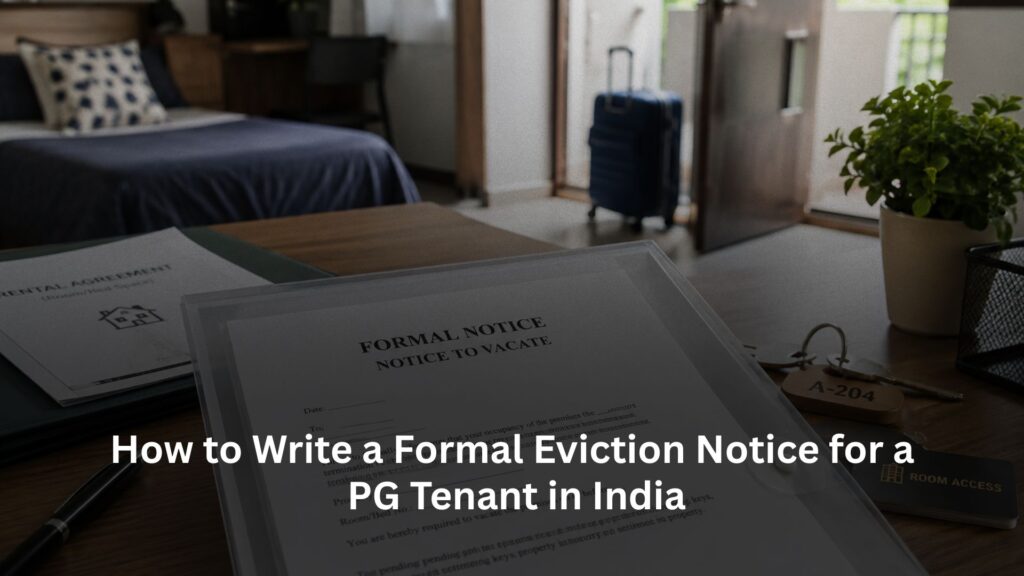
How to Write a Formal Eviction Notice for a PG Tenant in India
As a PG owner, asking a tenant to vacate is rarely a decision you take casually. A tenant may have repeatedly delayed rent, violated property rules, caused serious disturbances, damaged the property, or simply reached the end of an agreement that you do not want to renew.
The difficult part is not always deciding that the tenancy needs to end. It is handling the process correctly once that decision has been made.
A verbal warning may be enough to resolve a minor issue, but when a tenant actually needs to vacate, the communication should become formal, written, and properly documented. An eviction notice creates a clear record of what the issue is, what the agreement says, what action is being requested, and by when the tenant is expected to vacate.
For PG operators, this documentation becomes particularly important because rental arrangements often include additional terms around food, utilities, shared facilities, house rules, notice periods, lock-in periods, and security deposits. A properly drafted notice brings these details together instead of leaving the entire conversation to phone calls and WhatsApp messages.
If you are also dealing with tenants who repeatedly delay payments, you may find our guide on How to Deal with Tenants Who Pay Late Every Single Month useful for understanding when payment delays need to move from informal reminders to a more structured process.
If you are looking for a formal eviction notice format for a PG tenant in India, this guide explains what to include, how to structure the notice, and what to avoid before sending it.
When Should a PG Owner Send an Eviction Notice?
An eviction notice should not be treated as the first response to every tenant complaint.
In many cases, a property manager can resolve the problem through a reminder, warning, discussion, or written communication. However, when the issue continues or the agreement provides a valid ground for ending the occupancy, a formal notice may become necessary.
Common situations can include:
- Repeated non-payment of rent: If a tenant continues to leave rent or other agreed charges unpaid despite reminders or demands, the owner may need to move from informal follow-ups to formal written communication.
- Serious or repeated rule violations: PG agreements may contain rules relating to guests, property use, prohibited activities, noise, or conduct. Repeated violations should be documented before stronger action is taken.
- Damage or misuse of the property: Significant damage to rooms, furniture, appliances, or common facilities may become a ground for action when it breaches the agreement or applicable rules.
- Behaviour affecting other residents: Repeated disturbances, harassment, threats, or conduct that materially affects other occupants can create a situation where continuing the arrangement becomes difficult.
- End of the agreed occupancy period: In some cases, the issue is not misconduct at all. The agreement may simply be ending and the owner may choose not to renew it, subject to the applicable terms and law.
The important point is that the reason for asking a tenant to vacate should be connected to the agreement and the applicable legal framework. A notice should not be written simply because the owner is unhappy with a tenant.


What Should You Check Before Writing the Notice?
Before drafting an eviction notice, go back to the documents.
This is one of the simplest steps, but it is also one of the most commonly skipped. PG operators sometimes remember the agreement differently from the tenant, particularly when an arrangement has been running for several months.
Check the signed agreement and identify the clauses relating to:
- Tenancy or occupancy duration: Confirm whether the agreed period has ended or is still running.
- Notice period: Check how much advance notice is required and whether the agreement specifies a particular method for giving notice.
- Lock-in period: If there is a lock-in clause, understand whether the tenant is still within that period and what the agreement says about early termination.
- Grounds for termination: Review the specific situations in which the agreement allows termination or requires corrective action.
- Rent and other dues: Verify the actual outstanding amount rather than relying on an estimate.
- Security deposit: Check the agreed terms for deductions and final settlement.
- Move-out requirements: Review any conditions around room inspection, keys, belongings, utilities, or final handover.
This is also why maintaining a proper PG rental agreement matters. A strong agreement gives you something concrete to refer back to when an exit becomes complicated.
Eviction Notice vs. Notice Period: Are They the Same?
No.
A notice period is generally the advance period provided under an agreement or applicable law before an occupant is required or entitled to vacate. An eviction notice, on the other hand, is a formal communication that asks the tenant to vacate based on the circumstances and applicable terms.
The two can overlap, but they should not automatically be treated as identical.
For example, an agreement may contain a 30-day notice requirement. If an owner is terminating the arrangement for a permitted reason, the notice may need to provide the applicable period or follow a different procedure depending on the circumstances.
The exact legal requirement cannot be decided simply by using a standard “30-day eviction notice” format. Section 106 of the Transfer of Property Act contains default notice rules for certain leases when there is no contrary contract, local law, or usage, and it also requires notice to be in writing and properly delivered. State-specific tenancy laws can create additional requirements.
For a practical understanding of notice management inside a PG, you can also refer to RentOk’s guide on How to Handle Notice Period in PG Business.
What Should an Eviction Notice Include?
A formal notice should be specific enough that there is little room for confusion.
Avoid writing something as vague as:
“You have broken the rules. Please vacate the PG.”
That may communicate your intention, but it does not create a useful record of what actually happened.
A properly structured notice should generally contain the following information:
- Date of the notice: Clearly mention when the notice is being issued. This becomes important when calculating timelines and maintaining the sequence of events.
- Tenant details: Include the tenant’s full name, room or bed number, and other identifying details relevant to the occupancy arrangement.
- Property details: Mention the PG or property name and address so that there is no ambiguity about the premises involved.
- Reason for termination: State the relevant reason factually and briefly, referring to the applicable agreement clause where appropriate.
- Relevant dues or violations: If unpaid rent, damages, or repeated violations are involved, mention the relevant details instead of making broad accusations.
- Vacating date: Clearly state the date by which the tenant is required to vacate, subject to the applicable agreement and law.
- Handover instructions: Mention the expected process for handing over keys, belongings, room access, and other property-related items.
- Settlement information: Explain how pending dues, utilities, damages, or security deposit adjustments will be handled according to the agreement.
- Contact details: Provide a clear point of contact for questions or arrangements related to the move-out.
The objective is simple: the tenant should be able to read the notice and understand why it was issued, what happens next, and what they are expected to do.

Formal Eviction Notice for a PG Tenant
The following format may be used as a starting point for a PG-specific notice to vacate. It should be adapted to the actual occupancy agreement and applicable law rather than copied without modification.
Formal Notice to Vacate / Termination of PG Occupancy
Date: [DD/MM/YYYY]
To:
[Tenant Full Name]
Room/Bed No.: [Room/Bed Number]
[PG/Property Name]
[Property Address]
Subject: Notice for Termination of PG Occupancy and Vacation of Premises
Dear [Tenant Name],
This is to formally notify you that your occupancy at [PG/Property Name] is being terminated in accordance with the applicable terms of your occupancy agreement dated [Agreement Date].
Reason for Notice
The notice is being issued for the following reason:
[Clearly state the applicable reason, such as repeated non-payment of agreed rent, repeated violation of documented property rules, expiry or non-renewal of the agreed occupancy period, or another valid contractual reason.]
Vacating the Premises
In accordance with the applicable agreement and notice requirements, you are required to vacate the occupied premises on or before [Final Vacating Date], subject to applicable law.
Move-Out Requirements
Before vacating, please ensure that:
- All pending rent, utility charges, and other agreed dues are settled, as applicable.
- The room and property items provided to you are returned in the agreed condition, subject to normal wear and tear.
- All keys, access cards, and other property items are handed over to management.
- All personal belongings are removed from the premises by the agreed move-out date.
- The final room inspection and handover process is completed with the property management team.
Security Deposit and Final Settlement
Any security deposit or other refundable amount will be processed in accordance with the applicable agreement, after accounting for outstanding dues, damages, or other permitted adjustments.
Handover and Cooperation
You are requested to cooperate with the management during the move-out, inspection, and final settlement process.
For [PG/Property Name]
[Owner/Authorized Representative Name]
Contact: [Contact Number]
Email: [Email Address, if applicable]
Signature: __________________
Important Note: This format provides a general structure for a formal PG occupancy termination notice. The notice should comply with the occupancy agreement and local law. Check the notice period, grounds for termination, and required procedure before issuing it.
How Should You Write the Reason for Eviction?
This is where many notices become unnecessarily aggressive.
An eviction notice should remain factual and professional. Avoid including emotional details or a lengthy account of past disagreements with the tenant. If there have been ten arguments over the last three months, the notice does not need to describe all ten.
Instead, focus on verifiable facts.
For example, instead of writing:
“You are a very difficult tenant and have continuously created problems for everyone.”
A more professional approach would be:
“Despite previous written reminders dated [dates], the agreed rent amount of ₹[amount] remains outstanding as of [date].”
If the issue involves repeated rule violations, identify the relevant rule. List the documented instances clearly. Avoid insulting or exaggerated language.
A strong notice should present the facts clearly. Someone reading it later should understand the situation without hearing the owner’s side first.
That is one reason documentation matters so much in rental operations.
Why Documentation Matters Before and After the Notice
The eviction notice is only one document in the entire process.
If the matter becomes disputed, the owner may need to show what happened before the notice was issued. This could include the signed agreement, rent records, written warnings, payment reminders, complaint records, photographs, inspection reports, or previous communications.
A simple timeline can make the entire situation easier to understand:
Agreement signed → Issue occurs → Warning/reminder → Continued violation → Formal notice → Notice period → Move-out → Final settlement
Maintaining this sequence helps prevent a situation where the owner remembers one version of events and the tenant presents another.
RentOk’s existing guide on How to Handle Tenant Evictions Professionally also covers the importance of written notices, payment records, agreements, and move-out documentation when managing an eviction.
How Should You Deliver the Eviction Notice?
Writing the notice is only part of the process. You should also consider how the notice is served and whether you can later establish that the tenant received it.
The appropriate method can depend on the agreement and applicable law. Section 106 of the Transfer of Property Act, for example, specifies written notice and provides methods including post, personal delivery, and certain circumstances involving delivery to family or servants or affixing the notice at the property.
For a PG operator, the practical lesson is straightforward: do not depend entirely on a verbal conversation.
Keep a copy of the notice and maintain evidence of the method and date of delivery. If the notice is also communicated digitally, preserve that communication as part of the property’s records, while following any formal service requirements that apply to the situation.
If the tenant disputes receiving the notice later, having a proper record becomes significantly more useful than saying, “I told them about it on the phone.”
What Should PG Owners Avoid During an Eviction?
A formal process can quickly become messy when owners try to force the outcome themselves.
Avoid changing locks, removing belongings, cutting essential services, threatening the tenant, or using intimidation as a substitute for the legal process. Whether any particular action is permissible depends on the circumstances and applicable law, so owners should not assume that a tenant loses all rights simply because the owner has issued a notice.
The safer approach is to keep the process documented and follow the agreement and applicable legal procedure.
Also avoid making promises about the security deposit during an argument. If deductions are permitted, calculate them based on the agreement and actual records rather than deciding an amount emotionally.
A professional exit protects the property owner’s position while also reducing unnecessary escalation.
What Happens After the Tenant Receives the Notice?
Once the notice has been issued, the operator’s work does not end.
The next stage should be managed as an organised move-out process. The owner should know the expected exit date, the room that will become vacant, the pending financial obligations, and the steps required before the room can be offered to another tenant.
Before final settlement, operators should generally verify:
- Outstanding rent and utility charges: Confirm the actual balance using payment records rather than estimates or memory.
- Room condition: Conduct an appropriate inspection and document any damage that goes beyond normal wear and tear.
- Property items: Check keys, furniture, appliances, access cards, and other items provided as part of the occupancy.
- Final meter readings: Where utilities are separately charged, record the relevant readings before closing the account.
- Security deposit: Calculate the refundable amount and any permitted deductions according to the agreement.
- Move-out records: Preserve the final settlement, handover confirmation, and relevant tenant documentation.
For more on this part of the process, RentOk’s guide to tracking security deposits in PGs explains why maintaining clear records around dues, damages, notice periods, and final refunds matters.

How RentOk Helps PG Owners Manage Tenant Agreements and Exits
Writing the notice is one task. Managing everything behind that notice is where PG operations can become complicated.
RentOk helps PG and hostel operators keep important tenant information organised through a centralised property management system. Agreement records, tenant details, payment history, dues, occupancy information, and move-in or move-out workflows can be managed without depending entirely on scattered spreadsheets, paper files, and old WhatsApp conversations.
This becomes particularly useful when a property has dozens or hundreds of tenants and the owner needs to quickly verify an agreement, check payment history, review tenant details, or manage the move-out process. RentOk’s agreement and tenant-management features can help operators maintain better documentation and visibility across their property operations.
Final Thoughts
A formal eviction notice is only one part of managing a tenant exit professionally. The process starts much earlier with a clear rental agreement, properly documented terms, and transparent communication around notice periods, dues, deposits, and move-out conditions.
For PG owners, having these details properly documented can make difficult tenant situations much easier to manage. Instead of relying on verbal commitments or scattered records, a well-structured Rent Agreement gives both the property owner and tenant a clear reference point throughout the occupancy.
If you want to simplify tenant documentation and manage your rental agreements more efficiently, explore RentOk’s Rent Agreement feature and book a demo to see how it can fit into your PG management workflow.
FAQ’S
1. Can a PG tenant challenge an eviction notice?
Yes. A tenant may dispute a notice if they believe it was issued without a valid basis, violates the agreement, or does not follow the applicable legal process. The owner should therefore keep the agreement, payment records, previous communications, and other relevant documentation properly maintained.
2. What happens if a PG tenant refuses to vacate after receiving the notice?
If the tenant does not vacate after the applicable notice period, the owner should avoid taking forceful or self-help measures. The appropriate next step depends on the agreement and applicable law, and professional legal advice may be necessary before starting further proceedings.
3. Can a PG owner evict a tenant without a written agreement?
The absence of a written agreement does not automatically mean that the occupant has no legal protections or that the owner can remove them immediately. The nature of the occupancy, payment records, communications, and applicable state or local laws can all affect how the situation should be handled.
4. Is police intervention required for a PG eviction?
Police involvement is not automatically required simply because a PG owner has issued an eviction notice. If the situation becomes disputed or involves threats, violence, trespassing, or another legal issue, the appropriate authorities or legal professionals may need to be involved based on the circumstances.
5. Can an eviction notice include outstanding rent and other dues?
Yes, the notice can clearly mention outstanding amounts when they are relevant to the reason for termination or the final settlement. The figures should be supported by payment records and should distinguish between rent, utilities, damages, and other charges wherever applicable.
6. Should an eviction notice be sent separately to each tenant?
Yes. When the occupancy agreements are individual, the notice should generally identify the specific tenant and their room or bed details rather than issuing one vague notice to an entire property. This helps maintain clear documentation and avoids confusion about who the notice applies to.