
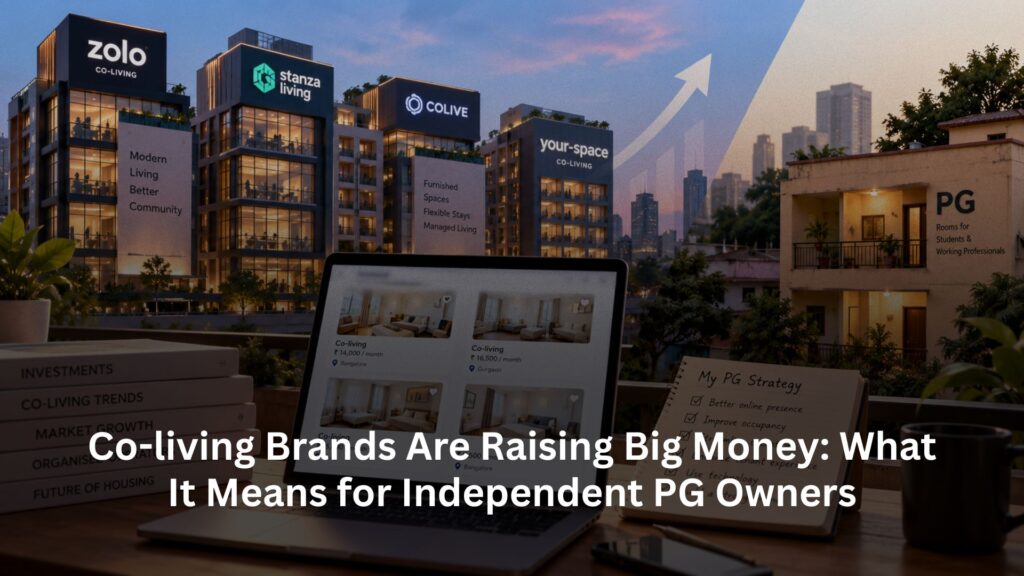
Co-living Brands Are Raising Big Money: What It Means for Independent PG Owners
India’s co-living market is attracting investor interest as more students and working professionals look for convenient, managed accommodation. Organised operators are investing in branding, technology, tenant services, and property expansion, changing what people expect from shared living.
For independent PG owners, this presents both competition and opportunity. Large brands may have bigger marketing budgets, but local owners can compete through better service, neighbourhood knowledge, and efficient operations. Understanding the difference between these business models can help you decide how to position your property and grow sustainably.
Co-living vs PG vs PG Brand: What’s the Difference?
Although these terms are often used interchangeably, they describe different aspects of the accommodation business.
| Term | What it means | Typical characteristics |
|---|---|---|
| PG accommodation | A shared-living arrangement where tenants rent a bed or room, often with meals or basic services | Local operations, room or bed-based pricing, shared facilities |
| Co-living | A managed accommodation model designed around shared spaces and a convenient living experience | Furnished rooms, common areas, structured services, and digital processes |
| PG brand | A PG business with a recognisable identity and consistent service standards | Professional listings, clear policies, reliable communication, and repeatable processes |
The distinction is not absolute. A PG can offer co-living-style amenities, and an independent owner can build a recognisable brand without operating multiple properties. Likewise, not every co-living operator follows the same service model.
The real difference lies in how the business is positioned and managed. A traditional PG may depend heavily on the owner’s personal involvement, while an organised operator generally aims to establish processes that can work consistently across properties.
An independent PG owner does not need to become a large co-living company to build a professional brand. The opportunity is to adopt the practices that improve tenant trust, occupancy, and profitability while retaining the flexibility of an independent business.
How Big Is the Co-living Market in India?
India’s organised co-living sector has significant room to grow. According to a May 2025 report by Colliers, the country had an estimated demand for 6.6 million co-living beds, while organised inventory stood at approximately 300,000 beds. The report projected that organised inventory could approach one million beds by 2030.
These figures suggest a substantial gap between potential demand and organised supply. However, projections are not guarantees, and actual growth will depend on affordability, property economics, tenant preferences, and the ability of operators to expand sustainably.
Several factors are contributing to the sector’s growth:
- Urban migration: Students and professionals continue to move to cities for education and employment, creating demand for accommodation close to campuses, offices, and transport links.
- Convenience: Furnished rooms, shared amenities, and managed services can reduce the effort involved in finding and setting up a place to live.
- Changing tenant expectations: Prospective residents increasingly compare properties online and consider cleanliness, safety, maintenance, and communication alongside rent.
- Investor interest: Capital can help organised operators expand their property networks, invest in marketing, and develop more structured management systems.
- Professional property management: Owners and operators are looking for ways to manage growing tenant numbers without relying entirely on manual processes.
For independent PG owners, the important takeaway is that organised accommodation is becoming more visible and competitive. This does not mean every tenant prefers a national brand. It means that property presentation, reliable service, and operational efficiency are becoming increasingly important.


Why Are Co-living Companies India Investors Interested In Attracting?
Investment in co-living is not simply about building more rooms. Investors and operators are looking at whether shared accommodation can become a repeatable business model with predictable demand, efficient operations, and sustainable returns.
1. A Large, Fragmented Market
A considerable part of India’s shared accommodation market consists of independent PGs, hostels, and smaller property operators. These businesses serve genuine local demand, but their service standards and management practices can vary widely.
Organised operators see an opportunity to introduce more consistent booking processes, standardised amenities, digital payments, and centralised property management. If they can deliver these services profitably, they may be able to expand across multiple locations.
2. Recurring Rental Revenue
Accommodation businesses can generate recurring monthly revenue from occupied beds or rooms. However, predictable revenue depends on more than the number of beds available. Vacancy periods, delayed payments, maintenance costs, and tenant turnover all affect profitability.
This is why operational discipline matters. Owners who want to understand their own business economics can read RentOk’s guide on how to increase profit in a PG business.
3. Opportunities to Improve Property Operations
Technology can help operators manage rent collection, tenant records, occupancy, maintenance, and expenses across several properties. These systems become particularly valuable when a business grows beyond the point where the owner can personally track every activity.
The same principle applies to independent PGs. Better systems can help owners improve visibility and reduce avoidable errors without needing the scale or investment of a large company.
4. A More Structured Tenant Experience
Tenants may prefer accommodation where prices, amenities, rules, and payment terms are communicated clearly. A reliable complaint process and organised move-in experience can also make a property feel more trustworthy.
This creates an opportunity for operators that can deliver a consistent experience rather than competing only on rent.
Where Co-living Brands Have an Advantage Over Independent PGs
Organised co-living brands have several advantages that can make it difficult for smaller operators to compete if they continue using informal processes.
1. Branding and Online Visibility
Established brands often invest in professional websites, property listings, digital advertising, and social media. Prospective tenants can discover their properties and compare available options before arranging a visit.
Independent PGs may offer comparable accommodation but lose enquiries because their online information is incomplete, their photographs are outdated, or their pricing is unclear.
The solution is to make your property easy to discover and evaluate. Use genuine photographs, list amenities accurately, communicate rent and deposit requirements clearly, and respond promptly to enquiries.
For practical ideas, explore RentOk’s guide on how to improve occupancy rate in a PG.
2. Standardised Service
Organised operators generally aim to maintain consistent standards across their properties. Tenants may expect a similar process for payments, maintenance requests, housekeeping, and complaint resolution at different locations.
Independent owners can face difficulties when every task depends on memory or individual staff members. A maintenance request might be resolved quickly one week but forgotten the next.
Creating documented procedures for routine tasks can make a significant difference. The goal is not to make every PG identical, but to ensure that tenants receive dependable service.
3. Technology and Operational Efficiency
Larger operators may use integrated systems to manage tenant information, rent collection, occupancy, maintenance, and reporting. These systems help them coordinate work across locations.
Smaller owners often rely on spreadsheets, notebooks, bank statements, and WhatsApp conversations. This may work at a small scale, but it becomes harder to maintain accurate records as tenant numbers increase.
RentOk’s guide on how to automate PG management completely explains how structured systems can reduce manual follow-ups and operational dependency.
4. Marketing Resources
Large brands may have dedicated marketing teams, centralised enquiry management, and the budget to promote multiple properties. Independent owners typically depend more on referrals, local brokers, property listings, and word of mouth.
However, a large marketing budget is not the only route to visibility. Local search listings, tenant reviews, useful property photographs, and clear communication can help independent owners reach prospective residents in their target neighbourhood.
5. Documented Processes
A growing accommodation business needs clear procedures for rent collection, tenant onboarding, maintenance, deposits, and move-outs. Informal arrangements become harder to manage as more people and properties are involved.
Independent owners can adopt the same discipline without creating complicated systems. Documented processes make it easier to delegate work, resolve disputes, and maintain service quality when the owner is unavailable.
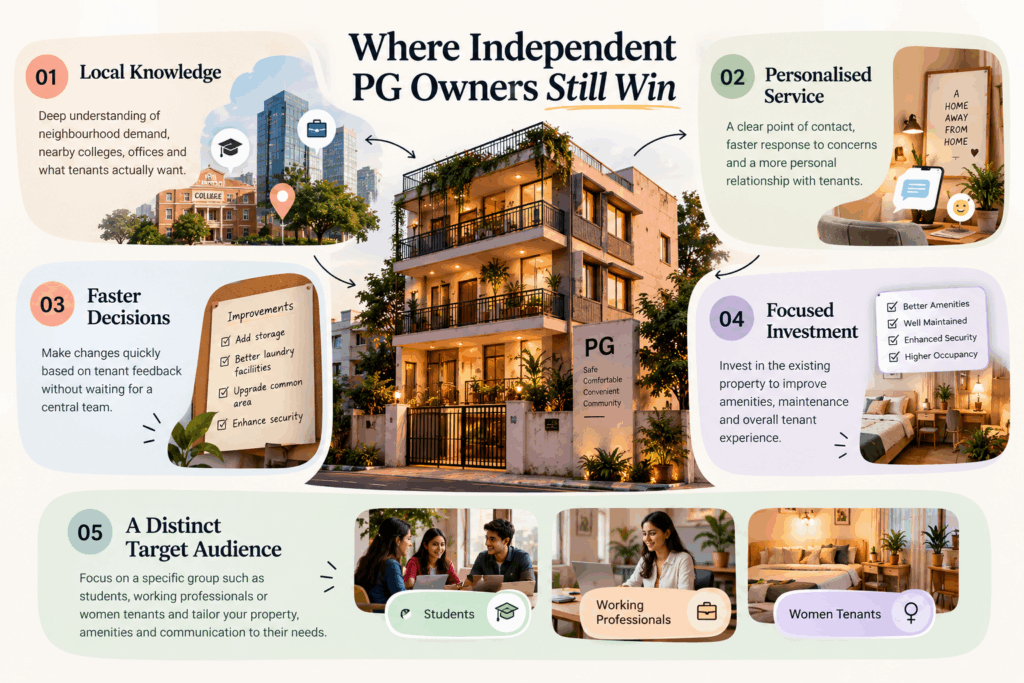
Where Independent PG Owners Still Win
Despite the growth of organised operators, independent PG owners have several strengths that can help them compete.
1. Local Knowledge
An owner who has operated in the same neighbourhood for years may understand local demand better than a company entering the area for the first time. They may know which colleges attract students, which offices bring working professionals, and which amenities tenants value most.
For example, a PG near a university may benefit from reliable Wi-Fi, study-friendly common areas, and affordable meals. A property near an office district may attract working professionals by offering convenient transport access and a quiet environment.
Local knowledge becomes a competitive advantage when owners use it to make better decisions about pricing, amenities, and marketing.
2. Personalised Service
Tenants may appreciate having a clear point of contact who understands their concerns and can make decisions quickly. An owner who responds promptly to a maintenance issue or communicates a resolution clearly can build trust and encourage tenants to stay longer.
Personalised service does not mean unlimited availability or inconsistent rules. It means treating tenants fairly, setting clear expectations, and following through on commitments.
3. Faster Decisions
Independent owners can often make changes without waiting for approval from a central team. If tenants repeatedly request additional storage, better laundry facilities, or improvements to common areas, the owner can evaluate the cost and implement practical solutions.
This flexibility can also help owners respond to local competition by adjusting room offerings or improving amenities. Decisions should still be based on tenant needs and financial viability rather than reacting to every request.
4. Focused Investment
An independent owner can concentrate resources on the property they already operate instead of funding expansion across multiple cities.
Upgrading bathrooms, improving ventilation, maintaining appliances, enhancing security, or improving the move-in process can make the property more attractive to tenants.
These improvements may be less visible than a national marketing campaign, but they can directly influence tenant satisfaction, referrals, and occupancy.
5. A Distinct Target Audience
Independent PG owners do not need to appeal to everyone. A clear niche can make a property easier to market.
An owner might focus on women professionals, students from a particular university, budget-conscious tenants, or working professionals seeking a quieter environment. The property’s amenities, pricing, and communication can then reflect the needs of that audience.
Instead of competing with a large brand on every feature, the owner can become a preferred option for a specific group of tenants.

Should Independent PG Owners Partner With Co-living Companies or Compete?
There is no single answer for every property owner. Some may benefit from working with an established operator, while others may be better off retaining control and building their own brand.
The decision should begin with a clear understanding of what the owner wants: predictable income, higher potential returns, less day-to-day involvement, or long-term control over the property.
When a Partnership May Make Sense
A partnership may be worth exploring when an owner has a suitable property but lacks the time, expertise, or resources to manage and market it effectively.
Depending on the agreement, an operator may handle marketing, tenant acquisition, property management, or the overall living experience. Some arrangements involve leasing the property, while others involve managing it on the owner’s behalf.
Before signing, owners should examine:
- Commercial terms: Understand the rent or revenue-sharing structure, payment schedule, deposit requirements, and responsibility for operating expenses.
- Property upkeep: Clarify who pays for repairs, furnishings, renovations, and replacements.
- Revenue risk: Determine whether income is fixed, variable, or linked to actual occupancy.
- Property control: Check who sets prices, approves tenants, and decides how the property can be used.
- Exit conditions: Review the agreement’s duration, termination clauses, handover requirements, and end-of-contract obligations.
A partnership can reduce the owner’s operational burden, but it does not guarantee higher income or eliminate risk. The agreement should be assessed on its actual economics and legal terms.
When Competing Independently Makes More Sense
Retaining independent operations may be preferable when the owner has a strong local reputation, understands the target market, and can manage the property profitably.
It can also suit owners who want control over tenant selection, pricing, service standards, and the property’s long-term direction.
However, staying independent should not mean remaining dependent on manual processes. Owners can build a more professional business by improving marketing, documenting operating procedures, tracking financial performance, and using technology to manage daily tasks.
Partnership is a business decision, not a measure of success. The right approach depends on the owner’s goals, property economics, and ability to deliver a dependable tenant experience.
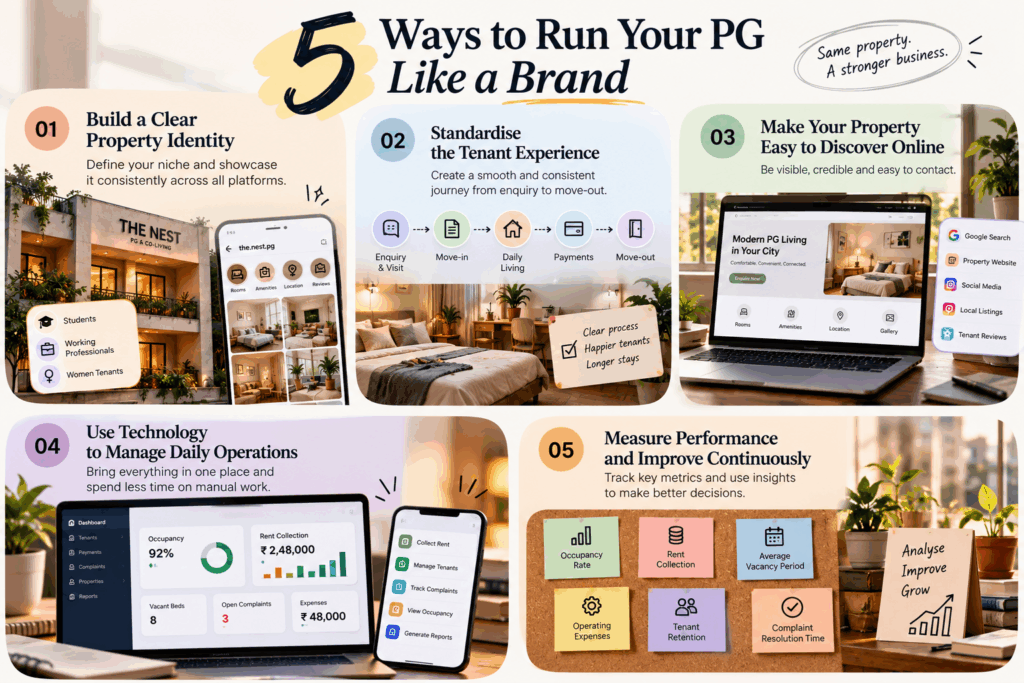
5 Ways to Run Your PG Like a Brand
You do not need multiple properties or a large investment to create a professional PG business. You need consistent standards, clear communication, and systems that help tenants trust your property.
1. Build a Clear Property Identity
Start by deciding what your PG stands for. Is it affordable accommodation for students, a comfortable stay for working professionals, or a secure and well-maintained home for women?
Once you identify your target audience, make sure your property listing communicates that positioning clearly. Use good photographs, accurate room descriptions, transparent pricing, and a complete list of amenities.
Keep the property name, contact details, and visual identity consistent across relevant online listings and social media profiles. This makes the property easier to recognise and helps prospective tenants distinguish it from competing options.
You do not need an elaborate brand campaign. You need accurate information and a credible first impression.
2. Standardise the Tenant Experience
Create a simple process for every major stage of the tenant journey, from the first enquiry to move-out.
Your process should cover:
- Enquiries and visits: Respond promptly, share accurate details, and make property visits easy to arrange.
- Move-in: Record tenant details, explain house rules, document the room’s condition, and clarify payment terms.
- Daily living: Establish clear processes for housekeeping, maintenance, complaints, and common-area use.
- Payments: Communicate rent due dates, accepted payment methods, and applicable charges.
- Move-out: Document the handover, check for outstanding dues, and explain any proposed deposit deductions.
Documenting these procedures helps ensure that tenants receive consistent service even when the owner is busy or staff members change.
3. Make Your Property Easy to Discover Online
Tenants often compare several accommodation options before booking a visit. If your PG has incomplete listings, outdated photographs, or unclear pricing, prospective tenants may move on before contacting you.
Improve your online presence by keeping property information updated, sharing genuine photographs, responding to reviews, and making it easy for interested tenants to contact you.
You can also create a simple property website that brings together your room options, amenities, location, contact information, and enquiry details. This gives prospective tenants one place to understand what you offer.
Track where enquiries come from, too. Knowing whether tenants discover you through referrals, local listings, social media, or your website helps you focus your marketing efforts on the channels that work.
4. Use Technology to Manage Daily Operations
A growing PG business involves more than collecting rent. Owners need to track occupancy, maintain tenant records, follow up on payments, handle complaints, manage expenses, and coordinate property-level tasks.
When these activities are spread across notebooks, spreadsheets, and chat messages, important information can become difficult to retrieve.
A digital management system can bring key tasks into one place and reduce dependence on manual follow-ups. Look for tools that help you track rent collection and expenses, maintain tenant and property records, monitor vacant beds, and record complaints until they are resolved.
The objective is not to use technology for its own sake. It is to spend less time chasing information and more time improving the business.
5. Measure Performance and Improve Continuously
Professional operators do not rely only on the number of occupied beds to judge performance. Independent owners should review a few useful indicators regularly, too.
| Metric | What it tells you |
|---|---|
| Occupancy rate | How much of your available capacity is occupied |
| Rent collection rate | How much of the rent due has actually been collected |
| Average vacancy period | How long beds typically remain unoccupied between tenants |
| Operating expenses | How much it costs to run and maintain the property |
| Tenant retention | Whether tenants choose to continue staying at your property |
| Complaint resolution time | How quickly issues are addressed |
Reviewing these figures can reveal problems before they become expensive. Recurring vacancies may point to pricing or marketing issues, while rising maintenance expenses may indicate that certain repairs should be addressed earlier.
You can also collect tenant feedback periodically. Ask what is working, what needs improvement, and which amenities matter most. Use that information to prioritise changes that improve the living experience without putting unnecessary pressure on margins.
How RentOk Helps Independent PG Owners Run Their Business Like a Brand
Building a professional PG business becomes easier when daily operations are organised. RentOk helps PG, hostel, and co-living operators manage key property activities through a connected platform, so owners can spend less time coordinating routine tasks manually.
With RentOk, owners can manage important parts of their operations, including:
- Rent collection and financial tracking: Monitor collections, outstanding dues, and expenses to maintain better visibility into property performance.
- Tenant and property management: Keep tenant, bed, and property information organised as the business grows.
- Occupancy insights: Understand vacancies and occupancy across properties to support better planning and follow-ups.
- Complaint management: Record tenant complaints, assign responsibility, and track resolution instead of relying on scattered messages.
- Property marketing tools: Create a property website and use marketing materials to present your accommodation more professionally.
- Reviews and feedback: Gather tenant feedback and review responses to identify areas that need attention.
RentOk also includes Rio, its AI assistant, which helps owners access operational information by asking questions conversationally. Owners can ask about details such as vacant beds and occupancy instead of searching through multiple records.
These capabilities can help independent owners build more consistent processes, improve visibility into their business, and deliver a more organised tenant experience without replicating the size of a national co-living company.
The aim is simple: make your PG easier to manage, easier to trust, and better prepared to grow.
Conclusion: You Don’t Need to Be a Big Brand to Run a Better PG
The growth of organised co-living in India is changing tenant expectations, but independent PG owners still have opportunities to compete. Large brands may have stronger marketing budgets and broader networks, yet local owners can stand out through neighbourhood expertise, personalised service, flexible decisions, and focused investments.
The real opportunity is to adopt the best practices of organised operators and adapt them to your own business. Build a recognisable identity, standardise the tenant experience, improve online visibility, track performance, and use technology to simplify daily operations. You can create a more professional accommodation business without expanding across multiple cities or making unnecessary investments.
Run your PG like a brand with RentOk.
FAQ’S
1. What is the difference between co-living and a traditional PG?
A traditional PG typically offers a room or bed with basic facilities, while co-living often focuses on furnished accommodation, shared amenities, and managed services. However, the two models can overlap depending on the property and services offered.
2. Can an independent PG owner build their own brand?
Yes, independent PG owners can build a recognisable brand through consistent service, professional property listings, clear pricing, and reliable communication. A strong local reputation can help attract tenants without requiring expansion across multiple cities.
3. Is investing in co-living property profitable in India?
Profitability depends on factors such as location, occupancy, rental income, operating expenses, maintenance costs, and tenant demand. Owners should evaluate the property’s financial viability before investing in furnishings, renovations, or additional facilities.
4. How can independent PG owners compete with large co-living companies?
Independent owners can compete by understanding local tenant preferences, offering personalised service, responding quickly to concerns, and maintaining their properties well. Improving online visibility and streamlining daily operations can also help them attract and retain tenants.
5. What amenities do tenants look for in co-living spaces and PGs?
Tenants commonly look for clean rooms, reliable Wi-Fi, security, convenient locations, well-maintained shared spaces, and responsive maintenance. The most important amenities vary according to the target audience, location, and rental budget.
6. How can technology help independent PG owners manage their properties?
Property management software can help owners track rent collection, occupancy, tenant records, expenses, and maintenance complaints in one place. These tools reduce manual follow-ups and provide better visibility into day-to-day operations and business performance.