
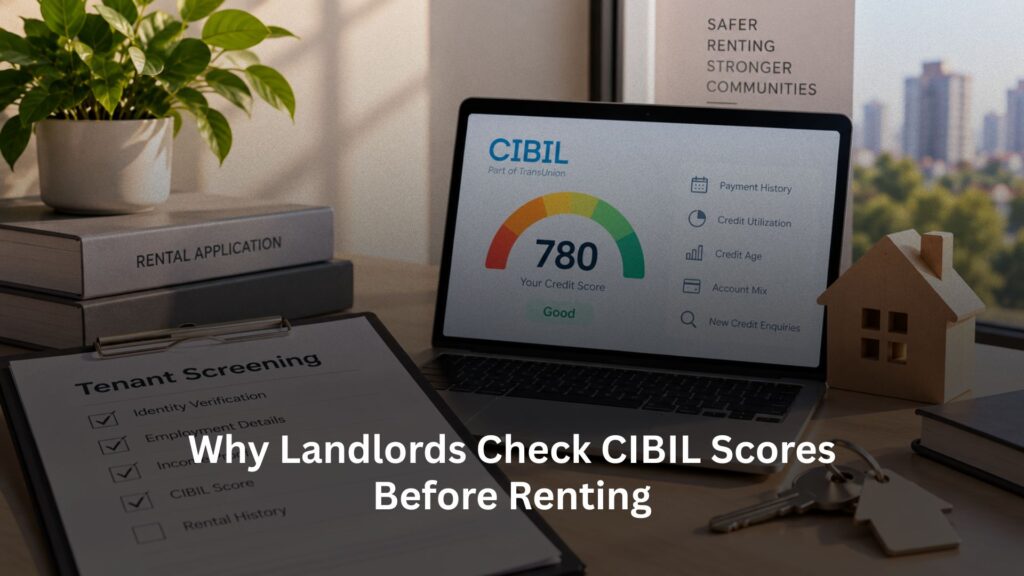
Why Landlords Check CIBIL Scores Before Renting
Renting a home in a major Indian city has become more than a simple exchange between a landlord and a tenant. Rising rental costs, security deposits, relocation expenses, and regular payment commitments have made financial reliability an important consideration for property owners.
Traditionally, landlords relied on identity documents, employment details, personal references, and police verification before approving a tenant. Now, some owners are exploring another screening tool: the tenant’s CIBIL score.
A CIBIL score is generally associated with loan repayments, credit cards, and other borrowing activities. It helps lenders understand an individual’s credit behaviour. Some landlords are beginning to consider this information when assessing a prospective tenant’s financial profile.
This practice has attracted attention in rental markets such as Mumbai, Bengaluru, and Delhi. These cities have large populations of working professionals, students, migrants, and first-time renters. They also have varied rental arrangements, ranging from independent apartments to PGs, hostels, and co-living spaces.
However, an important distinction must be made. There is no universally applicable CIBIL score requirement for renting a property in India. There is also no established rule stating that every landlord in these cities must check a tenant’s credit score.
Instead, CIBIL screening should be viewed as a possible addition to a broader tenant verification process. It can provide some financial context, but it cannot independently determine whether a tenant will be responsible, punctual, or suitable for a property.
The New Trend: CIBIL Checks Before Renting
CIBIL checks are traditionally linked to financial institutions. Banks and lenders use credit information to assess borrowing behaviour and repayment patterns. In rental housing, however, the purpose is different.
A landlord is not issuing a loan. The owner is entering into an arrangement that involves recurring payments, property access, and contractual responsibilities. Therefore, credit information may offer one additional reference point, but it does not answer every question related to tenancy.
For example, a tenant may have a strong credit score but still delay rent payments because of irregular income. Another tenant may have a limited credit history because they are a student or a first-time earner. Neither situation can be understood through a score alone.
This is why property owners should avoid treating CIBIL screening as a replacement for standard verification. A better approach is to combine relevant financial information with identity checks, rental references, and clearly documented rental terms.
A complete screening process may include:
- Identity verification: Confirming the tenant’s name, contact details, address, and submitted identity documents before the tenancy begins.
- Financial assessment: Understanding the applicant’s income source, payment capacity, and ability to manage the agreed rent and deposit.
- Credit information: Considering a CIBIL score or credit report only when it is relevant, appropriately obtained, and handled with care.
- Rental references: Reviewing previous rental information, where relevant, to understand the applicant’s tenancy history.
- Agreement clarity: Explaining rent, deposit, notice period, lock-in conditions, and other responsibilities before signing the agreement.
This approach creates a more balanced decision-making process. It also prevents one numerical indicator from becoming the entire basis of tenant selection.


Why Are Landlords Looking at Credit History?
The interest in credit history is closely connected to the financial risks of rental operations. For a landlord, delayed rent is not always an isolated problem. It can affect loan repayments, maintenance budgets, utility payments, and other property-related expenses.
The impact can become more significant for PG and co-living operators. These businesses manage multiple tenants, rooms, payment schedules, and operational expenses. Even a small number of delayed payments can create additional administrative work.
A credit score may appear useful because it provides information about an individual’s previous credit behaviour. However, owners must understand the limits of that information before using it in rental decisions.
Credit history can provide context
A credit report may contain information about repayment history, credit accounts, outstanding balances, and credit utilisation. These details can help explain how an individual has managed formal credit obligations.
They do not directly establish whether the person will:
- Pay rent on the agreed date.
- Follow the property’s rules.
- Maintain shared spaces responsibly.
- Communicate with the management team.
- Report maintenance issues on time.
- Respect other residents and neighbours.
These behaviours are important in rental housing, particularly in shared accommodation. A credit score cannot measure all of them.
Landlords should therefore use credit information as one part of their assessment. It should support a broader process instead of replacing practical checks and direct communication.
Rental costs require greater financial clarity
Renting in a large city often involves several expenses beyond monthly rent. Tenants may need to pay a security deposit, brokerage, moving costs, utility charges, and furnishing expenses. For students and working professionals, these costs can place pressure on their monthly budgets.
A landlord may want to understand whether the applicant has planned for these commitments. The tenant, meanwhile, should have a clear understanding of the total cost of moving into the property.
This is where transparency becomes important. A landlord should explain the rental amount, deposit, payment date, and additional charges before the tenant commits. A tenant should also ask questions when any condition is unclear.
Credit screening cannot replace this conversation. In fact, a well-explained rental agreement can prevent many misunderstandings that later become payment or deposit disputes.
For more information on preventing disagreements during tenancy, property owners can explore RentOk’s guide to managing tenant lock-in periods without conflict. The article explains why clear terms and communication matter when defining rental commitments.
What Score Ranges Do Landlords Typically Accept?
One of the most common questions about CIBIL checks is whether landlords follow a specific minimum score.
The answer is no single score applies to every rental arrangement. Individual landlords may establish their own preferences, but those preferences should not be confused with an official industry benchmark.
Some discussions mention scores such as 650, 700, or 750. These figures may be used by certain owners as informal reference points. However, they are not universal rental eligibility standards.
A tenant should not assume that a particular score guarantees approval. Similarly, a landlord should not assume that a score below a chosen threshold automatically indicates an unreliable tenant.
Why a fixed score can create problems
Credit scores must be understood in context. An individual with a limited credit history may not have enough information to generate a strong score. This can happen with students, young professionals, and people who have never used formal credit products.
A lower score may also result from a temporary financial issue. It does not necessarily provide a complete picture of the applicant’s current financial position.
Two tenants with similar scores may also have different circumstances. One may have a stable salary and manageable expenses. Another may have irregular income and significant financial obligations.
A more meaningful assessment can consider:
- Current income: The landlord may review whether the applicant has a reliable and relevant source of income or financial support.
- Payment capacity: The applicant’s ability to manage monthly rent should be considered alongside the deposit and other agreed expenses.
- Credit history: Where relevant, the credit profile may provide additional context, but it should not be the only factor.
- Rental arrangement: A shared PG room, independent flat, and premium apartment may involve different financial expectations and risks.
- Additional safeguards: Depending on the arrangement, both parties may discuss acceptable guarantor arrangements or other lawful contractual protections.
The central principle is simple: a credit score should support informed screening, not replace informed judgment.
Is It Legal for Landlords to Ask for a CIBIL Score?
Landlords may ask prospective tenants to provide financial information. However, requesting a CIBIL score does not give an owner unrestricted access to a person’s complete credit report.
Credit information contains personal financial details. Its collection, use, and disclosure are governed by applicable rules and privacy considerations. Access should follow the relevant requirements, including consent or authorisation where necessary.
The method used to obtain the information also matters. A landlord should not attempt to access a tenant’s credit report through unauthorised channels. They should also avoid collecting more information than is reasonably required for the stated purpose.
Transparency should guide the request
A tenant should know why their credit information is being requested. The landlord should be able to explain how the information will be used and who may have access to it.
A responsible request should address the following points:
- Purpose of collection: The landlord should explain whether the information is being used for financial screening or another specific rental-related reason.
- Scope of information: The owner should avoid requesting unrelated financial documents when a more limited form of information may be sufficient.
- Storage and access: Any collected report should be handled carefully and shared only with authorised individuals who need it for a legitimate purpose.
- Decision-making: A landlord should avoid presenting an informal score preference as a mandatory legal requirement.
- Consistency: Screening standards should be relevant to the tenancy and applied fairly across applicants.
The legal position may depend on the information collected, the method of access, the parties involved, and applicable regulations. Owners planning to introduce formal credit screening across several properties should seek professional legal guidance.
Credit checks should also be distinguished from tenant KYC and police verification. These processes serve different purposes and should not be treated as interchangeable.
RentOk’s guide to tenant police verification for landlords explains the role of identity documents, verification forms, and local police procedures. It also highlights why tenant verification should be handled as a defined operational process.

What Tenants Can Do to Prepare
Tenants who are asked for their CIBIL score should first understand the reason behind the request. They should not automatically assume that a limited credit history makes them unsuitable for renting.
Students, first-time earners, and individuals who have never used formal credit may not have an extensive credit profile. In such cases, other relevant information may help explain their financial position.
The exact documents required will depend on the property and the landlord’s screening process. However, tenants can take several practical steps before submitting an application.
Review your credit information
Tenants with an existing credit history can review their own credit report through an official or authorised channel. This may help them identify incorrect details, unfamiliar accounts, or information that requires attention.
Reviewing the report beforehand also allows the applicant to understand what information may appear during a screening conversation.
Tenants should avoid sending sensitive financial documents through random links or unverified channels. Before sharing a report, they can ask the landlord how it will be used and whether a score alone would be sufficient.
Prepare a complete rental profile
A tenant’s financial readiness can be explained through several relevant documents. The objective should be to provide enough information for the landlord to understand the rental arrangement without unnecessarily exposing private details.
Depending on the circumstances, the applicant may prepare:
- Employment or income information: A joining letter, salary details, or suitable income proof can help explain the source of monthly payments.
- Guarantor information: Students and first-time renters may discuss whether a parent, guardian, or other acceptable guarantor arrangement is possible.
- Previous rental references: A previous landlord or accommodation provider may help verify relevant rental history, where appropriate.
- Address details: Current and permanent addresses should be recorded accurately, particularly when the tenant has recently moved between cities.
- Payment planning: The tenant should understand the deposit, monthly rent, utility charges, and other costs before confirming the booking.
RentOk’s guide to completing tenant verification quickly as a working professional also highlights the importance of preparing documents and confirming local requirements before the move-in date.
Understand the rental agreement
A credit check should never distract tenants from reviewing the rental agreement. The agreement should clearly state the payment schedule, deposit terms, notice period, lock-in clause, maintenance responsibilities, and other relevant conditions.
Tenants should ask questions before signing. Clear communication at the beginning can reduce confusion later, especially when financial responsibilities change during the tenancy.
Credit Screening Should Not Replace Tenant Verification
CIBIL screening is only one possible part of a wider rental risk-management strategy. A landlord who focuses exclusively on credit history may overlook other information that is more directly connected to the tenancy.
For example, identity verification helps establish who the tenant is. Address details help connect the individual to their residential background. Police verification may be required under local procedures. Rental references can provide additional context about previous accommodation.
Each process answers a different question.
A well-designed tenant onboarding system should bring these steps together without treating them as one identical activity. It should also help the property team identify incomplete information before the tenant moves in.
For PG and hostel operators, this becomes especially important. A property may onboard several residents during the same week. If documents are collected through separate conversations, staff members may lose track of pending requirements.
A structured process can help the team maintain visibility over:
- Which tenant details have been collected.
- Which documents are missing or incomplete.
- Whether the required verification process has been initiated.
- Whether the rental agreement has been completed.
- Whether the tenant’s records are connected to the correct room or property.
RentOk’s guide to maintaining tenant KYC records digitally explores the challenges of storing tenant documents through scattered files, paper records, and separate messaging platforms.
Digital organisation does not remove the need for careful verification. It helps make the process more consistent and easier to monitor.
How Should Landlords Build a Responsible Screening Policy?
A screening policy should be designed around the property’s actual requirements. The process used by an individual landlord may differ from the workflow needed by a large PG or co-living operator.
Before introducing CIBIL screening, property owners should identify the purpose of the check. They should also determine what information is necessary, how it will be collected, and how the results will be documented.
A practical policy can include the following stages:
- Define the screening criteria: Establish which checks are relevant to the property and the rental arrangement.
- Communicate requirements early: Inform prospective tenants about the documents and information they may need to provide.
- Collect information responsibly: Use appropriate channels and avoid unnecessary personal data collection.
- Review information in context: Consider credit information alongside income, references, identity documents, and rental requirements.
- Maintain accurate records: Store relevant information in an organised system with controlled access.
- Review the process regularly: Check whether the screening workflow creates delays, confusion, or inconsistent decisions.
The policy should also account for applicants with limited credit histories. A first-time renter may require a different form of assessment from someone with several years of formal credit activity.
The purpose is not to make the process complicated. It is to create a screening method that is relevant, transparent, and practical for both parties.
Tenant Experience and Data Privacy Must Work Together
Tenant screening can influence the first impression a resident forms about a property. A process that is organised and clearly explained can create confidence. A process that involves repeated document requests and unclear instructions can create frustration.
This is particularly important for PGs and co-living spaces. Residents may interact with property staff before moving in, during onboarding, and throughout their stay. Every interaction contributes to their perception of the management team.
Landlords should therefore treat data privacy as part of the tenant experience. Documents should not be shared casually across staff groups or stored without a clear purpose. Information should remain connected to legitimate rental operations.
A tenant should also feel comfortable asking questions about personal data. This does not mean that every request is inappropriate. It means that the purpose and handling of the information should be explained.
RentOk’s article on how landlords should handle personal data during verification provides further context on data collection, storage, and responsible tenant verification practices.
A professional rental process protects more than the property. It also respects the personal information of the people living there.

How RentOk Helps Owners Screen Tenants
RentOk helps landlords, PG owners, and property operators organise tenant onboarding and property management through a digital platform. It brings relevant tenant information, documentation workflows, and operational records into a more structured environment.
For owners managing frequent move-ins, organised tenant records can make it easier to identify missing information and connect documentation with the correct resident or property. This reduces dependence on scattered spreadsheets, paper files, and individual WhatsApp conversations.
RentOk can also support broader rental operations through features related to tenant management, payment tracking, communication, and property records. These workflows help connect the initial onboarding process with the tenant’s ongoing experience.
However, no software can guarantee that a tenant will always pay on time or that every rental risk will disappear. Credit screening and verification still require responsible policies, accurate information, and appropriate human judgment.
The role of a digital platform is to improve visibility, consistency, and operational control. With a structured workflow, property owners can spend less time searching for records and more time managing their properties effectively.
Conclusion: Is CIBIL Screening Becoming Part of Rental Management?
The discussion around CIBIL checks reflects a wider change in rental management. Landlords are exploring additional ways to understand financial risk before entering into a tenancy agreement.
However, a CIBIL score should not become the sole measure of a tenant’s reliability. Credit history, income stability, rental references, identity verification, and agreement terms each provide different information.
For tenants, preparation means understanding their financial position, reviewing relevant credit information, and asking how their documents will be used. For landlords, the priority should be a screening process that is consistent, transparent, and connected to broader property operations.
As rental businesses become more organised, the focus should move beyond collecting documents. The real objective is to build a system that supports informed decisions, protects personal information, and creates a smoother onboarding experience.
FAQ’s
1. Can a tenant with no credit history still rent a property?
Yes, having limited or no credit history does not automatically mean a tenant is financially unreliable. Landlords can consider other factors, such as income proof, rental references, guarantor details, and payment capacity.
2. Does checking your CIBIL score reduce your credit score?
Checking your own CIBIL report is generally considered a soft inquiry and does not negatively affect your credit score. However, tenants should understand how a third party intends to access their credit information.
3. How often should tenants review their CIBIL report?
Tenants can review their credit report periodically to identify inaccurate information, unfamiliar accounts, or outdated records. Reviewing the report before a rental application may help them address potential discrepancies early.
4. What should a tenant do if their CIBIL report contains errors?
If a tenant identifies incorrect information, they should raise a dispute with the relevant credit information company or reporting institution. Supporting documents may be required to help verify and correct the information.
5. Can landlords use income proof instead of a CIBIL score?
Income proof can help landlords understand a tenant’s current financial capacity. Depending on the property’s screening policy, salary details, employment records, references, and guarantor information may provide useful context alongside credit information.
6. Should tenants share their complete credit report with every landlord?
Tenants should first understand why the report is being requested and how their information will be handled. They should avoid sharing sensitive financial documents through unauthorised channels and clarify the purpose of data collection before providing them.