
Do I Really Need Property Management Software for Just 3–4 Flats?
Property management software has become increasingly common among landlords and rental businesses.
With features such as rent tracking, tenant management, maintenance coordination, and automated reminders, it can make property operations significantly more organized. But if you are managing only three or four flats, you may reasonably wonder whether you actually need another system at all.
For a small portfolio, the answer is not necessarily. If your tenants are stable, your properties are nearby, rent is usually paid on time, and you can manage everything through a spreadsheet and regular communication, a dedicated software may not add enough value yet. The real question is not how many flats you own, but whether your current way of managing them is still giving you enough control and visibility.
When a Spreadsheet May Be All You Need
Managing three or four flats is very different from managing a large rental portfolio. With only a few tenants, you may already know everyone’s payment schedule, have their contact details saved, and be able to handle maintenance requests personally. In such a situation, introducing software can sometimes create more work than it removes.
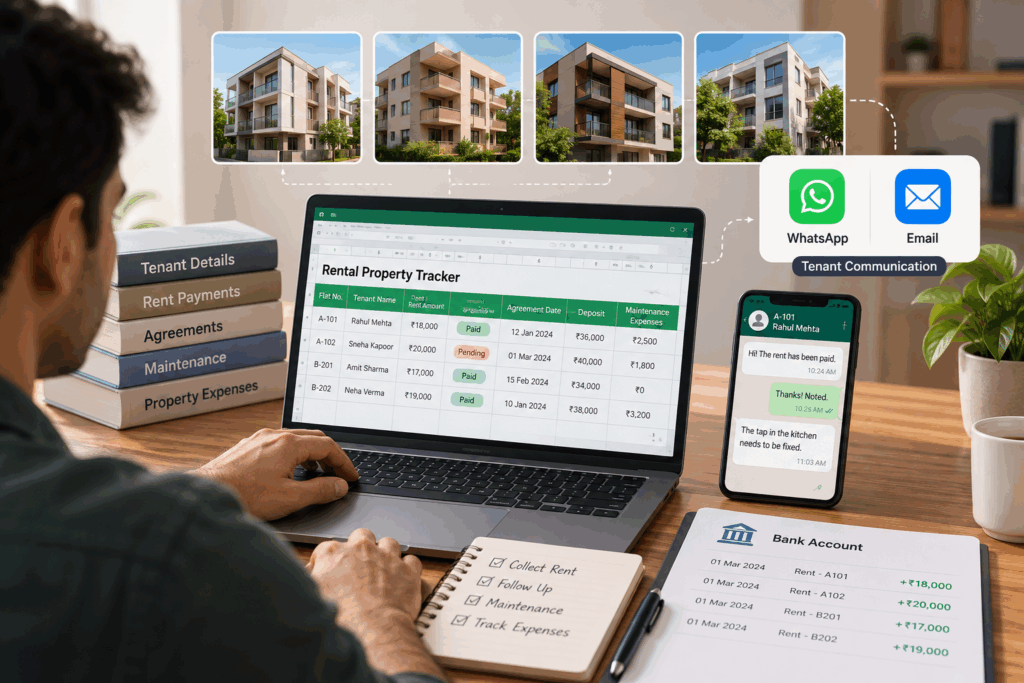
A simple spreadsheet can be enough to maintain important information such as tenant details, rent payments, deposits, agreement dates, and property expenses. WhatsApp or email can handle regular communication, while your bank account provides a straightforward record of incoming payments. If this system is working smoothly and does not require much time, there is little reason to change it simply because property management software exists.
There is also a financial consideration. A small portfolio has a limited income base, so recurring expenses deserve attention. If a software subscription does not meaningfully reduce your workload or improve your ability to manage the properties, keeping those costs out of the business may make more sense.
The biggest advantage of manual management at this stage is simplicity. There is no new platform to learn, no additional workflow to maintain, and no need to change a system that already works.

But What Happens When the Portfolio Becomes More Complicated?
The limitations of manual management usually do not appear because a landlord suddenly acquires dozens of properties. They appear gradually, as more small responsibilities begin competing for attention.
One tenant may have an overdue payment while another is asking about a maintenance issue. You may need to check an old agreement, confirm whether a repair bill was paid, and remember which tenant has already been reminded about rent. Each task is manageable on its own, but together they create a growing administrative load.
This is where the distinction between number of properties and operational complexity becomes important.
A landlord with four flats in the same building may have a relatively simple operation. Another landlord with three flats across different cities could already be dealing with vendors, remote tenant communication, payment follow-ups, and maintenance coordination from a distance.
The second landlord may have fewer properties, but a much greater need for structure.
This is also where landlord tenant management software becomes relevant. The value of software is not simply that it stores information. It brings different parts of property management into a more organized workflow.
Managing Properties From Another City Changes the Equation
Location can have a surprisingly large impact on how difficult a small rental portfolio is to manage.
When your property is nearby, a maintenance problem can often be resolved with a quick visit. You can meet the tenant, speak to a vendor, check whether the work has been completed, or deal with an unexpected issue yourself. Physical access gives you a level of visibility that digital tools cannot completely replace.
Remote management is different. When you are in another city, you depend much more heavily on accurate information and timely updates. You need to know whether rent has been received, whether a complaint is still pending, and whether the property is being maintained without having to physically check it yourself.
In that situation, software can become useful even if you own only three or four flats. The requirement is not being driven by portfolio size. It is being driven by the lack of physical visibility.
This becomes especially relevant for landlords living outside India or managing properties from another city. Our guide on Managing Rental Property in India as an NRI Landlord explores some of the additional challenges that come with managing rental properties remotely.
Rent Collection Is Often the First Sign That You Need More Structure
Rent collection is usually straightforward when every tenant pays on time. You check your account, record the payment, and move on.
The situation changes when payments start requiring follow-ups. You may need to check who has paid, send individual reminders, wait for responses, check your account again, and update your records manually. When this happens every month, the process becomes repetitive even if you only have a few tenants.
The problem is not necessarily that rent collection is difficult. It is that the process depends heavily on your memory and manual follow-up.
A structured system can give you a clearer view of payments, pending dues, upcoming rent dates, and tenant payment history. This becomes particularly useful when the number of tenants starts increasing or when you are managing properties remotely.
If rent collection is becoming one of the more time-consuming parts of your monthly routine, our article on how property management software helps you collect rent on time goes deeper into the role of reminders, digital payments, receipts, and organized rent records.
Maintenance Can Become Messy Faster Than Rent Collection
Maintenance is slightly different because it is less predictable.
A tenant may message you about a leaking tap today, call about an electrical issue tomorrow, and send another message next week about an appliance that has stopped working. When you have only a few flats, handling these requests through WhatsApp can work perfectly well.
The difficulty begins when you need to remember what happened after the initial complaint.
Was the vendor contacted? Was the repair completed? How much did it cost? Did the tenant confirm that the issue was resolved? Was the same problem reported previously?
Searching through old conversations for these answers may not feel like a major problem at first. But as requests increase, the time spent looking for information can become greater than the time spent solving the actual problem.
This is one of the clearest signs that your management process may need more structure. The problem is no longer the number of properties; it is the number of moving parts.

Financial Records Need Attention Too
Small portfolios often begin with very simple financial records. Rent comes in, maintenance expenses go out, and the landlord records everything in a spreadsheet or notebook.
Over time, however, those records can become scattered. Rent payments may sit in bank statements, repair bills may be saved as photographs, utility expenses may be stored in emails, and important information may remain inside WhatsApp conversations.
That becomes particularly inconvenient when you need to review the performance of a property or prepare your financial records at the end of the year.
A structured system can help you maintain a clearer picture of income, expenses, dues, and property-level performance throughout the year instead of reconstructing everything later.
This does not mean every landlord needs sophisticated accounting software. It simply means that financial organization becomes increasingly valuable as the number of transactions and properties increases.
Planning to Grow? Build a System Before You Need One
There is another reason a landlord with three or four flats might consider software early: future growth.
If those three or four flats represent the full extent of your rental portfolio, manual management may remain perfectly practical. But if you are planning to add more properties, the process that works today may become difficult to maintain later.
Think about what happens when four tenants become fifteen. You are no longer tracking only rent payments. You may also be managing multiple agreements, deposits, maintenance requests, vacancies, property expenses, and tenant conversations.
The problem with waiting until that point is that you may already have years of information spread across different spreadsheets, chats, documents, and payment records.
You do not necessarily need to automate everything from the beginning. But establishing a structured management system early can make scaling considerably easier.
So, When Is the Right Time to Switch?
There is no universal number of properties at which every landlord should start using software.
For one landlord, three flats may be completely manageable without it. For another, three flats spread across different locations may already create enough complexity to justify a centralized system.
A useful way to make the decision is to look at the amount of effort your current system requires.
If you can easily answer questions such as:
- Which tenants have paid this month?
- Who has pending dues?
- What maintenance requests are still open?
- How much did each property spend this month?
- When does each agreement need attention?
then your existing system may still be working well.
But if answering these questions requires checking several spreadsheets, messages, bank statements, or documents, your current system may be creating more work than you realize.
That is usually the real tipping point.
How RentOk Can Help as Your Portfolio Grows
RentOk brings key property management workflows into one connected platform, helping landlords and property managers manage information that would otherwise be scattered across different tools.
Instead of maintaining separate systems for tenants, payments, dues, complaints, expenses, and property activity, RentOk allows these workflows to be managed from a centralized platform.
For a growing landlord, this can provide better visibility into:
- Tenant details and occupancy
- Rent collection and pending dues
- Property expenses
- Complaints and maintenance
- Agreements and tenant records
- Day-to-day property operations
The benefit becomes particularly clear when several processes begin interacting with each other. A payment is connected to a tenant, a tenant is connected to a property, and a maintenance request is connected to that same tenant and property. Having these details organized together makes it easier to understand what is happening without searching across multiple systems.
This is also why property management software should not be viewed simply as a tool for landlords with large portfolios. Its value comes from reducing operational friction, and that friction can appear much earlier than most landlords expect.
For a broader understanding of what to look for before adopting a platform, you can also read What Features Should I Look for Before Buying a Landlord App?.
The Goal Is Not to Make a Small Portfolio More Complicated
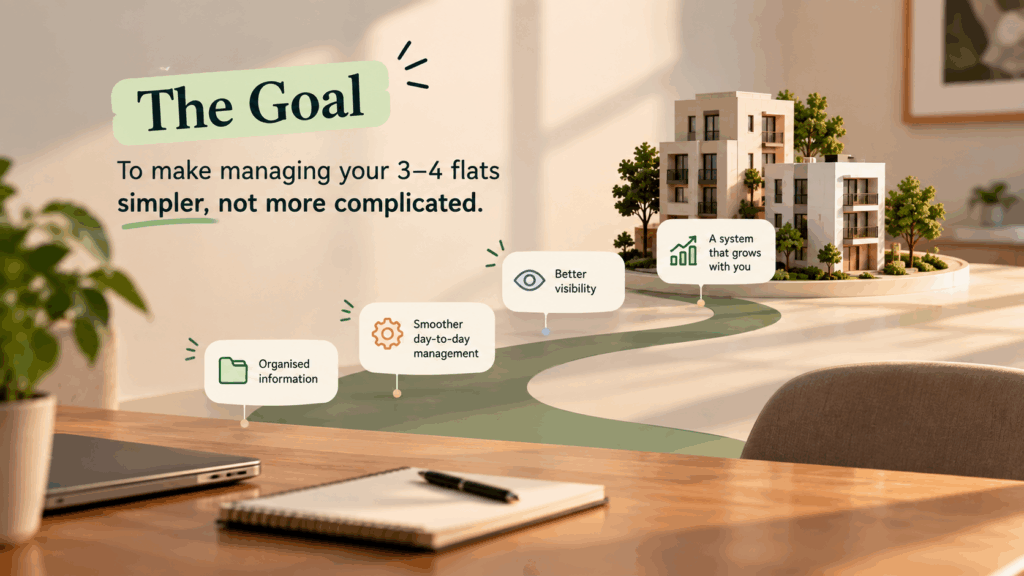
Technology should simplify property management, not add another layer of work.
If a spreadsheet and WhatsApp are genuinely enough for your three or four flats, there is no reason to replace them simply to appear more professional. A good management system should earn its place by saving time, improving visibility, or reducing the chances of something being missed.
However, once you start spending more time following up on payments, searching through conversations, coordinating maintenance, organizing expenses, or managing properties remotely, the calculation changes.
At that point, software is no longer about having an impressive dashboard. It is about creating a reliable system around the work you are already doing.

Final Thoughts
So, do you really need property management software for just three or four flats?
Not automatically.
If your portfolio is small, your properties are nearby, your tenants are stable, and your current process works well, simple tools may be all you need. There is nothing wrong with keeping things manual when the operation itself is simple.
But the number of flats is not the only factor to consider. Payment follow-ups, maintenance requests, tenant turnover, scattered records, and future expansion can make even a small portfolio harder to manage.
The right time to move to software is not when you reach a certain number of flats. It is when your current system starts making property management harder than it needs to be.
If spreadsheets and scattered conversations are becoming difficult to manage, RentOk brings tenant management, rent collection, dues, complaints, expenses, and everyday operations into one connected system.
Ready to simplify your property management? Start Free on RentOk.
FAQs
1. What is the 2% rule for properties?
The 2% rule is a general real estate guideline suggesting that monthly rent should ideally be around 2% of the property’s purchase price. However, it is only a rough benchmark and should not be used alone to judge an investment.
2. Is property management software useful for individual landlords?
Yes, it can help individual landlords organize rent records, tenant information, expenses, and maintenance in one place. Its usefulness depends more on the landlord’s workload and management needs than the number of properties.
3. What information should a landlord track for each property?
Landlords should generally maintain records of tenant details, rent payments, security deposits, agreements, maintenance expenses, and important property-related dates. Keeping these records organized makes financial and operational reviews easier.
4. Can property management software help with tenant communication?
Yes, property management software can help landlords organize tenant communication, send reminders, share updates, and manage requests more systematically. This reduces the need to search through multiple conversations for important information.
5. What is the difference between property management software and a spreadsheet?
A spreadsheet primarily stores information, while property management software can connect workflows such as tenants, payments, dues, complaints, and property operations. This becomes more useful when several processes need to be managed together.
6. What should landlords consider before choosing property management software?
Landlords should consider ease of use, relevant features, pricing, scalability, payment management, tenant support, and reporting capabilities. The right software should solve current management problems without adding unnecessary complexity.