
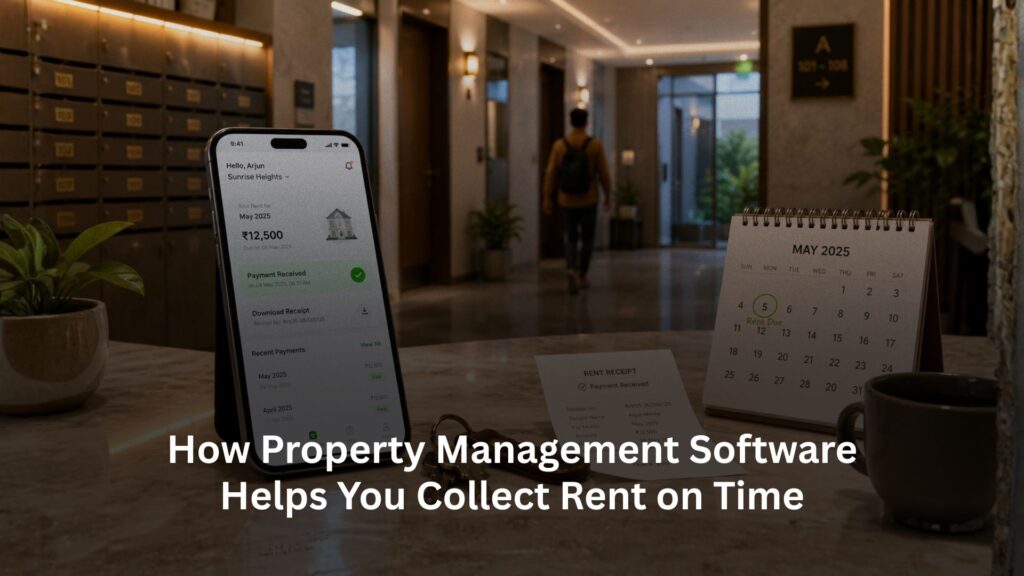
How Property Management Software Helps You Collect Rent on Time
Rent collection is one of the most important recurring processes in any rental business. Yet, many landlords and PG operators still manage it manually. Each month, the same cycle repeats: rent becomes due, reminders are sent, and tenants respond at different times. Payment screenshots arrive, bank statements are checked, and outstanding amounts are tracked in spreadsheets.
The challenge is not always that tenants are unwilling to pay. Often, the process itself makes timely collection more difficult than it needs to be.
This is closely connected to the broader issue of revenue visibility in rental businesses. What Revenue Leaks Look Like in Rental Businesses highlights how small gaps in collections, dues, and financial tracking can gradually impact overall property revenue.
As a property grows, managing rent collection manually becomes harder. A missed reminder or incorrect payment record can affect cash flow. Overlooked dues can also lead to unnecessary follow-ups.
This is where property management software becomes more than a digital record-keeping tool. It can streamline the entire rent collection cycle. This includes automated reminders, payment tracking, outstanding dues, and revenue visibility. The result is a more structured process with less manual work.
The problem with chasing rent manually
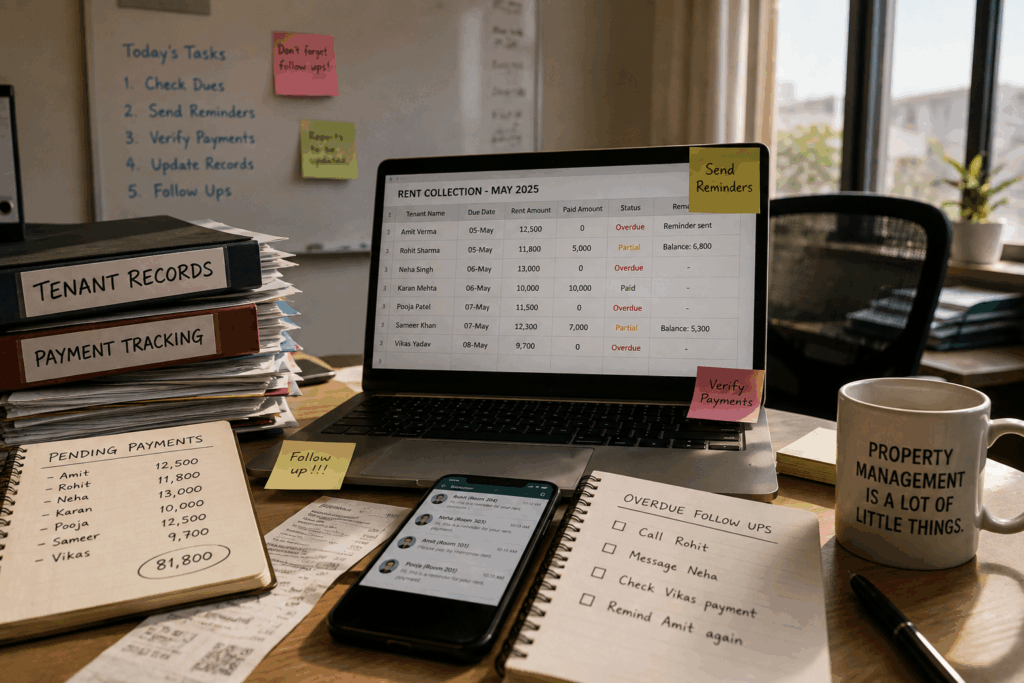
For a landlord with a few tenants, individual rent reminders may be manageable. But for a PG with 100 tenants, different due dates, rent amounts, partial payments, deposits, and multiple properties, manual collection quickly becomes difficult.
It relies heavily on staff remembering what needs to happen and when. A missed reminder, unrecorded payment, or incorrectly tracked partial payment can leave balances unclear.
The bigger issue is that rent collection involves several connected tasks, from tracking dues and sending reminders to verifying payments and following up on overdue amounts.
And rent collection is only one part of property operations. What is Rental Management? Tools to Manage Your Property Efficiently explores how these processes can be managed more efficiently.
A typical manual process may involve:
- Checking who needs to pay: Reviewing spreadsheets or registers to identify upcoming and overdue payments.
- Sending reminders: Manually contacting tenants through WhatsApp or calls, which can be time-consuming.
- Verifying payments: Matching UPI, bank, or other payments with the correct tenant.
- Updating records: Recording payments and adjusting outstanding balances.
- Following up on overdue rent: Sending additional reminders until pending amounts are collected.
While each task is simple, the repetition becomes a major operational burden as the tenant base grows.
This is why digital rent collection should be more than a way to accept online payments. As explained in our guide on how to collect rent online from tenants in India, the real opportunity is to build a system around the payment process, making reminders, tracking, verification, and follow-ups more structured and efficient.

What changes when rent collection becomes automated?
The biggest difference between manual and software-driven rent collection is consistency.
A property management system can be configured around the property’s rent cycle. This reduces the need for manual follow-ups. Rent can be generated on schedule, and reminders can be sent before or after the due date. Payment status can also be tracked from a central dashboard.
This creates a more predictable workflow.
Instead of asking, “Who needs a reminder today?”, operators can quickly see the overall collection status and identify pending payments.
Good rent collection is not just about receiving money. It is about knowing what should have been collected, what has been paid, what remains outstanding, and where delays are occurring.
As a property grows, the same structured approach can also simplify communication, complaints, occupancy, documentation, and reporting. All-in-One Property Management Software: Is It Worth It? explores how managing these functions across separate tools can create unnecessary complexity.
How automated reminders work
Reminders are one of the simplest parts of rent collection to automate, but they can have a significant operational impact.
A well-designed reminder system can communicate with tenants around the property’s defined payment cycle. A tenant may receive a notification before the due date, another reminder when payment becomes due, and further communication if the payment remains pending.
The important part is that the reminder is no longer dependent on a property manager remembering to send it.
Automated reminders also make the interaction more professional. Instead of repeatedly messaging a tenant with “Please pay your rent” or asking when they plan to make the payment, the system provides a standard notification based on the property’s process.
A structured reminder workflow can help with:
- Early awareness: Tenants receive payment reminders before the due date. This gives them time to complete the payment.
- Due-date visibility: Tenants know exactly when rent is due. They do not have to rely on a message from the property manager.
- Follow-up on pending amounts: The system can send reminders for unpaid rent. Staff do not need to track every pending payment manually.
- Reduced communication: Property managers spend less time on repetitive payment follow-ups. They can focus on issues that need personal attention.
This is especially useful for larger PGs and co-living properties. Automated reminders can save significant staff time.
Our article on stopping manual rent chasing with automated reminders explores this problem from another angle and shows why reminder automation becomes increasingly important as the tenant base grows.
Making payment easier for tenants
A reminder can tell a tenant that rent is due, but it does not make the payment process convenient.
If tenants have to search for the right UPI ID, request bank details, or wait for a payment link, each extra step can create friction and delay.
This is where integrated online payments become valuable.
Payment should also be connected to the property’s broader financial records. Once transactions flow through a system, rent, expenses, and accounting data can be tracked together. Accounting Software for Property Management Companies explains why this connection is important for maintaining financial visibility as a property business grows.
With property management software, reminders and payments can work together, allowing tenants to move from being notified about their dues to completing the payment with less unnecessary back-and-forth.
Depending on the system, this can include options such as:
- UPI payments: Tenants can use a familiar payment method. This makes monthly rent payments easier.
- Payment links: Staff can share a direct payment option. Tenants do not need payment instructions each month.
- Multiple payment methods: Digital options give tenants more flexibility. Payments can still stay linked to the tenant’s record.
- Payment confirmation: Once a payment is recorded, both tenants and staff can see its status clearly.
The goal is not to give tenants dozens of ways to pay. It is to make the expected payment process clear, accessible, and easy to complete.
That distinction is important. A property may technically accept online payments and still have a poorly designed collection process if the operator continues managing reminders, verification, and records manually.
Why a rent ledger matters more than a payment notification
Getting paid is only one part of rent management. A property operator also needs a reliable record of the transaction.
Imagine a tenant who has been living in the property for eight months. They have made regular payments, one partial payment, perhaps received a late fee once, and may have additional charges associated with their stay. If all of this information is scattered across bank statements, WhatsApp conversations, and Excel sheets, answering a simple question about their account can take time.
A tenant-wise rent ledger creates a continuous financial record.
It can help property managers understand:
- What amount was raised for the tenant during a particular period.
- Which payments have already been received and when they were recorded.
- Whether any amount remains outstanding after a payment has been made.
- How the tenant’s payment history has changed over time.
- What receipts or transaction records are associated with the tenant’s account.
This becomes particularly useful when there is a payment-related dispute. Instead of reconstructing the entire history from screenshots and bank statements, the operator can refer to the tenant’s organized record.
It also improves internal accountability. If multiple staff members manage a property, everyone can work from the same information rather than maintaining separate versions of the rent record.
Digital receipts close another gap in rent collection
Receipts may seem like a small part of the process, but they contribute significantly to financial clarity.
In manual systems, receipts may be generated only when someone remembers to create them. Tenants may then have to request proof of payment, while management teams spend additional time finding the relevant transaction.
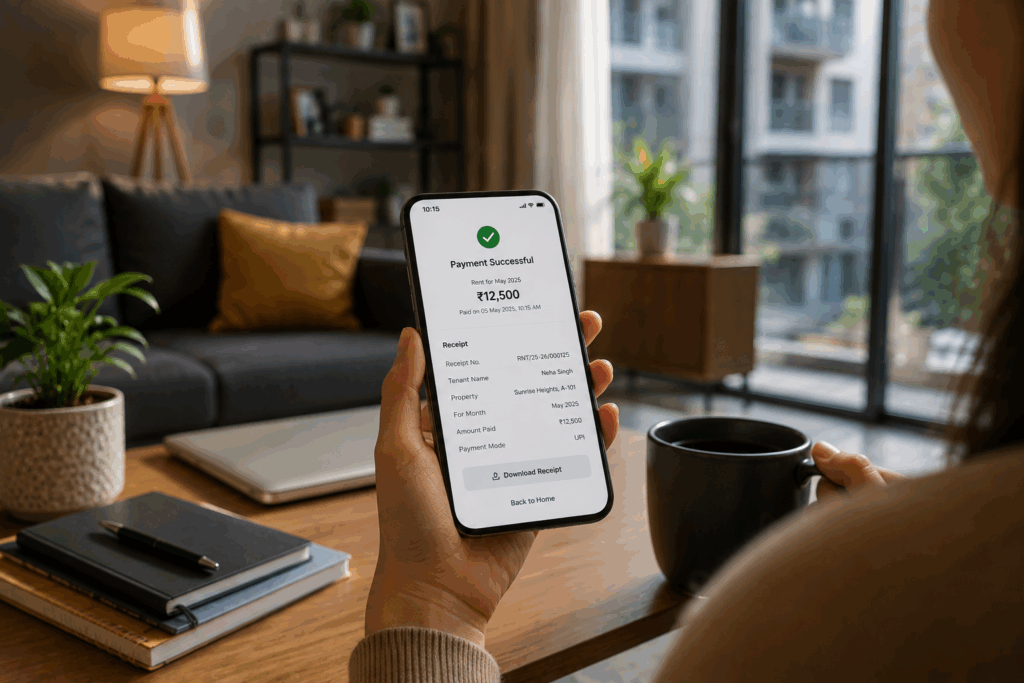
Digital receipts create a clearer connection between payment, record, and acknowledgement.
Once a payment is recorded, the tenant should be able to see confirmation that the transaction has been accounted for. For the property manager, the receipt becomes part of the broader tenant record. There is no need to create and store it separately.
This is especially useful for properties with many transactions. As the business grows, manual document management becomes harder to maintain.
A professional collection system should therefore not stop at “payment received.” It should create a reliable financial trail around that payment.
What happens when a tenant pays late?
Late payments are inevitable in rental operations. The objective of a good collection system is not to assume that every tenant will always pay perfectly. It is to make delays visible early and create a consistent process for handling them.
Without proper tracking, overdue rent can quietly accumulate. A tenant may make a partial payment, the remaining amount may get carried forward, and the operator may not notice the complete outstanding balance until much later.
Property management software can make overdue amounts easier to identify by showing payment status at the tenant and property level.
This gives operators a clearer picture of:
- Who has paid on time: Useful for understanding the overall health of the monthly collection cycle and identifying whether most tenants are following the expected schedule.
- Who has an outstanding amount: Instead of checking individual conversations, operators can immediately identify tenants whose accounts still require attention.
- Where partial payments exist: A tenant who has paid only part of the rent should not appear the same as someone whose entire payment is pending.
- Which payments are consistently delayed: Historical records can help identify recurring payment patterns rather than treating every late payment as an isolated incident.
Where the property’s policies allow it, software can also support automated late-fee handling. This reduces the need to calculate recurring penalties manually and makes the application of the property’s rules more consistent.
The broader benefit is visibility. A delayed payment is easier to manage when it is identified early rather than becoming a problem several weeks later.
For operators interested in going beyond basic collection and actually measuring how efficiently rent is being collected, our guide on how to track rent collection performance covers useful metrics such as on-time payment rates, delayed payments, outstanding dues, and collection time.
Rent collection data can tell you more than who has paid
Once payment information is organized, it becomes useful for decision-making as well.
A property manager should not only be able to answer, “How much rent did we collect this month?” They should also be able to understand whether the collection process is becoming more efficient.
For example, if a property consistently has a large amount of outstanding rent after the due date, the issue may not simply be tenant behaviour. The operator may need to examine whether reminders are being sent at the right time, whether payment methods are convenient enough, or whether certain charges are creating confusion.
Over several months, organized collection data can help reveal patterns around:
- Payment timing: Whether tenants generally pay before the due date, on the due date, or after repeated reminders.
- Outstanding dues: Whether pending rent is remaining stable, increasing, or being cleared more quickly.
- Collection consistency: Whether monthly collections are becoming more predictable as processes improve.
- Property-level performance: For operators managing multiple properties, comparing collection patterns can highlight locations or teams that require additional attention.
This is where property management software becomes more valuable than a simple payment application. A payment app records a transaction. A property management system can place that transaction within the wider context of the tenant and property operation.
Why this matters when you manage multiple properties
The need for software becomes even more obvious when an operator moves beyond a single property.
A landlord managing one building may still be able to keep track of payments manually for some time. But when several properties are involved, the number of tenants, transactions, due dates, staff members, and outstanding balances increases simultaneously.
At that point, the challenge is no longer simply collecting rent. It is maintaining one reliable source of information across the entire portfolio.
A centralized system allows operators to move from property to property without rebuilding the same information manually every month. It also makes delegation easier because staff can work within a defined workflow rather than relying on personal spreadsheets or informal communication.
This is one of the broader reasons property management software is becoming increasingly important for rental businesses in India. As we discuss in our guide to real estate property management software, the value of software comes from bringing multiple operational processes together rather than solving one isolated task.
A better rent collection workflow, from due date to receipt
The real advantage becomes clearer when the entire process is viewed as one workflow rather than a series of separate tasks.
A structured monthly cycle can look something like this:
- Rent is generated: The expected rent is created according to the tenant’s defined payment schedule, so management does not have to recreate the same dues manually every month.
- The tenant is reminded: Automated communication alerts the tenant about the upcoming or current payment obligation, reducing dependence on individual staff follow-ups.
- Payment is completed: The tenant uses the available online payment method, such as UPI or a payment link, without having to request payment instructions separately.
- The transaction is recorded: The payment becomes part of the tenant’s financial record, reducing the need for manual reconciliation and repeated data entry.
- The ledger is updated: The tenant’s outstanding balance reflects the latest transaction, making the account easier to understand.
- Receipt and confirmation are available: Both sides have clearer documentation of the payment, which becomes useful for future reference.
- Pending payments remain visible: If the tenant does not pay, the outstanding amount continues to appear in the system and can move into the appropriate reminder or follow-up workflow.
The important difference is that these steps are connected. Instead of treating rent generation, reminders, payments, records, and follow-ups as separate jobs, software brings them into one operational process.
For a rental business, that creates something far more valuable than convenience: predictability.
What should you look for in property management software?
Not every software platform will solve the rent collection problem equally well. Before choosing a system, landlords and property managers should look beyond whether an app simply accepts payments.
A useful property management solution should ideally provide:
- Automated rent generation and reminders: The system should reduce the amount of recurring work required from staff and ensure tenants are consistently informed about upcoming payments.
- Integrated digital payments: Tenants should have a straightforward way to complete payments without creating additional reconciliation work for the management team.
- Tenant-level financial records: Every payment, outstanding amount, and relevant transaction should be connected to the correct tenant rather than stored as disconnected information.
- Clear dues visibility: Operators should be able to understand total outstanding rent as well as individual tenant balances without manually combining multiple records.
- Receipt and payment history: A proper record of completed transactions makes future reconciliation, tenant queries, and internal reporting much easier.
- Scalability across properties: The system should remain useful when the operator moves from one property to multiple buildings, locations, or larger tenant volumes.
The right software should reduce operational effort rather than simply move the same manual process onto a phone.
That distinction is important when evaluating software because a longer feature list does not automatically mean a better system. Best Property Management Software in 2026 looks at the features and capabilities that actually matter when choosing a property management platform.
How RentOk Helps
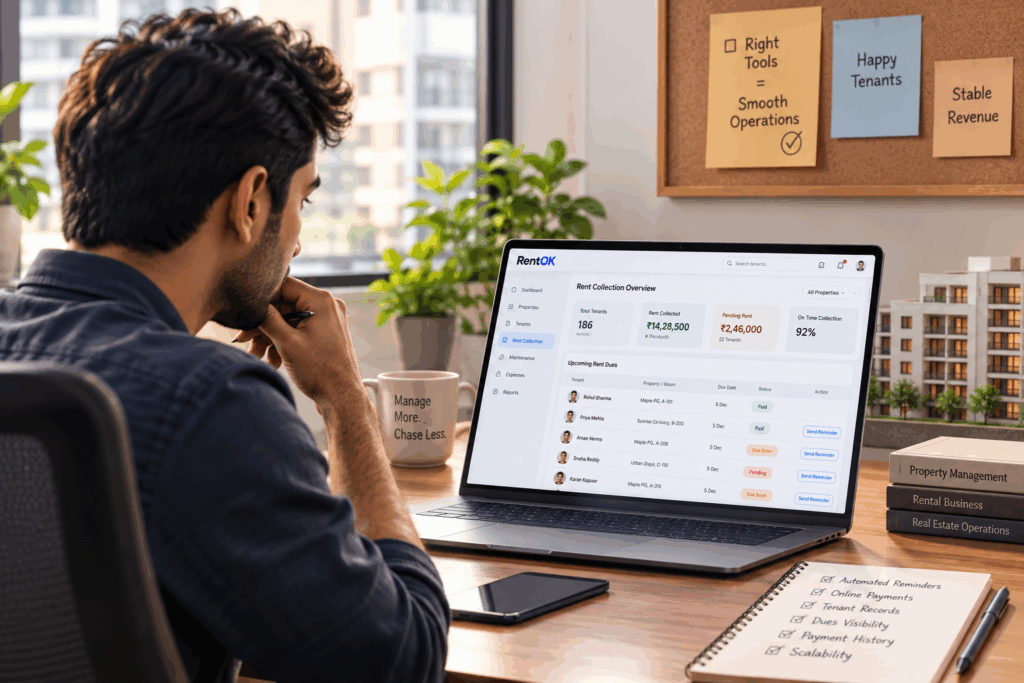
RentOk brings the core rent collection workflow together so landlords, PG owners, and property managers can spend less time chasing payments and more time managing their properties.
With RentOk, operators can automate recurring rent and bill generation, send payment reminders through channels such as WhatsApp, SMS, and notifications, and provide tenants with convenient online payment options. Payment visibility, tenant-wise ledgers, dues tracking, and digital receipts help keep the financial side of each tenancy organized in one place.
The platform also helps operators maintain better visibility into pending dues and payment history instead of relying on separate spreadsheets, bank statements, and chat conversations. This becomes particularly valuable as the number of tenants grows, because the same system can support a more structured collection process across properties.
The objective is not simply to collect rent digitally. It is to build a rent collection process that is consistent, trackable, and easier to manage at scale.
Conclusion
Collecting rent on time is not only about reminding tenants when a payment is due. It depends on how well the entire process is structured, from generating the right amount and communicating the due date to making payment convenient, recording the transaction, issuing a receipt, and identifying outstanding dues.
For small rental setups, manual processes may appear manageable. But as tenant numbers and properties increase, the cost of continuing with spreadsheets, individual messages, and scattered payment records becomes harder to ignore.
Property management software brings these activities into one connected workflow. It reduces repetitive follow-ups, improves payment visibility, creates better financial records, and gives property managers the information they need to act before delayed payments become larger collection problems.
If your current rent collection process still depends on manual reminders and scattered records, it may be time to move to a more structured system. Start your free RentOk trial and simplify the way you collect, track, and manage rent.
FAQ’S
1. What happens if a tenant makes a partial rent payment?
A property management system can record the amount received and keep the remaining balance visible, making it easier to identify and follow up on partial payments without manually recalculating dues.
2. Can property management software handle different rent due dates?
Yes. Different tenants can have different payment schedules, allowing property managers to track individual due dates instead of maintaining separate reminders or spreadsheets for each tenant.
3. How can landlords keep track of rent payments across multiple properties?
A centralized property management system brings tenant and payment records together, helping landlords view collection status across properties without switching between multiple spreadsheets or records.
4. Can property management software help with security deposit records?
Yes. Tenant financial records can include relevant deposit information alongside rent and other transactions, giving property managers a clearer financial history for each tenancy.
5. How does property management software reduce errors in rent records?
By connecting rent generation, payments, ledgers, and receipts within one system, software reduces repeated manual data entry and makes it easier to keep tenant balances accurate.
6. Is property management software useful for small rental businesses?
It can be useful even for smaller properties because it creates structured processes from the beginning and reduces repetitive administrative work as the number of tenants grows.