
10 Signs It’s Time to Stop Using Excel and Switch to a PG App
Excel has been one of the most dependable tools for property owners for years. It is flexible, familiar, inexpensive, and for a small PG with a limited number of tenants, it can handle basic records without much trouble.
But property management changes as the business grows.
A spreadsheet that once helped you keep track of ten or twenty tenants can become difficult to manage when you are dealing with hundreds of residents, multiple properties, different rent cycles, staff members, maintenance requests, deposits, expenses, and daily communication. Suddenly, managing the property starts involving multiple Excel files, formulas, filters, WhatsApp conversations, payment screenshots, and manual updates.
The issue is not that Excel stops working.
The issue is that your property has outgrown what Excel was designed to manage operationally.
This is where the difference between Excel and a dedicated PG management app becomes important. A PG app is built around the recurring workflows of rental businesses, allowing property managers to bring tenant information, rent collection, occupancy, expenses, communication, and reporting into one connected system.
For a broader look at how rental businesses are moving from manual processes to structured digital operations, you can also read What is Rental Management? Tools to Manage Your Property Efficiently.
So, how do you know when it is actually time to make the switch?
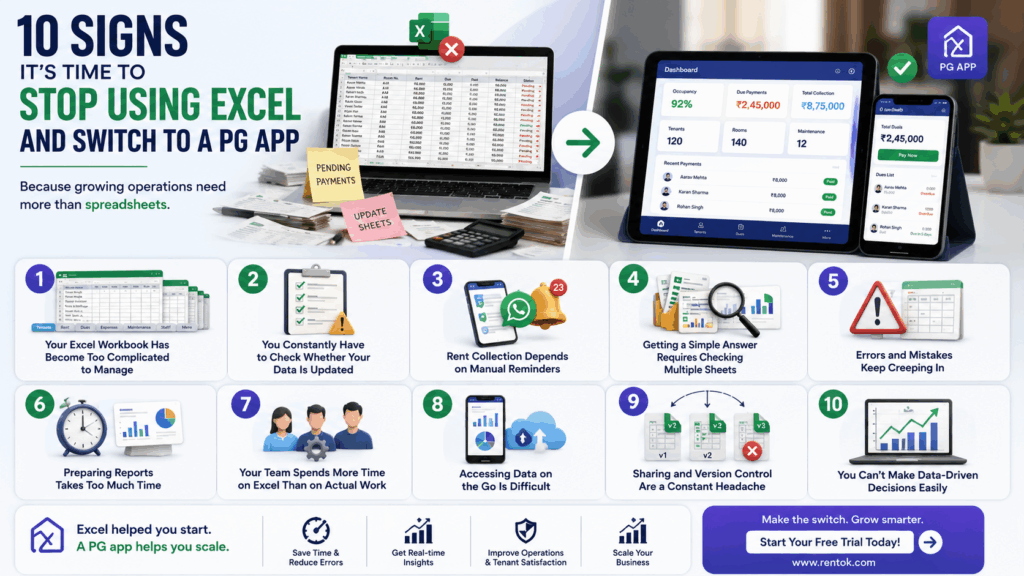
Here are 10 signs that your PG may have reached that point.


1. Your Excel Workbook Has Become Too Complicated to Manage
One of the earliest signs is when your Excel file is no longer really a file. It has become an entire management system.
You may have separate sheets for tenant details, rent collection, deposits, expenses, occupancy, maintenance, and staff information. Then, as new requirements appear, more tabs get added. Someone creates another sheet for pending payments, another for room availability, and perhaps another one to calculate monthly collections.
Initially, this feels organised.
Over time, however, these sheets start depending on each other. A tenant changes rooms, for example, and suddenly the information needs to be updated in several places. A tenant checks out, and someone has to make sure the occupancy sheet, payment records, deposit details, and tenant database all reflect the same change.
This is where manual management starts creating unnecessary operational work.
A complicated Excel setup usually means your team is spending time maintaining the system instead of managing the property.
If your team needs a detailed explanation before someone else can understand how your Excel system works, that is a strong indication that the process has become more complicated than it needs to be.
2. You Constantly Have to Check Whether Your Data Is Updated
The biggest strength of Excel is also one of its biggest operational limitations: it depends on people entering and updating information correctly.
When a payment is received but not recorded, your spreadsheet has no way of knowing about it. A tenant changing rooms can create inaccurate records if only one sheet is updated. Meanwhile, maintaining multiple copies of the same file can leave your team wondering which version is actually correct.
This creates a hidden workload that many property owners don’t immediately notice.
Instead of simply checking the status of the property, someone has to verify the information first.
You may find yourself asking:
- Has this month’s payment actually been received, or has someone simply forgotten to update the sheet?
- Is this tenant still occupying the same room, or was the room allocation changed somewhere else?
- Are these dues genuinely pending, or were they already collected but not reconciled?
- Is this the latest version of the file, or has another team member made more recent changes?
When these questions become part of everyday property management, the problem is no longer Excel itself. The problem is the amount of manual coordination required to keep Excel accurate.
This becomes even more important when tenant information is spread across different systems. For a closer look at what a structured tenant management setup should actually solve, read Landlord Tenant Management Software: A Complete Overview.
A dedicated PG app can reduce this dependency by keeping recurring property operations within a connected system rather than relying entirely on manual updates.
3. Rent Collection Depends on Manual Reminders
Rent collection is one of the clearest areas where a property can start feeling the limitations of Excel.
A spreadsheet can tell you who has paid and who has not. But it does not automatically solve the process of reminding tenants, tracking follow-ups, communicating payment information, and maintaining visibility over pending dues.
As the tenant count increases, this becomes a repetitive monthly exercise.
First, someone checks the spreadsheet. Then reminders are sent through WhatsApp. Some tenants respond immediately, while others need another follow-up. A few may send payment screenshots. Someone then has to verify the payment and update the records.
The cycle repeats every month.
For a property with a small number of residents, this may not seem like a major burden. But when the same process has to be repeated across hundreds of tenants, manual collection starts consuming significant staff time.
This is where moving from Excel to a PG management app becomes less about convenience and more about operational efficiency.
A structured system can help property managers organise rent cycles, dues, payment tracking, and reminders in one place instead of making every month’s collection dependent on manual follow-ups.
Rent collection is only one part of the transition, though. If you are evaluating software specifically for tenant and payment management, Best Tenant Management Software in India breaks down the features that actually matter for growing rental operations.
4. Getting a Simple Answer Requires Checking Multiple Sheets
A property owner should not need to spend half an hour finding out something that should be visible within seconds.
How much was collected this month?
Which tenants still have pending dues?
How many beds are vacant?
What were the property’s expenses last month?
Which property is performing better?
These are basic operational questions, but they become surprisingly difficult to answer when the information is distributed across multiple Excel files.
Someone may need to open one workbook for tenants, another for payments, another for expenses, and then manually combine the information before giving the owner an answer.
That creates two problems.
First, it takes time. Second, by the time the information has been collected and reconciled, the underlying numbers may have changed again.
This becomes particularly challenging for owners managing their properties remotely. They need visibility into the business without having to depend on multiple people for individual pieces of information.
A PG management app changes this by bringing key property data into a central operational view. Instead of asking the team to search through different files, the information can be accessed through a system designed specifically around property management.
The benefit is not simply faster reporting.
It is faster decision-making.
When you know what is happening across your property, you can respond to collection issues, vacancies, expenses, and operational problems much earlier.
5. Your Staff Has Become the Actual Property Management System
Imagine one employee knows how the rent sheet works, another manages tenant records, and someone else tracks maintenance requests through WhatsApp. The owner may understand the monthly expense sheet, but nobody else knows how to interpret it.
Technically, the information exists. Operationally, however, the system depends on specific people.
That becomes a problem when someone takes leave, changes roles, leaves the organisation, or forgets to update something. Important knowledge that should belong to the business ends up belonging to individuals.
As the property grows, this dependency becomes increasingly risky.
A structured property management system can centralise information and give team members access based on their responsibilities. This helps employees find what they need, follow consistent processes, and keep operations running even when key people are unavailable.
For a growing PG, this means:
- Owners can get a broader view of collections, occupancy, expenses, and property performance without requesting separate updates.
- Property managers can access tenant and operational information without maintaining multiple personal spreadsheets.
- Team members can work with clearer responsibilities and access the information relevant to their roles.
- Important operational knowledge stays with the business rather than with individual employees.
This becomes even more important when an owner starts managing multiple locations. As the business expands, structured systems make it easier to maintain consistency and control across properties.
RentOk explores this transition in How a Dedicated PG App Can Scale Your Business to 500+ Beds.
At this stage, the question is no longer whether Excel can store the information.
It is whether your entire team can work efficiently with that information.
That is where switching from Excel to a dedicated PG management app becomes increasingly relevant.
6. You Are Managing Multiple Properties From Separate Excel Files
Managing one PG through Excel can be manageable. Managing several properties through Excel is a different challenge altogether.
Once you expand, every property starts generating its own set of information: tenant records, rent collections, dues, expenses, occupancy, deposits, staff activity, and day-to-day updates. If each property has its own workbook or set of sheets, getting a consolidated view becomes increasingly difficult.
The problem is not simply the number of files. It is the lack of connection between them.
An owner managing five properties may have to open five different workbooks to understand overall collections. If they want to compare occupancy, they may need to manually bring numbers together. If they want to understand which property has the highest outstanding dues, another round of filtering and calculation may be required.
This is where a PG management app can offer a significant operational advantage.
Instead of treating every property as an isolated spreadsheet, a centralised system allows the owner to manage property-level information while also getting a broader view of the business.
That becomes particularly important when expansion is part of the plan. A system that works only when the owner personally knows where every number is stored is difficult to scale.
7. Tenant Information Is Scattered Across Different Places
Tenant management involves far more information than a name and phone number.
A typical PG may need to maintain details related to room allocation, check-in and check-out dates, agreements, deposits, payments, KYC information, complaints, and other operational records. When these details are divided between Excel, WhatsApp, physical documents, and individual folders, the tenant’s complete history becomes difficult to access.
You might know that the information exists somewhere. The challenge is finding it when you actually need it.
For example, a tenant may ask about a previous payment, the manager may need to verify their check-in date, and the accounts team may need to check the deposit record. If every department maintains its own information, answering a simple question can turn into a coordination exercise.
A connected PG management system approaches the tenant record differently. Instead of treating each piece of information as a separate entry, it allows the team to work with a more complete view of the tenant.
This matters because good tenant management is not just about storing information; it is about being able to use that information when an operational decision needs to be made.
For properties looking to reduce scattered workflows, an all-in-one property management system can also help bring different parts of the tenant lifecycle into one operational environment.
8. Occupancy Tracking Has Become More Complicated Than It Should Be
For a PG, every occupied bed contributes to revenue, while every vacant bed represents an opportunity that needs attention.
That makes occupancy one of the most important numbers a property manager needs to monitor.
Yet occupancy tracking can become surprisingly difficult when it is managed manually. A tenant checks out, someone updates the Excel sheet, the room needs cleaning, another employee marks it as available, and the sales team may have a separate list of vacant rooms.
If these updates do not happen at the same time, different people can end up working with different information.
This can create problems such as:
- A vacant bed remaining invisible to the team because the occupancy sheet was not updated immediately after checkout.
- A room being shown as available even though it has already been assigned to another incoming tenant.
- Upcoming move-outs being missed because there is no central visibility into tenant timelines and expected vacancies.
- Owners struggling to compare occupancy across properties because each location is maintaining its information differently.
A dedicated PG app can make occupancy a live operational metric rather than something that is reconstructed from spreadsheets.
This becomes especially useful when the property is trying to reduce vacancy periods. The faster management knows that a bed is becoming available, the faster the business can act on it.
Occupancy visibility also becomes useful when the goal is not simply to know which beds are vacant, but to understand why vacancies are happening and how quickly they can be filled. RentOk explores this in How to Improve Occupancy Rate in PG.
9. Preparing Reports Takes More Time Than Analysing Them
Reports should help an owner understand the business. They should not become another monthly project for the accounts or property management team.
But when information lives across multiple Excel sheets, preparing a report can involve a surprising amount of manual work.
Someone has to collect the data, clean it, check formulas, remove duplicates, reconcile payments, calculate totals, and finally turn the information into something that management can actually understand.
By the time the report is ready, the owner may already be dealing with a new set of operational issues.
The bigger concern is what happens when management wants to ask a second question.
Suppose the monthly report shows that collections have fallen. The owner may then want to know whether the issue is concentrated in one property, one room category, or a particular group of tenants. With a manual system, answering that follow-up can mean going back into the spreadsheets again.
A more connected system makes reporting part of everyday operations rather than a separate activity.
The objective is not to create more reports. It is to make the information already being generated by the property easier to understand and act upon.
This is one of the strongest reasons larger PG operations eventually move beyond Excel.
10. You Are Planning to Grow, and You Already Know Excel Will Become a Problem
You do not have to wait for your Excel system to completely fail before making a change.
In fact, that is usually the worst time to switch.
If you are planning to add another property, increase your bed count, hire more staff, or expand into another city, your operational complexity is going to increase along with the business.
As the tenant base grows, so do payment volumes and communication needs. A larger property portfolio brings greater occupancy demands and more reporting. Adding employees also means more coordination and access requirements. Meanwhile, higher transaction volumes create a greater need for accurate reconciliation.
The same spreadsheet structure that feels manageable today can become a serious bottleneck six months later.
This is why growing PG businesses should think about property management software before the manual system becomes impossible to maintain.
The question is not really:
“Can Excel manage more tenants?”
It probably can.
The better question is:
“How much of my team’s time should go into making Excel manage those tenants?”
That distinction is important.
A property owner should be focused on occupancy, revenue, tenant experience, expansion, and business decisions. If a significant portion of the team’s time is being spent updating sheets, checking formulas, reconciling records, and searching for information, the business is using valuable operational bandwidth simply to maintain its management system.
Excel vs PG App: What Is the Actual Difference?
The Excel vs PG app comparison is often presented as a technology upgrade. But that misses the more important point.
Excel is primarily a flexible tool for organising and analysing data. A PG management app is designed around the workflows that property managers perform repeatedly.
That means the difference is less about spreadsheet versus software and more about manual coordination versus connected operations.
With Excel, the team often has to build the process around the tool. With a dedicated PG app, the system is built around the process.
| Excel-based management | PG management app |
|---|---|
| Information is often distributed across multiple sheets and files. | Tenant, payment, occupancy, and operational information can be managed through a connected system. |
| Rent reminders and follow-ups usually depend heavily on manual coordination. | Recurring dues and communication workflows can be structured and automated. |
| Reporting often requires gathering information from different sheets. | Property data can be accessed through centralised reporting and dashboards. |
| Staff may develop their own ways of maintaining and accessing information. | Teams can work within defined workflows and access relevant information more systematically. |
| Scaling usually means adding more sheets, formulas, and manual processes. | Scaling can happen through a system designed to handle larger tenant and property operations. |
This does not mean Excel has no place in property management. It remains useful for calculations, analysis, ad-hoc data work, and many other business tasks.
The issue begins when Excel becomes the entire operating system of the PG.
If you are at the stage of actively comparing software options, the next question is not simply whether you need a PG app, but which one actually fits your operational model. RentOk’s How to Choose the Right PG Management Software covers the features and considerations worth evaluating before making that decision.
So, When Should a PG Actually Make the Switch?
There is no universal tenant count at which every property needs a management app.
A 30-bed property with highly complex operations may need one earlier than a simple 100-bed setup. What matters more is the amount of manual coordination required to keep the business running.
If several of the signs above sound familiar, it may be worth evaluating the switch.
Pay particular attention if your team is experiencing:
- Increasing time spent on repetitive administrative work instead of tenant-facing or revenue-generating activities.
- Frequent discrepancies between payment records, tenant information, occupancy status, or different versions of spreadsheets.
- Difficulty getting a clear picture of the property without asking multiple team members for updates.
- Growing dependence on individual employees who know how specific sheets, formulas, and processes work.
- Plans to add more properties or tenants without having a scalable operational system in place.
The strongest time to adopt a PG management app is often before these problems become severe.
Digitalisation works best when it is introduced as part of growth, rather than as an emergency response to operational chaos.
How RentOk Helps PG Owners Move Beyond Excel
RentOk is built around the day-to-day workflows that PG, hostel, co-living, and rental property operators need to manage. Instead of maintaining separate systems for tenant records, rent and dues, occupancy, expenses, communication, team management, and reporting, operators can bring these workflows into one connected property management platform. This creates greater visibility for owners and gives property teams a more structured way to manage recurring operations without relying entirely on spreadsheets and manual coordination.
For a business moving beyond Excel, the value is not simply having an app instead of a spreadsheet. It is having a system that can support the business as the number of tenants, properties, transactions, and team members increases.
Conclusion
Excel is often the right place to start. It is familiar, flexible, and capable of handling basic property records effectively.
But as the PG grows, the limitations usually become visible in the form of scattered information, repetitive rent follow-ups, staff dependency, difficult reporting, occupancy confusion, and increasing manual work.
That is the real signal that it may be time to switch.
A PG management app should not simply replace your spreadsheets. It should give your team a more organised way to manage the operations that those spreadsheets were trying to handle in the first place.
If your property is already showing several of these signs, start your free RentOk trial and see how a dedicated PG management system can simplify your day-to-day property operations.
FAQ’S
1. Is a PG management app suitable for small properties?
Yes. Even smaller PGs can benefit from organised tenant records, payment tracking, occupancy management, and automated communication. It also creates a scalable system that can support the property as it grows.
2. Can a PG management app replace multiple Excel sheets?
A dedicated PG app can bring commonly separated workflows such as tenant records, rent and dues, occupancy, expenses, and reporting into one connected platform, reducing the need to maintain several spreadsheets.
3. Does switching to a PG app require technical knowledge?
Most modern PG management apps are designed for everyday property teams rather than technical users. The key is choosing a system with simple workflows that staff can learn and use consistently.
4. Can property management software help reduce manual errors?
Yes. Centralising property information and using structured workflows can reduce errors caused by duplicate entries, outdated spreadsheets, missed updates, and inconsistent manual calculations.
5. Can I manage more than one PG through the same app?
Many dedicated PG management platforms support multiple properties, allowing owners and managers to maintain property-level information while getting a broader view of their overall operations.
6. What should I look for before choosing a PG management app?
Look for features that match your actual operations, including tenant management, rent and dues tracking, occupancy visibility, communication, reporting, team management, and ease of use. The right system should simplify your existing workflow rather than add another layer of complexity.