
What Is MDR on Rent Payments, and What Changes for Owners From October 15?
Digital payments have made rent collection easier for property owners across India. Tenants can pay through UPI, owners can receive money quickly, and property teams can track transactions online. However, accepting digital payments also requires businesses to understand payment charges, transaction categories, and settlement processes.
This becomes especially important for PG owners, hostel operators, landlords, and co-living businesses. Their operations often involve hundreds of recurring payments every month. Even a small change in payment processing costs can affect financial planning when applied across a large tenant base.
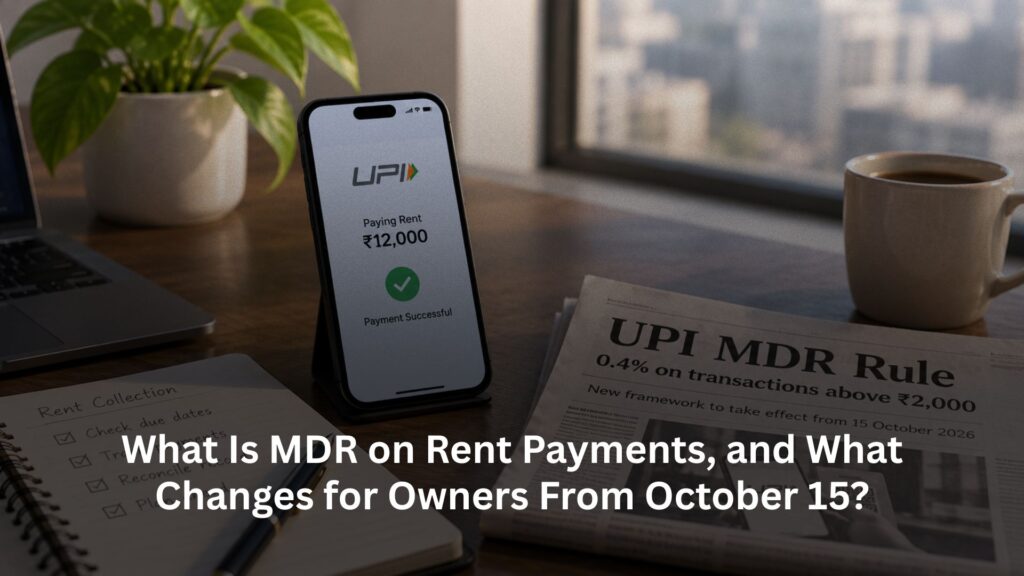
A revised UPI framework is scheduled to take effect from 15 October 2026. Under the announced framework, a 0.4% Merchant Discount Rate (MDR) will apply to specified Person-to-Merchant (P2M) UPI transactions above ₹2,000. Transactions of ₹75,000 and above will have a maximum MDR of ₹300, subject to the applicable category and conditions.
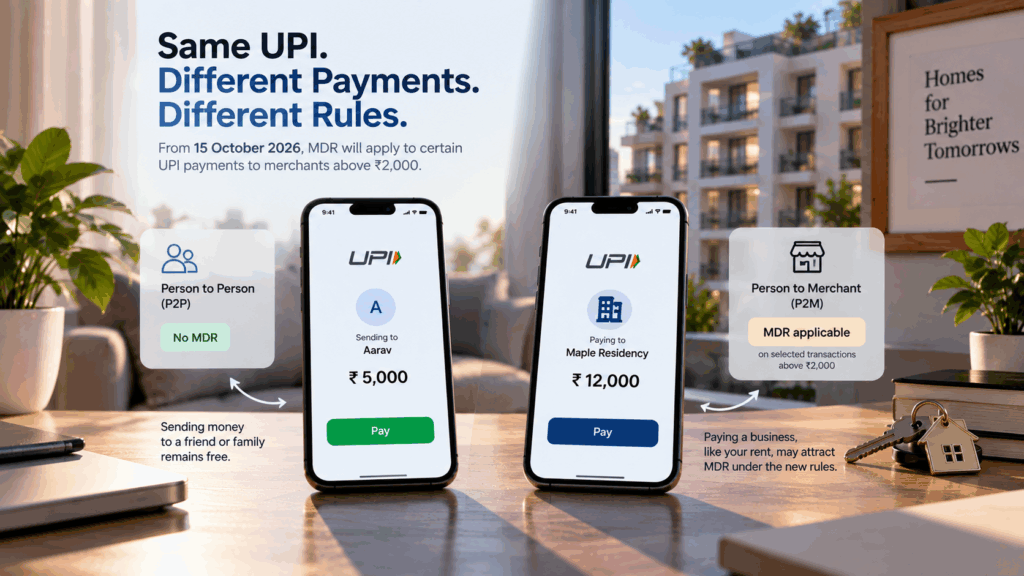
The change does not apply to every UPI payment. Person-to-Person (P2P) payments remain free, while UPI merchant transactions up to ₹2,000 also remain free. Eligible small merchants receiving up to ₹1 lakh per month through UPI QR codes will continue to receive zero-MDR protection under the stated conditions.
For property owners, the key issue is understanding how the new framework may interact with rent collection. Owners must review their payment channels, understand transaction classifications, and maintain accurate financial records.
This article explains MDR, the changes from 15 October, the possible operational risks, and the role of UPI AutoPay in recurring rent collection.
What Is MDR in UPI Payments?
MDR stands for Merchant Discount Rate. It is a fee associated with processing certain digital payments made to merchants. The payment ecosystem may involve banks, payment service providers, and other intermediaries.
MDR is not a universal charge on every digital transaction. Its application depends on factors such as the transaction type, merchant category, payment method, and applicable regulations.
The revised UPI framework focuses on specified P2M transactions above ₹2,000. This distinction matters because businesses and individuals use UPI in different ways.
For example, a person transferring ₹5,000 to a friend is making a P2P payment. A customer paying ₹5,000 to a registered business may be making a P2M payment. These transactions may receive different treatment under the payment framework.
Property owners should therefore avoid assuming that every rent payment above ₹2,000 will automatically attract the same MDR.
P2P and P2M: What Is the Difference?
Understanding the difference between these payment categories can help owners evaluate their collection process.
- Person-to-Person payments: These payments happen between individuals. Examples include sending money to a friend or transferring funds to a family member. The revised framework continues to keep these transactions free.
- Person-to-Merchant payments: These payments are made to businesses or registered merchants. Certain P2M transactions above ₹2,000 will attract MDR under the revised framework from 15 October 2026.
- Small-value merchant payments: UPI merchant transactions up to ₹2,000 remain free under the announced structure. This does not mean every high-value payment will have the same charge.
- Eligible small merchants: Merchants receiving up to ₹1 lakh per month through UPI QR codes remain eligible for zero-MDR protection under the specified conditions.
The government has also clarified that customers should not be charged MDR as a direct UPI transaction fee. Payment providers and merchants must follow the applicable rules when handling these charges.
For rental businesses, the payment route is important. A tenant paying rent to a registered PG or property operator may be making a merchant payment. However, the exact treatment depends on the transaction structure and applicable payment category.
Owners should confirm these details with their payment provider before making decisions about charges or collection methods.

Why MDR Matters for PG Owners and Landlords
Rent collection is a recurring financial activity. Unlike occasional purchases, rent payments happen every month and often involve a large number of tenants.
A PG owner managing 30 tenants may receive 30 separate payments. An operator managing multiple properties may process hundreds of transactions during each collection cycle. The payment value, transaction category, and settlement process can influence the cost and complexity of these collections.
The impact of MDR should not be assessed only by looking at one payment. Owners should also examine the overall volume of transactions processed through their system.
Consider a property where most tenants pay ₹12,000 every month. The owner must track the expected rent, payment status, transaction reference, and outstanding balance. If payment charges are introduced or transaction records become harder to reconcile, the effect can extend beyond the payment itself.
A strong rent collection process should provide clear visibility into both payments and costs.
What Should Owners Review?
Before 15 October, property owners should review the following areas:
- Monthly collection volume: Calculate the number of rent payments received each month. Also, review the average transaction value and the total amount collected through digital channels.
- Payment classification: Identify whether payments are processed as P2P transactions, P2M transactions, or recurring mandates. The classification can influence how the payment is treated.
- Settlement amount: Compare the expected collection amount with the amount received in the bank account. This helps identify any applicable deductions or settlement differences.
- Payment records: Check whether each transaction is connected to the correct tenant. This becomes important when multiple tenants pay similar amounts.
- Payment provider terms: Contact the payment provider for clarification about MDR, settlement timelines, transaction categories, and any changes to the payment process.
A payment system should not only help an owner receive money. It should also support visibility, reconciliation, and accurate financial reporting.
Property owners looking to strengthen their collection process can explore How to Collect Rent Online from Tenants in India. The guide explains different payment options and the importance of building a structured digital collection system.
What Changes From 15 October 2026?
The revised framework will introduce MDR on specified P2M UPI transactions above ₹2,000. The announced rate is 0.4%, while transactions of ₹75,000 and above will have a cap of ₹300. Certain sectors and payment categories may follow different rates or conditions.
This means owners must assess their own payment arrangements. They should not assume that all transactions will attract a uniform charge.
The framework also continues to protect several payment categories. P2P transactions remain free, and P2M payments up to ₹2,000 remain free. Eligible small merchants receiving up to ₹1 lakh per month through UPI QR codes will also continue to receive zero-MDR protection under the applicable conditions.
Important Changes for Property Operators
The following points are relevant for owners who accept digital rent payments:
- Specified merchant transactions may attract MDR: Payments that fall within the eligible P2M category may attract a 0.4% charge when they exceed ₹2,000.
- The charge is not universal: The applicable rate depends on the payment category, merchant classification, and relevant conditions. Owners should confirm the treatment of their transactions.
- Customers should not be charged MDR directly: The revised framework does not intend for merchants to pass MDR to customers as a direct UPI transaction fee.
- Recurring mandates require separate attention: UPI AutoPay transactions may be treated differently from one-time merchant payments. Owners should verify the applicable treatment with their payment provider.
- Settlement and accounting become more important: Businesses should track the amount collected, applicable deductions, and final settlement amount to maintain accurate records.
These changes make it important for property owners to review their payment infrastructure before the new framework takes effect.
The objective should not be to make quick assumptions. Instead, owners should gather accurate information and evaluate the payment process based on their actual operations.
Can MDR Be Passed on to Tenants?
The question of passing MDR to tenants is likely to become important for rental businesses. Owners may want to recover additional payment costs, especially when they collect rent from a large number of occupants.
However, the official framework states that customers should not be charged MDR as a direct UPI transaction fee. Merchants and payment providers must follow the applicable requirements. Therefore, owners should not add an automatic “UPI MDR charge” to the tenant’s payment without proper legal and payment-related verification.
This does not prevent businesses from reviewing their overall operating costs. Property owners regularly manage expenses related to maintenance, utilities, staffing, technology, and administration. These costs may influence business planning, but they should not be confused with directly transferring MDR to a tenant.
The distinction is particularly important in PG and co-living operations. Tenants may already pay a combined amount for accommodation, food, electricity, housekeeping, and other services.
Principles for Transparent Payment Communication
Owners should follow a clear and responsible approach when communicating payment changes.
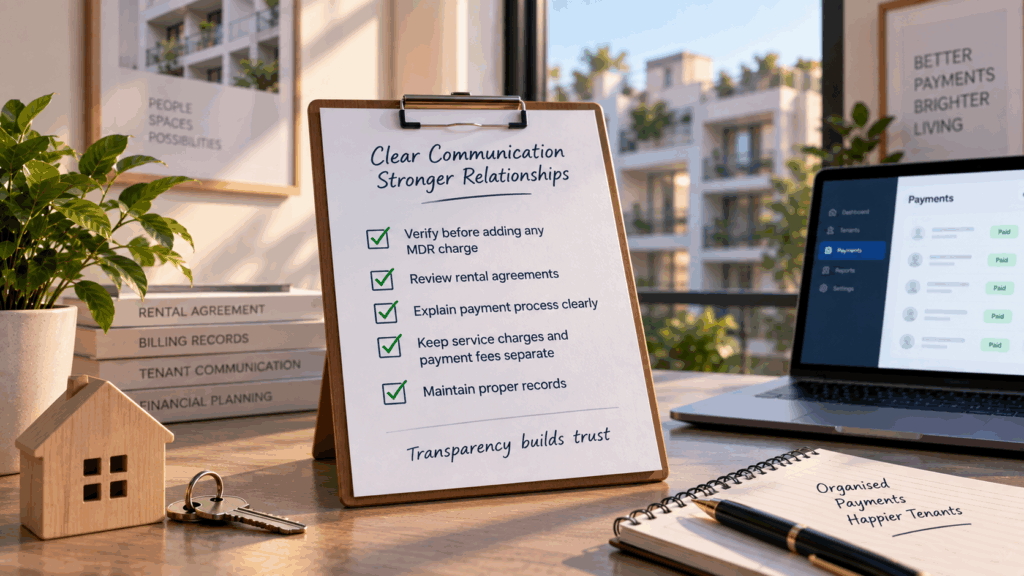
- Do not introduce an unverified MDR charge: Owners should confirm the applicable rules before adding any separate amount to a tenant’s payment request.
- Review rental agreements: Existing agreements should be examined before changing rent, service charges, or other agreed amounts.
- Explain payment processes clearly: If the payment method changes, tenants should receive advance communication. The message should explain the process in simple terms.
- Separate service charges from payment fees: A legitimate service charge and a payment processing fee are not automatically the same. They should not be presented as interchangeable.
- Maintain proper records: A clear billing structure helps both the owner and tenant understand the amount due and the reason for each charge.
Transparency can reduce confusion and prevent avoidable disputes. It also helps property operators maintain trust while adapting to changes in the payment ecosystem.
For more information about improving the payment experience, owners can read How Property Management Software Helps You Collect Rent on Time. The article explains how reminders, payment links, digital receipts, and rent ledgers support organised collections.
Is There an Account-Freeze Risk if MDR Is Ignored?
Discussions about new payment rules may sometimes include claims about bank account freezes. Such claims should be examined carefully.
The sources reviewed for the revised UPI MDR framework do not establish that a bank account will automatically be frozen because a merchant fails to pay MDR. Therefore, property owners should not treat an automatic account freeze as a confirmed or universal consequence.
However, payment-related compliance and settlement issues can still create operational challenges. These challenges may depend on the terms of the payment provider, transaction disputes, verification requirements, or other account-related conditions.
Owners should focus on verified risks rather than relying on unconfirmed claims.
Operational Problems That Owners Should Monitor
A poorly managed payment process may create several difficulties:
- Settlement delays: A payment provider may hold or delay a settlement because of a dispute, verification issue, or other operational concern. This can affect the timing of incoming funds.
- Reconciliation errors: If payment deductions are not recorded properly, the amount received may differ from the amount expected. This can create confusion during accounting.
- Unexpected expenses: Owners who do not understand the applicable payment costs may find it difficult to prepare accurate monthly budgets.
- Payment disputes: Tenants may question a payment if the amount, status, or receipt is unclear. A centralised record can help staff respond with accurate information.
- Weak compliance visibility: Businesses may face difficulties if they do not maintain relevant documents, provider communication, or transaction records.
The practical approach is to confirm the payment rules directly with the service provider. Owners should also maintain clear records of transactions, settlements, and communication.
Financial discipline comes from accurate information. It should not be based on rumours about automatic penalties or account restrictions.
Why UPI AutoPay Is Relevant for Rent Collection
Rent is a recurring obligation. Tenants must usually make payments on a fixed date every month. When the process depends entirely on manual action, delays can occur because of forgetfulness, busy schedules, payment confusion, or insufficient follow-up.
UPI AutoPay offers a different approach. It allows tenants to authorise recurring payments through a mandate. Once approved, the payment can be processed according to the agreed schedule and conditions.
Recurring mandates may receive different treatment from one-time merchant transactions under the revised framework. However, owners should confirm the exact applicability with their payment provider before assuming that a particular payment is exempt from MDR.
AutoPay should be viewed as a payment workflow tool. It can reduce repetitive payment actions and improve consistency, but it does not eliminate every possible payment failure.
How a Recurring Rent Payment Works
A typical UPI AutoPay process may include the following steps:
- Mandate request: The tenant receives a recurring payment request through the payment platform.
- Tenant authorisation: The tenant reviews the details and approves the mandate through their UPI application.
- Payment schedule: The payment date, amount, and applicable limit are established according to the mandate.
- Recurring collection: Rent is processed on the scheduled date, subject to mandate validity and other payment conditions.
- Payment confirmation: The payment status is recorded so that the tenant and property team can identify whether the transaction was successful.
- Follow-up for failed payments: If the transaction fails, the property team can follow the appropriate process for communication and collection.
AutoPay can make recurring collections more predictable. It can also reduce the need for owners to send the same payment reminder every month.
For a detailed explanation of the feature, read What Is AutoPay for Rent Collection?. The article explains mandate approval, recurring payments, tenant control, and common collection challenges.
What Are the Benefits of AutoPay for PG Owners?
The value of AutoPay extends beyond automatic payment initiation. It can help owners create a consistent collection process across multiple tenants.
In a manual system, staff may spend several days sending reminders and checking payment screenshots. They may also need to contact tenants whose payments have not been received. This process becomes harder when the number of occupants increases.
AutoPay can reduce some of these repetitive activities. It gives tenants an option to authorise payments in advance, while the property team can focus on monitoring payment status and handling exceptions.
Key Benefits for Rental Businesses
- Reduced manual follow-ups: Owners may not need to send repeated reminders for every recurring payment. This can reduce routine administrative work for property staff.
- Improved payment consistency: A scheduled mandate creates a defined payment process. Tenants still need to maintain sufficient funds and ensure that their mandate remains active.
- Better collection planning: Recurring payment schedules can help owners estimate when payments are expected. This supports monthly cash-flow planning.
- Lower reconciliation effort: When payment records are connected to tenant information, staff can spend less time identifying individual transactions.
- Easier scaling: A structured payment workflow becomes more useful as the property adds tenants or expands across multiple locations.
AutoPay does not guarantee that every payment will succeed. Transactions may fail because of insufficient funds, technical issues, cancelled mandates, or other conditions. Therefore, owners still need a process for tracking failed payments and outstanding dues.
The strongest approach combines automation with visibility. Automatic payments can support the process, while accurate records help staff manage exceptions.
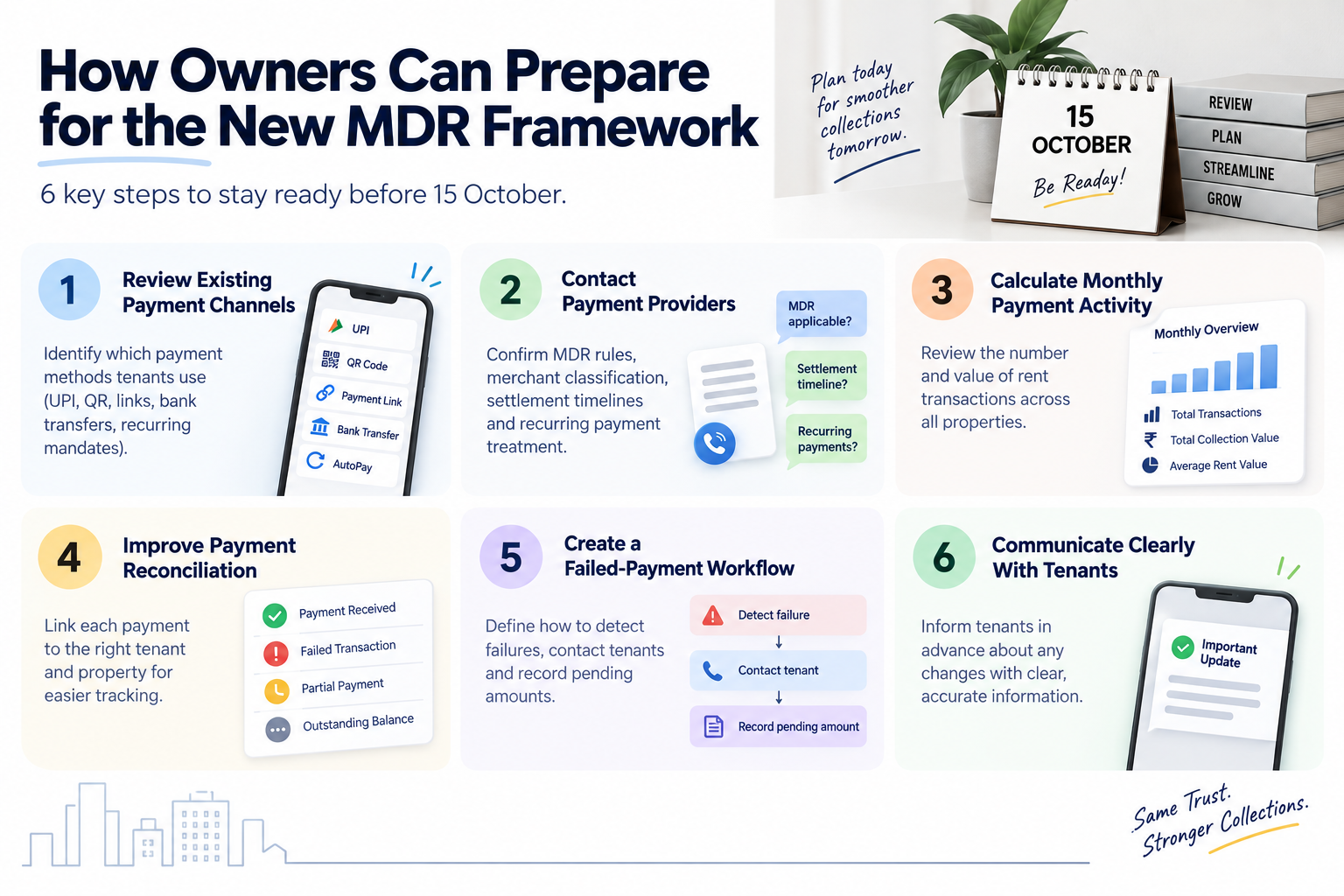
How Owners Can Prepare for the New MDR Framework
Preparation should begin before 15 October. Owners should first understand how rent is currently collected and then review whether the existing system can support the new requirements.
The process does not need to be complicated. A structured review can help owners identify payment costs, operational gaps, and opportunities for improvement.
1. Review Existing Payment Channels
Identify whether tenants use UPI IDs, QR codes, payment links, bank transfers, or recurring mandates. Record which channels are most frequently used and whether they create reconciliation challenges.
This review will help owners understand the payment routes used across their properties.
2. Contact Payment Providers
Owners should ask their payment providers about MDR applicability, merchant classification, settlement timelines, and recurring payment treatment.
Written clarification can help prevent confusion later. It is better to confirm the applicable rules than to rely on assumptions.
3. Calculate Monthly Payment Activity
Review the number and value of monthly rent transactions. Owners should consider the total collection volume rather than looking at one payment in isolation.
This can help them understand possible financial and operational implications.
4. Improve Payment Reconciliation
Payment records should be connected to the relevant tenant and property. The system should make it easy to identify successful payments, failed transactions, partial payments, and outstanding balances.
This is especially important when multiple tenants pay similar amounts or use family members’ bank accounts.
5. Create a Failed-Payment Workflow
AutoPay and other digital payment methods can still experience failures. Owners should define how the team will identify failed transactions, contact tenants, and record pending amounts.
A consistent workflow reduces confusion and prevents missed follow-ups.
6. Communicate Clearly With Tenants
If the payment process changes, tenants should be informed in advance. Communication should be accurate, simple, and aligned with the applicable rules.
Owners should avoid presenting unverified claims about MDR, account freezes, or mandatory additional charges.
For owners who want to measure the efficiency of their collection process, How to Track Rent Collection Performance explains useful metrics. These include on-time payments, delayed collections, outstanding dues, and collection performance.

How Rent Collection Software Supports Financial Visibility
MDR is only one part of a property’s payment operations. Owners must also track rent generation, payment status, outstanding dues, and settlement records.
A standalone payment app may show that money has been received. However, property management software can connect the payment with a broader tenant and property record.
This distinction becomes important when a business grows. Owners need more than a list of bank transactions. They need to understand which tenants have paid, how much is outstanding, and whether the collection cycle is progressing as expected.
A connected system can support several activities:
- Tenant-level tracking: Payment records can be associated with individual tenant profiles. This makes it easier to review payment history and outstanding amounts.
- Property-level visibility: Owners managing multiple properties can review collections across different locations instead of relying on separate spreadsheets.
- Automated reminders: Payment reminders can help tenants remember upcoming or overdue payments. The timing and communication should follow the property’s policies.
- Digital receipts: Receipts provide documentation of completed payments. They can also help reduce confusion during tenant queries.
- Collection reporting: Reports can help owners identify delayed payments, recurring issues, and changes in monthly collection performance.
The purpose of technology is not simply to digitise an existing manual task. It is to connect different parts of the process so that owners can make decisions using reliable information.
Property operators can also explore Best Property Management Software in 2026. The guide discusses rent collection, tenant management, digital documentation, and other important software features.
How RentOk Helps
RentOk helps PG owners, landlords, and property managers organise rent collection through a connected property management platform. Its payment and tenant management features can support recurring rent workflows, payment tracking, reminders, and financial visibility. With RentOk AutoPay, owners can explore a more structured way to manage recurring rent payments and reduce repetitive manual follow-ups. The platform also helps connect payment activity with tenant records, making it easier to monitor collections and identify pending dues. While AutoPay does not automatically remove every payment-related cost or guarantee that transactions will never fail, it can support a more organised collection process. This allows property teams to focus on payment visibility, reconciliation, and timely action when a transaction requires attention.
Conclusion: Prepare Your Rent Collection Process Before 15 October
The revised UPI MDR framework will introduce charges on specified P2M transactions above ₹2,000 from 15 October 2026. However, the framework does not apply to every UPI transaction. P2P payments remain free, small-value merchant payments remain protected, and eligible small merchants continue to receive zero-MDR benefits under the stated conditions.
For property owners, the priority should be understanding the payment classification and reviewing the current collection process. They should confirm the applicable rules with their payment providers and avoid making assumptions about direct tenant charges or automatic account freezes.
A structured payment system can help owners manage recurring collections, track settlements, reduce manual work, and maintain clearer financial records. As rental businesses grow, these capabilities become increasingly important.
Explore RentOk AutoPay to understand recurring rent collection, simplify payment workflows, and prepare your property for changing digital payment requirements.
FAQ’S
1. Can MDR rates differ based on the type of merchant?
Yes, MDR rates may vary depending on the merchant category and transaction type. Property owners should confirm the applicable rate and conditions with their payment service provider.
2. Does the ₹2,000 threshold apply to the total monthly rent?
The framework refers to eligible individual UPI transactions above ₹2,000. Owners should review how their payment provider classifies each transaction rather than assuming that monthly rent totals determine MDR.
3. How can owners identify MDR deductions in their settlements?
Owners should compare the gross payment amount with the final settlement received in their bank account. Payment statements and transaction reports can help identify applicable deductions and reconciliation differences.
4. What information should owners request from payment providers?
Owners should ask about merchant classification, applicable MDR rates, settlement timelines, transaction categories, and recurring mandate treatment. Written clarification can help prevent confusion during implementation.
5. Can tenants cancel an active UPI AutoPay mandate?
Yes, tenants may have options to manage or cancel mandates through their UPI application, subject to the applicable terms and process. Owners should maintain a clear procedure for handling cancelled or inactive mandates.
6. What happens when a recurring rent payment fails?
A recurring payment may fail due to insufficient funds, technical issues, or an inactive mandate. Property teams should track failed transactions and follow up with tenants through a defined collection process.