
Hostel Channel Manager Explained
If you’re running a hostel today, your biggest challenge isn’t demand, it’s coordination.
Beds are getting booked across Hostelworld, Agoda, Booking.com, and sometimes even direct channels. Each platform operates independently, but your inventory does not. And that gap, between where bookings happen and where availability is tracked, is where most operational issues begin.
At a smaller scale, this might feel manageable. You can update availability manually, keep track of bookings, and coordinate things as they come. But as soon as booking volume increases, this approach starts showing cracks.
A hostel channel manager exists to solve exactly this problem. It connects all your booking platforms to a single system, ensuring that availability, reservations, and updates stay aligned in real time.
It’s not just about saving time, it’s about creating a system that continues to work even as your hostel grows.
Managing beds across platforms is not the same as managing rooms
Most booking systems are built with rooms in mind. Hostels, however, operate on a completely different structure.
You’re managing beds within shared rooms, which means availability is constantly changing. A dorm might be partially occupied, almost full, or just opening up, and that exact state needs to reflect across every platform instantly.
This introduces a layer of complexity that manual systems struggle to handle.
For example, a single booking doesn’t just “block availability.” It:
- Reduces bed count within a shared room while keeping the room active for further bookings
- Needs to reflect accurately across multiple platforms at the same time
- Requires continuous updates as guests check in and out at different times
When handled manually, this creates a repetitive loop, log in, update, verify, repeat. It works temporarily, but it’s fragile.
A channel manager removes this dependency.
Instead of managing each platform separately, you control your inventory from one place. The system distributes availability automatically, ensuring every platform reflects the same data without delay.
This shift is important because it changes your role, from constantly updating systems to actually managing operations.
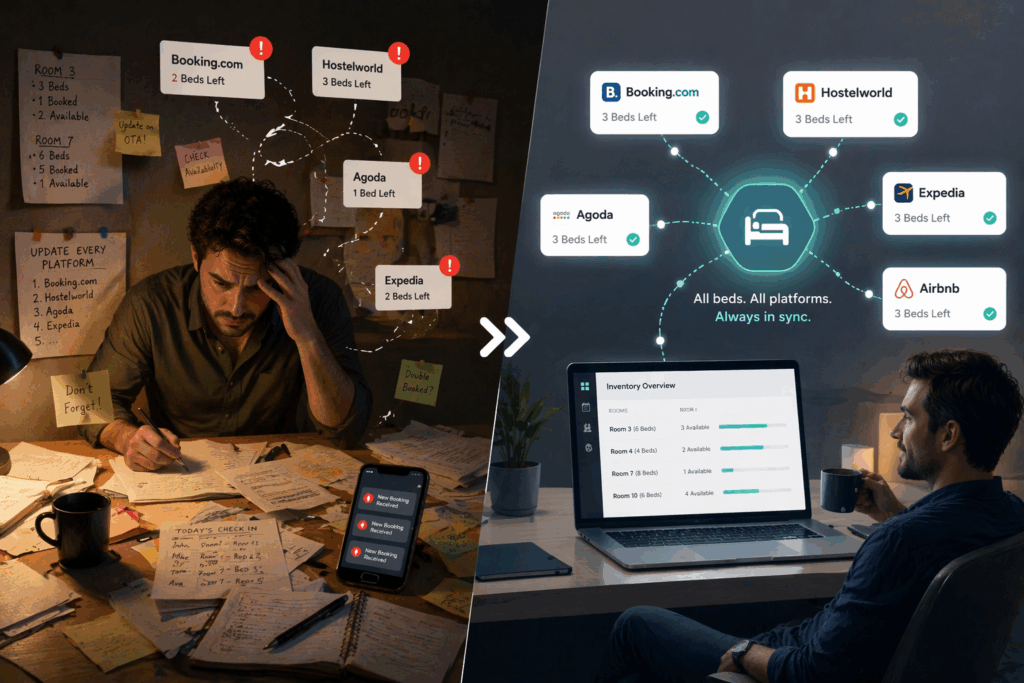
Overbooking isn’t a rare error it’s a system failure
Most hostel operators treat overbooking as something that “just happens sometimes.” In reality, it’s predictable.
It happens when your systems are not connected.
A booking comes in on one platform. Another platform hasn’t updated yet. A second booking is accepted. Now you’re not managing inventory, you’re managing damage.
The consequences are immediate:
- You scramble to relocate guests
- You issue refunds
- You lose trust
- You get reviews that stay online longer than the mistake itself
What’s important to understand is this:
Overbooking is not a human error problem. It’s a synchronization problem.
A channel manager removes this entirely by ensuring that every booking instantly updates your availability across all platforms. There’s no delay window where conflicts can happen.
And once that system is in place, overbooking stops being something you manage, it becomes something that simply doesn’t occur.
Why fragmented reservations quietly slow you down
Even when bookings are flowing in, inefficiencies often build quietly behind the scenes.
Your reservations are spread across multiple platforms. Guest messages arrive from different inboxes. Availability sits in separate dashboards. None of this is broken individually, but together, it creates friction.
You might not notice it immediately, but over time it shows up in your workflow.
You start:
- Switching between platforms just to confirm a single booking detail, which slows down response time
- Rechecking availability across systems because there’s no single source of truth
- Spending more effort coordinating information than actually managing the property
This kind of fragmentation divides your attention. Instead of working in a flow, you’re constantly resetting context.
A hostel channel manager brings everything into one place.
When reservations are centralized, your workflow becomes smoother. You no longer need to track where information lives, it’s already aligned. That clarity allows you to focus on operations instead of coordination.
Central visibility changes how decisions are made
When your data is scattered, your decisions tend to be reactive.
You respond to bookings as they come in, adjust availability when needed, and handle issues as they arise. There’s little room for planning because you’re always catching up.
Centralized visibility changes this dynamic.
With everything in one place, patterns start becoming visible. You can see how your beds are filling, which dorms are moving faster, and where availability gaps are forming.
This allows you to act earlier and more strategically.
For instance, you can:
- Identify high-demand periods in advance and adjust availability or pricing accordingly
- Allocate rooms more efficiently based on booking patterns instead of reacting last minute
- Maintain better control over occupancy instead of constantly adjusting to changes
This level of visibility doesn’t just improve efficiency, it improves confidence in your decisions.
A channel manager works best as part of a larger system
A channel manager handles distribution and syncing. But hostel operations go beyond just bookings.
You’re also managing guest movement, check-ins, room allocation, payments, and daily coordination. If these processes exist outside your booking system, you’re still dealing with disconnected workflows.
This is where many setups fall short, they solve one layer but leave the rest fragmented.
A complete online hostel management system connects these pieces.
When bookings and operations are part of the same system:
- Availability updates are already reflected in your day-to-day operations
- Guest movement aligns with booking data without manual coordination
- You don’t need to constantly verify whether information is up to date
Everything moves in sync, which reduces confusion and improves consistency across your operations.
Why hostel operations need more than generic tools
Hostels are dynamic environments. Beds turn over frequently, rooms are partially occupied, and availability changes throughout the day.
This is very different from traditional setups where availability is more static.
Generic tools often struggle here because they are built for simpler structures. They assume full-room bookings, predictable occupancy, and minimal overlap.
Hostels require a system that can handle:
- Continuous changes in availability at the bed level, not just room level
- Frequent updates without slowing down operations or requiring manual correction
- Clear visibility into occupancy that reflects real-time conditions, not delayed data
When these capabilities are missing, small inconsistencies start appearing. They may not seem critical at first, but over time they create friction in daily operations.
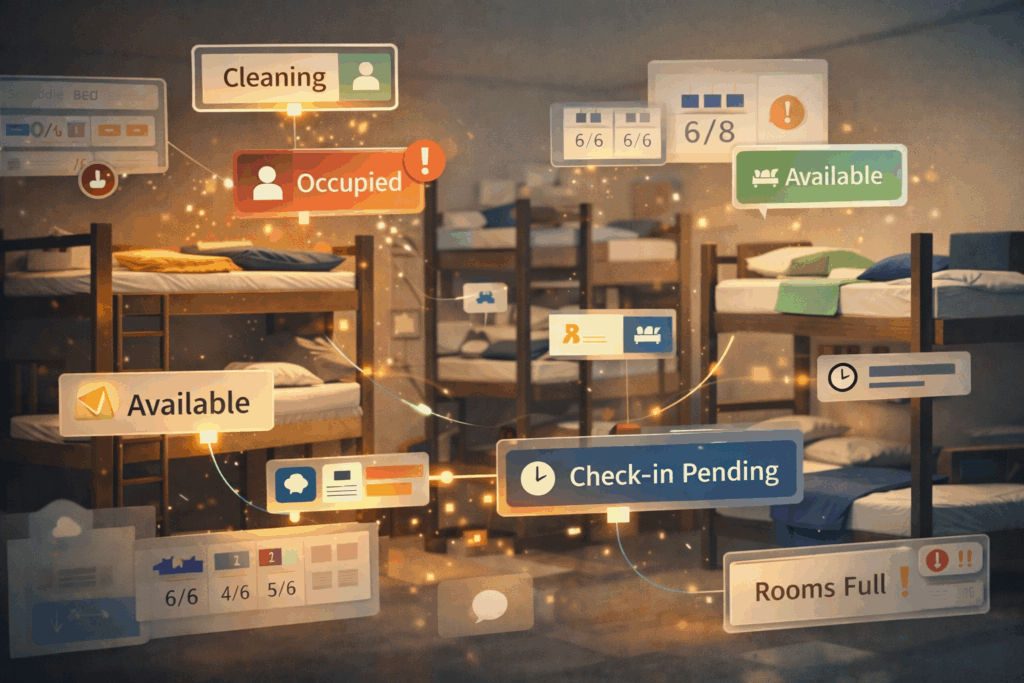
When manual coordination starts holding you back
Manual systems don’t fail immediately, they gradually become inefficient.
At first, everything feels under control. But as bookings increase, coordination starts taking more time. You spend more effort keeping things aligned than actually improving operations.
It often shows up subtly:
- You double-check availability before confirming bookings because you don’t fully trust the system
- You rely on notes, messages, or memory to track important details across platforms
- You spend more time coordinating between systems than focusing on guests or experience
This is usually the point where growth slows down, not because demand is low, but because the system isn’t structured to handle it.
A channel manager removes this constant dependency on manual coordination. It ensures that availability, bookings, and updates stay aligned without requiring continuous attention.
That’s what creates operational stability.
Where RentOk fits into hostel operations
A channel manager ensures your external bookings stay synced. But your internal operations still need structure.
RentOk connects these layers.
Instead of managing bookings, availability, and occupancy separately, it brings them into a single system where everything is visible and aligned.
This allows you to:
- Track bed-level availability while simultaneously monitoring how rooms are actually occupied
- Manage bookings without needing to cross-check multiple systems or platforms
- Maintain clear and structured guest records that stay connected to your operations
This becomes especially valuable in shared setups like hostels, PGs, and co-living spaces, where everything is interconnected.
When your system reflects how your property actually functions, operations become significantly easier to manage.
Bringing it all together
At a certain point, managing a hostel stops being about handling bookings and starts being about managing systems.
A hostel channel manager is the foundation of that system. It keeps your availability accurate, your bookings aligned, and your operations stable across platforms.
As your hostel grows, this structure becomes the difference between constant coordination and controlled operations.