
Airbnb Booking Management Software vs. Property Software
Most operators don’t begin by comparing tools. They begin by solving immediate problems.
It usually starts with one or two Airbnb listings. At that stage, managing everything manually still feels manageable. You reply to messages, track bookings, and coordinate check-ins without much friction. There’s effort involved, but it’s still under control.
As listings increase, however, the nature of the work changes.
You’re no longer just managing bookings, you’re managing volume. Messages start overlapping, availability needs constant updating, and coordinating cleaning between back-to-back stays becomes more demanding. Small delays begin to create bigger issues.
This is when most operators adopt airbnb booking management software. It brings immediate relief by organizing bookings, automating communication, and reducing the operational pressure of handling multiple guests.
But over time, a different challenge starts to emerge, one that booking tools alone don’t fully address.

Comparing Niche Airbnb Tools to Full Property Systems
Airbnb booking tools and property management systems are built with fundamentally different intentions.
Booking software is designed to handle short-term rental activity efficiently. It focuses on managing reservations, automating guest communication, and keeping availability synchronized across platforms. These tools are highly effective at dealing with the fast-paced nature of short-term rentals.
Property management software, in contrast, is designed to manage the broader system behind those bookings. It looks at the property not just as a listing, but as an ongoing operation that needs structure, visibility, and consistency.
This includes managing:
- Payment flows across multiple tenants or guests
- Occupancy patterns across properties
- Operational processes like maintenance and record-keeping
At a glance, both systems may appear similar because they interact with bookings. But in practice, they operate at completely different levels.
One helps you stay organized in the moment.
The other helps you understand and manage the entire system over time.
The Real Problem: Bookings Are Only One Layer
One of the biggest misconceptions in rental operations is that bookings are the hardest part.
In reality, bookings are just the entry point.
Once a booking is confirmed, a series of operational responsibilities follow, payment tracking, room readiness, tenant or guest records, and overall performance monitoring. These layers are less visible but far more critical as operations grow.
For example, you may be handling bookings efficiently, but still struggle to answer questions like:
- How consistent is your occupancy across properties?
- Are all payments being tracked accurately?
- Which units are underperforming and why?
These are not booking-level concerns. They are operational insights.
Airbnb booking tools are not built to answer these questions in depth. They are designed to manage activity, not to provide a complete view of how your rental business is functioning.
This is why many operators feel organized on the surface, but still lack clarity underneath.
Feature Overlaps: Why the Choice Feels Unclear
As the market has evolved, the distinction between tools has started to blur.
Airbnb management tools now include dashboards, limited reporting, and basic financial tracking. At the same time, modern property management systems have introduced booking views, calendar integrations, and guest-level data.
This overlap creates the impression that both systems can serve the same purpose.
However, the difference lies in how deeply each system supports its core function.
Booking tools provide just enough structure to improve how you manage reservations and communication. Property systems go further by connecting that data to financial tracking, operational workflows, and long-term performance.
The result is a difference not in features, but in context.
Booking tools show you what is happening right now.
Property systems help you understand what is happening overall.
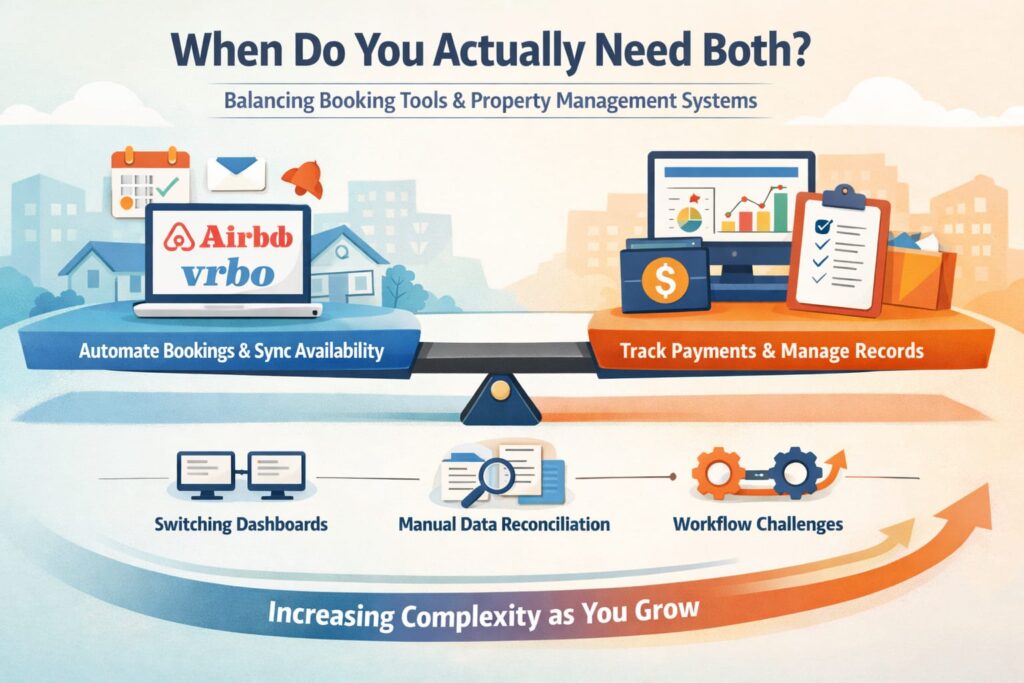
When Do You Actually Need Both?
There are scenarios where using both systems is justified.
If you are managing multiple listings across platforms like Airbnb and Vrbo, booking tools can significantly improve efficiency by automating guest communication and synchronizing availability. At the same time, a property management system can help track payments, maintain records, and monitor overall performance.
In such cases, each system handles a different layer of your operation.
But this approach also introduces a new kind of complexity.
Managing two systems often means:
- Switching between dashboards to get a complete picture
- Reconciling data manually when inconsistencies appear
- Maintaining workflows across tools that are not fully integrated
While this setup may work initially, it can become harder to manage as your portfolio expands.
The Shift From Managing Bookings to Managing a Business
Every rental operator reaches a point where the focus shifts.
Initially, the goal is to manage bookings efficiently, responding quickly, avoiding double bookings, and ensuring smooth guest experiences.
But as operations grow, the priority changes.
You begin to focus on:
- How consistently your properties are performing
- Where inefficiencies are affecting operations
- How to maintain control as complexity increases
This is where the limitation of booking-only tools becomes evident.
They continue to perform well at what they were designed for. But they do not provide the depth required to manage a growing operation.
At this stage, what you need is not just automation, but visibility and structure.
How RentOk Fits Into This Transition
As the gap between booking tools and full property systems becomes clearer, many operators start looking for a solution that doesn’t force them to choose between the two.
This is where RentOk fits in.
Instead of focusing only on bookings or only on backend operations, RentOk connects both sides of the workflow. It allows you to manage availability, track bookings, monitor occupancy, and maintain structured records, all within a single system.
This becomes especially useful when your operations go beyond a single rental model. Whether you’re handling short-term stays, PG setups, or long-term units, managing everything through separate tools can quickly become inefficient.
RentOk brings these workflows together, helping you move from simply managing bookings to actually understanding how your properties are performing.
Bringing Bookings and Operations Together
The difference between managing bookings and managing a rental business becomes more apparent as you scale.
Airbnb booking software is highly effective at helping you handle reservations and guest interactions. But as your operations expand, the need shifts toward understanding performance, maintaining structure, and ensuring consistency across properties.
This is where a more integrated system becomes essential.
Discover how RentOk can help you go beyond basic Airbnb booking management. Track availability, monitor occupancy, streamline operations, and manage your entire rental workflow from one centralized platform built for growing property businesses.