
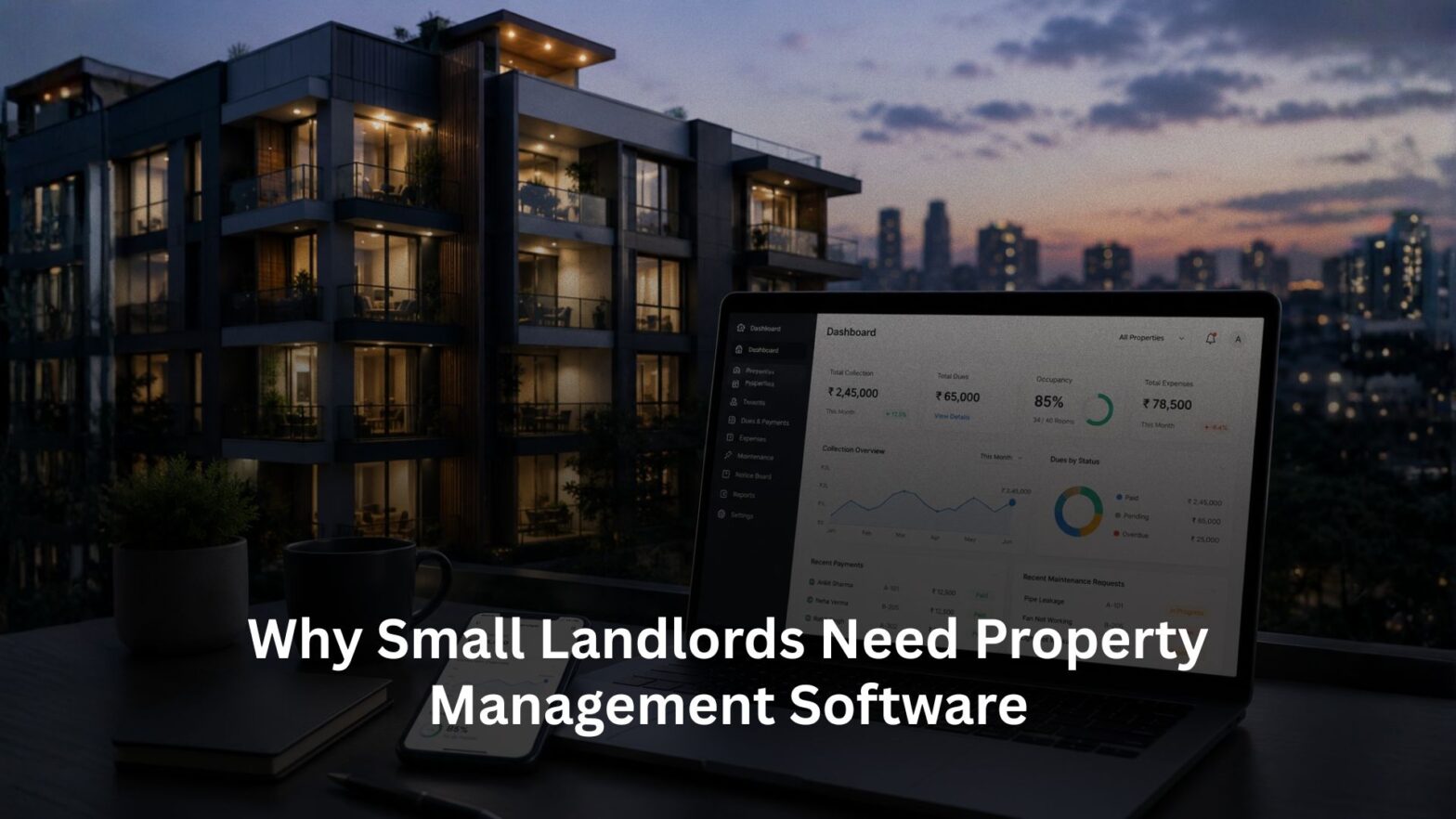
Why Every Small Landlord Needs Property Management Software
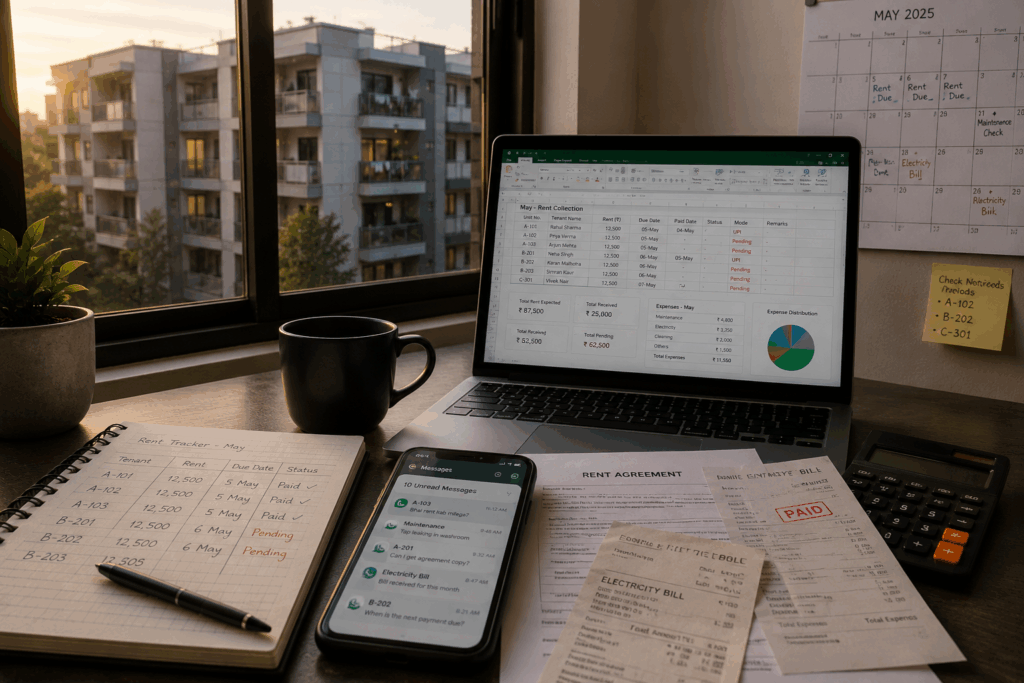
Managing a rental property can look deceptively simple from the outside. Rent comes in every month, tenants occupy the property, maintenance gets handled when required, and the landlord collects the income. For a property with a handful of tenants, this may genuinely be manageable through a notebook, Excel sheet, WhatsApp conversations, and a few reminders on the phone.
The difficulty begins when these small responsibilities start happening at the same time.
One tenant has not paid rent. Another has raised a maintenance complaint. A third is asking for a copy of the agreement. An expense needs to be recorded, a room is about to become vacant, and at the end of the month the landlord still needs to figure out how much the property actually earned. None of these tasks is particularly difficult on its own, but managing all of them manually creates a system that depends heavily on memory and constant follow-up.
This is why property management software for small landlords is becoming increasingly relevant. It is not about introducing technology for the sake of technology. It is about creating a more reliable operating system for the property, one where payments, tenants, expenses, communication, and occupancy are easier to track and manage.
For landlords who are still growing their portfolio, adopting a structured system early can also prevent a common problem: waiting until operations become chaotic before deciding they need better tools.
When Does Manual Property Management Start Becoming a Problem?
Manual management is not automatically bad. If you own one property with two tenants, a spreadsheet and direct communication may be perfectly practical.
The problem is that rental operations rarely stay that simple.
As the number of tenants or properties grows, so does the amount of information that needs to be tracked. Every tenant adds payment cycles, documents, complaints, notices, agreements, and communication to manage.
- Repetitive Rent Follow-Ups – Rent follow-ups become repetitive because every payment cycle requires checking who has paid, who is pending, and who needs a reminder instead of having the process happen systematically.
- Scattered Tenant Information – Tenant information becomes scattered across spreadsheets, WhatsApp chats, documents, and phone records, making it difficult to find the right information when it is actually needed.
- Missed Maintenance Requests – Maintenance requests are easily missed because a complaint mentioned casually in a conversation does not provide the same visibility as a properly recorded and trackable request.
- Difficult Expense Tracking – Property expenses become harder to reconcile because individual repairs, utilities, purchases, and other costs are often recorded separately from the income they affect.
- Reactive Vacancy Management – Vacancies become reactive rather than planned because landlords may not have a clear view of upcoming move-outs, notice periods, or which rooms are likely to become available.
The issue is not that landlords cannot manage these tasks manually. It is that manual systems make consistency dependent on the landlord, and that becomes harder as the property business grows.
For a deeper look at how this dependency affects a landlord’s time and day-to-day operations, read The Landlord’s Life: How to Automate and Regain Your Weekends.
And that becomes increasingly difficult as the property business grows.
WhatsApp and Excel Are Useful. But Are They Enough?
WhatsApp and Excel are popular among landlords for a simple reason: they are familiar, accessible, and inexpensive.
A landlord can create an Excel sheet for rent payments, maintain another tab for expenses, and use WhatsApp to communicate with tenants. There is nothing inherently wrong with using these tools. The problem arises when they are expected to function as a complete property management system.
Excel can store information very well, but it does not automatically manage the workflow around that information. A spreadsheet may tell you that a tenant’s rent is pending, but someone still has to notice it, contact the tenant, record the payment, and update the sheet.
WhatsApp has a similar limitation. It is excellent for communication, but conversations are not designed to become structured operational records. A payment reminder sent three weeks ago, a complaint discussed yesterday, and an important notice buried between unrelated messages are difficult to manage systematically.
This is why the difference between recording information and managing operations matters.
A spreadsheet can tell you what happened. A proper property management system should help you understand what is happening, what requires attention, and what needs to happen next.
This shift from individual tools to connected workflows is explored further in All-in-One Property Management Software: Is It Worth It?, which looks at why using separate tools for tenants, payments, communication, and reporting can create operational friction as a property business grows.
That distinction becomes especially important when a landlord is managing multiple properties or several dozen tenants.
What Does Property Management Software Actually Change?
Property management software brings the different parts of rental operations into a connected system. Instead of treating rent collection, tenant management, expenses, complaints, and occupancy as separate activities, it creates a centralized view of the property.
The objective is not to make landlords spend more time inside software. It is almost the opposite: less time should be required to keep the operation organized.
At a basic level, property management software can help landlords manage:
- Rent collection and dues: Payments, pending amounts, reminders, and payment history can be organized without manually reconciling every tenant every month.
- Tenant records: Important information can remain connected to the tenant rather than being distributed across multiple files, notebooks, and conversations.
- Property and room information: Landlords can maintain better visibility into occupied, vacant, and upcoming available units, particularly when managing shared accommodation.
- Expenses and financial records: Property-related costs can be recorded alongside income, making it easier to understand the financial performance of the property.
- Communication and announcements: Important updates can be delivered more systematically instead of relying entirely on individual follow-ups or busy WhatsApp groups.
- Reports and dashboards: Instead of manually combining information from different sheets, landlords can access a clearer view of collections, dues, expenses, occupancy, and other operational metrics.
The real advantage comes from having these functions connected. A landlord should not have to look in five different places to understand the current state of one property.
Which Features Actually Matter for a Small Landlord?
Choosing property management software should not become a competition over who offers the longest feature list. A small landlord does not necessarily need dozens of advanced functions. What matters is whether the software solves the repetitive problems that consume time every month.
Automate Rent Collection
Rent automation is one of the most important starting points. Rent is the financial engine of the property, so the system should make it easier to generate dues, send reminders, record collections, and maintain payment history. The purpose is to reduce the amount of manual chasing required every month.
Keep Tenant Information Organized
Tenant management should go beyond simply storing names and phone numbers. A useful system should give landlords a structured tenant profile where relevant details, documents, payment history, occupancy information, and other records can be accessed without searching through old conversations.
Track Occupancy and Availability
Occupancy visibility becomes increasingly important as the property grows. Knowing which rooms are occupied today is useful, but knowing which tenants are approaching their move-out dates or which rooms may soon become available is far more valuable for planning.
Monitor Property Expenses
Expense tracking should also be part of the workflow. Maintenance, utilities, repairs, and other property costs directly affect profitability. If these expenses are recorded separately or only reviewed at the end of the month, landlords can easily lose visibility into the actual performance of the property.
Turn Activity Into Useful Reports
Reports turn daily activity into business information. Instead of simply knowing that rent was collected, landlords should be able to understand collections, dues, expenses, and other property-level numbers without rebuilding the information manually every month.
These are not necessarily “advanced” features. They are the basic building blocks of a property business that needs to operate consistently.
For a broader look at what landlords should expect from these platforms, RentOk has also covered 10 Best Apps for Landlords to Manage Properties in 2026, including the features that matter across different rental setups.
Is Property Management Software Only for Large Property Owners?
This is one of the biggest misconceptions surrounding property management software.
Many small landlords assume that software only becomes worthwhile after they own several buildings or manage hundreds of tenants. In reality, the value of a system often comes from how much repetitive work it removes, not simply from how many properties someone owns.
Imagine two landlords.
The first owns one building with 40 tenants and handles rent collection, complaints, expenses, and tenant records personally. The second owns three apartments with five tenants each but has a very simple operating structure.
The first landlord may actually have a greater need for software because the daily volume of interactions is much higher.
This is why the right question is not, “Do I own enough properties to need software?”
The better question is:
“How much of my time is being spent managing information that software could organize for me?”
If rent reminders, payment tracking, tenant records, expenses, and follow-ups are already taking up significant time, the need for structure has probably arrived.

The ROI Is More Than Just Saving Time
When landlords evaluate software, they often focus on the subscription cost. That is understandable, but it only represents one side of the calculation.
The more useful question is what the current manual process is costing the business.
Consider the time spent every month checking bank statements, updating rent sheets, sending reminders, responding to repetitive tenant questions, tracking expenses, finding documents, and preparing reports. Even if each task takes only a few minutes, the cumulative time can become significant.
There is also a less visible cost: operational mistakes.
A missed reminder can delay a payment. An overlooked vacancy can extend downtime. An incorrect expense entry can distort profitability. A lost document can make a simple dispute unnecessarily difficult to resolve.
A structured system can help reduce these risks while also creating better visibility.
For a small landlord, the return can therefore come from several directions:
- Faster rent collection: Consistent reminders and clearer payment visibility can reduce the dependency on manual follow-ups.
- Lower administrative workload: Repetitive tasks can be organized or automated, freeing the landlord to focus on higher-value responsibilities.
- Better vacancy planning: Earlier visibility into move-outs gives landlords more time to prepare rooms and work on the next occupancy.
- Fewer operational disputes: Centralized records make payment history, tenant information, and property activity easier to verify when questions arise.
- Greater scalability: A system creates repeatable processes that can continue working when another property or more tenants are added.
The financial benefit is therefore not simply “software saves X hours.” It is the combination of time, visibility, consistency, and reduced operational leakage.
What Happens When Your Portfolio Starts Growing?
Growth is where manual systems are tested most severely.
A process that works for ten tenants may start becoming difficult at 30. A spreadsheet that works for one property can become confusing when several properties, rooms, tenants, and payment cycles are added. The problem is not that Excel suddenly stops functioning. The problem is that the person managing it becomes the bottleneck.
Every new property adds another layer of information. With each new tenant comes another payment cycle. As the team grows, every additional staff member introduces another person who needs access to accurate information.
Without a centralized system, landlords often respond by creating more spreadsheets, more WhatsApp groups, and more manual processes.
That creates what can be called operational fragmentation.
Instead of simplifying as the business grows, management becomes increasingly dependent on individual people remembering what needs to happen.
A property management system changes that equation by standardizing the workflow. The goal is to create processes that remain understandable even when the number of tenants, properties, or team members changes.
This is particularly relevant for landlords who are planning to expand into PGs, hostels, co-living, or multiple rental units. The system you build at the beginning can determine how difficult expansion becomes later.
Why Tenant Experience Should Be Part of the Calculation
Property management is not only about the landlord’s convenience. The systems used behind the scenes eventually influence the tenant experience.
A tenant may never see the landlord’s dashboard, but they notice whether rent reminders arrive on time, whether payment records are clear, whether complaints are acknowledged, whether communication is organized, and whether management can quickly answer basic questions.
This matters because tenant experience has a direct connection with retention and reputation.
A property that is professionally managed creates confidence. Tenants know where to make a request, how payments are recorded, and what to expect from management. This reduces unnecessary friction for both sides.
Technology therefore becomes more than an administrative tool. It becomes part of the operating structure that supports the tenant relationship.
For landlords exploring how rental management is changing more broadly, What Is Rental Management? Tools to Manage Your Property Efficiently is a useful next read, particularly around tenant management, automation, occupancy, reporting, and the shift toward digital rental operations.
How Should a Small Landlord Choose the Right Software?
The best property management software is not necessarily the one with the most features or the longest list of integrations. It is the one that fits the landlord’s actual operating model.
Before choosing a platform, look at how easily it can handle your current workflow. If the software requires extensive manual setup for every small task, it may simply replace one administrative burden with another.
A practical evaluation should include questions such as:
- Does it support the way you collect rent today? For Indian landlords, convenient digital payment options and reliable payment tracking should be considered essential rather than optional.
- Can you access your property information when you are away from the property? Mobile accessibility matters because property management rarely happens entirely from a desk.
- Can it grow with your portfolio? A system should remain useful if you move from one property to multiple properties or from a few tenants to a larger rental operation.
- Does it give you meaningful reports? A dashboard should help you understand the business rather than simply display information without context.
- Will your tenants and staff actually be able to use it? The most sophisticated system has little value if everyday users find it difficult to understand or adopt.
The objective is simple: choose a system that reduces complexity rather than adding another layer to it.
For landlords comparing platforms based on features, usability, automation, reporting, and overall suitability, Best Property Management Software in 2026 provides a broader comparison of what to look for in a modern property management platform.
How RentOk Helps Small Landlords Manage Their Properties
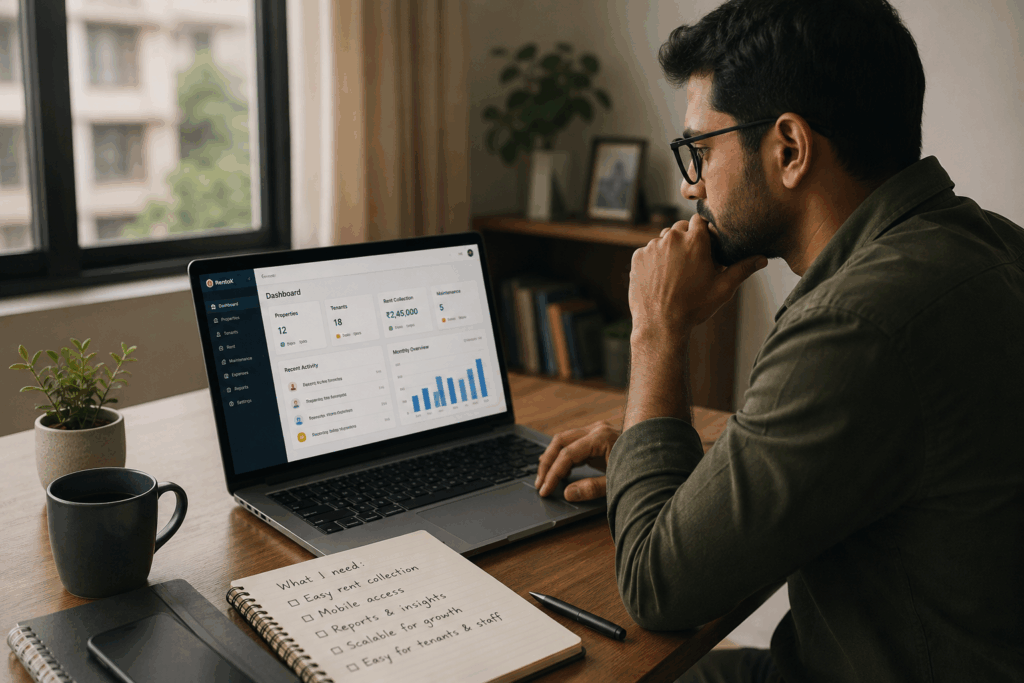
RentOk is built around the day-to-day operational problems that landlords, PG owners, and property managers face as their rental businesses grow. Instead of keeping tenant information, rent tracking, expenses, occupancy, and communication in separate systems, RentOk brings these workflows into a centralized platform.
Landlords can use RentOk to manage tenant records, rent and dues, property expenses, occupancy, communication, and property-level reporting, giving them a clearer view of what is happening across the rental operation. The platform is designed to reduce dependence on spreadsheets, registers, repeated reminders, and fragmented records.
For a small landlord, this can be particularly useful because the same platform can support the business as it grows. What begins as a way to organize a single property’s daily operations can become a broader system for managing multiple properties, tenants, and financial workflows.
RentOk’s approach is also focused on the realities of Indian rental operations, including digital rent collection, automated reminders, tenant management, and operational reporting. Its current property management offering is positioned around helping landlords reduce manual work while maintaining better visibility over their properties.
Final Thoughts
Small landlords often do not need more work; they need better systems. Managing rent, tenants, expenses, maintenance, communication, and occupancy manually may be possible in the early stages, but the same approach becomes increasingly difficult to maintain as the rental business grows.
Property management software creates a more structured way to handle these responsibilities. It can reduce repetitive work, improve payment visibility, organize tenant information, support better vacancy planning, and give landlords a clearer understanding of how their properties are performing.
The real advantage is not simply replacing an Excel sheet with an app. It is moving from a property business that depends on constant manual attention to one that runs on repeatable, visible, and organized processes.
For landlords who are ready to spend less time chasing payments and information and more time growing their rental business, start your free RentOk trial today and explore a simpler way to manage your properties.
FAQ’S
1. Is property management software difficult to set up?
Most modern property management platforms are designed for straightforward onboarding, so landlords can add their property, tenant details, and financial information without needing technical expertise. The right platform should make the transition from manual records simple rather than adding another complicated process.
2. Can a landlord manage multiple properties through one platform?
Yes, property management software can provide a centralized view of multiple properties, allowing landlords to manage tenants, payments, expenses, and property-level information without maintaining separate systems for each location.
3. Can property management software help reduce missed rent payments?
It can make rent collection more consistent by providing better visibility into pending dues and enabling timely reminders. This reduces the need for landlords to manually remember which tenants need follow-ups every month.
4. Is property management software useful for managing tenant documents?
Yes. A centralized system can help landlords keep important tenant information and documents organized, making them easier to access when needed instead of searching through emails, physical files, or messaging conversations.
5. Can small landlords use property management software without a dedicated team?
Absolutely. In fact, small landlords can benefit significantly because they often handle most property operations themselves. A centralized platform can reduce repetitive administrative work without requiring a separate team for every operational task.
6. Does property management software make it easier to track property profitability?
Yes. By bringing collections and property expenses into a structured system, software can give landlords a clearer view of their financial activity. This makes it easier to understand where the property is generating income and where costs are increasing.