
The Landlord’s Life: How to Automate and Regain Your Weekends
Most people enter the rental business believing that property ownership eventually creates freedom. The assumption is simple, once occupancy stabilizes and tenants start moving in consistently, the business becomes easier to manage over time.
But for most landlords, the exact opposite happens.
As operations grow, the property slowly starts demanding constant attention. Rent collection becomes repetitive. Maintenance requests increase. Tenant communication spreads across multiple channels. Staff coordination starts consuming evenings. And eventually, even weekends stop feeling personal because the business remains operational every single day.
This is one of the biggest realities of the rental industry that rarely gets discussed honestly.
Most landlords are not struggling because their properties are unsuccessful. They are struggling because the business depends too heavily on their personal involvement for routine operational tasks.
The issue is not hard work itself. The issue is operational dependency.
When every complaint, payment update, maintenance request, room inquiry, and tenant issue requires the landlord’s direct attention, the business slowly becomes mentally exhausting to run. Over time, this affects not just productivity, but also:
- personal time, because weekends become extensions of operational management instead of actual rest,
- decision-making quality, since constant interruptions reduce mental clarity throughout the day,
- tenant experience, because reactive systems eventually create slower response times and inconsistent communication,
- and long-term business growth, because scaling becomes difficult when the owner remains the center of every workflow.
This is exactly why automation has become such an important shift in modern rental operations.
Not because landlords want to remove the human side of management, but because they want to eliminate repetitive operational friction that consumes time without improving business quality.
Why Most Rental Businesses Quietly Become Exhausting
One of the biggest misconceptions landlords have is assuming burnout only happens when the property faces major problems.
In reality, exhaustion usually comes from continuous small operational interruptions that happen every day.
A tenant asks whether their payment has been received. Another complains about housekeeping delays. Someone requests Wi-Fi support. Staff members need maintenance approvals. A broker asks about room availability. Another tenant suddenly plans to vacate earlier than expected.
Individually, these situations feel manageable.
But collectively, they create a business environment where the landlord remains mentally connected to operations all the time. Even during family dinners, vacations, or weekends, there is always some unresolved issue requiring attention.
This becomes especially difficult in PGs and co-living businesses because the property never truly “closes.” Unlike traditional businesses with fixed working hours, rental operations remain active:
- late at night when tenants return from work or college and report issues,
- early mornings when housekeeping and maintenance coordination begin,
- weekends when move-ins, inspections, and cleaning schedules overlap,
- and during holidays when operational disruptions become harder to manage with limited staff availability.
Without structured systems, every small activity eventually flows upward toward the landlord.
That is where operational fatigue begins.

The Real Cost of Manual Operations
Most landlords think of inefficiency only financially. They focus on:
- rent delays,
- vacancy losses,
- or maintenance expenses.
But the deeper cost is usually invisible.
Manual systems slowly create operational chaos because information becomes fragmented across:
- spreadsheets,
- personal chats,
- verbal coordination,
- notebooks,
- and scattered payment records.
Over time, this creates:
- slower communication because important updates become difficult to retrieve quickly,
- repetitive work since landlords keep handling the same operational tasks manually every month,
- reduced accountability because complaints and follow-ups are not properly tracked,
- and mental overload because the operator constantly switches attention between unrelated issues throughout the day.
Take payment management as an example.
Many landlords still track rent through bank screenshots, manual reminders, and WhatsApp confirmations. Initially, this feels manageable. But once occupancy increases, payment tracking alone starts consuming several hours every week.
The landlord now needs to:
- verify transfers manually across multiple accounts and payment methods,
- identify pending tenants repeatedly before sending reminders,
- maintain records for deposits, extensions, and dues manually,
- and resolve confusion caused by incomplete or scattered financial updates.
The same pattern appears in maintenance coordination.
When complaints arrive through calls, verbal conversations, and individual chats, issue tracking becomes inconsistent. Eventually, the landlord spends more time coordinating updates than actually solving problems.
This is where automation changes the nature of the business completely.
Automation Is Not About Removing Human Interaction
One reason many landlords hesitate to automate operations is because they assume automation makes property management feel impersonal.
But professionally managed rental businesses are not successful because they remove human involvement. They succeed because they reduce unnecessary operational chaos.
That difference matters.
Good automation does not replace management. It improves operational visibility.
Instead of manually checking everything repeatedly, landlords gain structured insight into:
- occupancy movement,
- payment tracking,
- complaint resolution timelines,
- room availability,
- and tenant communication history.
This creates a calmer operational environment because decisions stop depending entirely on memory and reactive coordination.
For example, automated systems can help:
- send structured rent reminders consistently instead of requiring repeated manual follow-ups,
- centralize complaint tracking so maintenance visibility improves significantly,
- maintain organized tenant records that are easy to retrieve during escalations or renewals,
- and simplify occupancy planning by giving real-time room-level visibility.
The result is not less professionalism.
It is stronger operational control.
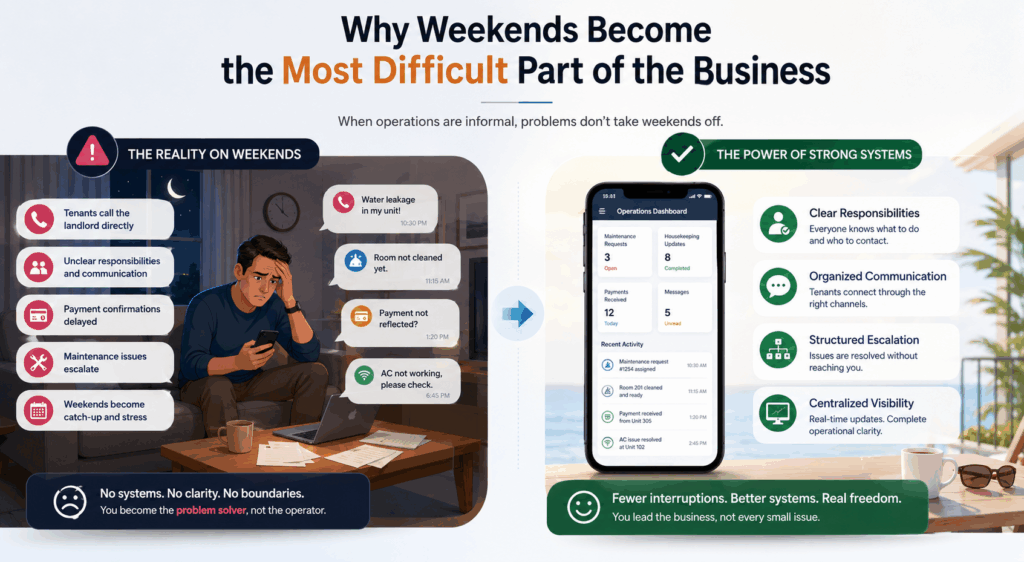
Why Weekends Become the Most Difficult Part of the Business
Interestingly, weekends often reveal operational weaknesses more clearly than weekdays.
This happens because many rental businesses still function informally behind the scenes. Staff responsibilities remain unclear. Tenant communication depends heavily on the landlord. Maintenance coordination lacks structured escalation systems.
As a result, even routine issues quickly reach the owner directly.
For example, a tenant may contact the landlord personally because:
- they do not know whom to approach during emergencies,
- housekeeping updates were not communicated clearly,
- payment confirmation is delayed,
- or staff coordination breaks down outside standard working hours.
Eventually, the landlord stops feeling like an operator and starts functioning like a full-time problem resolver.
This creates a dangerous cycle where:
- weekends become catch-up periods for unresolved operational tasks,
- personal boundaries disappear because tenants expect continuous availability,
- and the business becomes emotionally exhausting even when occupancy is stable.
Strong operational systems solve this differently.
They create predictable workflows where:
- responsibilities are clearly defined,
- communication channels remain organized,
- issue escalation follows structure,
- and operational visibility remains centralized.
Once systems become more structured, landlords no longer need to supervise every small activity personally.
That is where real operational freedom begins.
The First Areas Landlords Should Automate
One common mistake operators make is trying to automate everything immediately. The better approach is identifying the areas creating the highest repetitive workload first.
Rent Collection and Payment Visibility
Rent tracking is one of the largest operational drains in rental businesses because it combines financial coordination, communication, and follow-up management simultaneously.
Manual systems often create unnecessary friction because landlords repeatedly need to:
- check whether payments were received correctly across different payment methods,
- identify pending tenants manually before sending reminders,
- reconcile deposits, dues, and extensions separately,
- and maintain financial records across multiple disconnected systems.
Structured automation simplifies this significantly by creating centralized payment visibility. This improves:
- financial clarity, because pending dues and completed payments become visible instantly instead of requiring repeated manual verification,
- communication consistency, since reminders and payment timelines follow predictable workflows rather than emotional follow-ups,
- operational speed, because landlords spend less time handling repetitive administrative coordination every month,
- and tenant accountability, since payment expectations remain clearly documented and trackable.
Over time, this alone can save landlords several operational hours every week.
Complaint and Maintenance Management
Maintenance coordination becomes difficult when complaints are scattered across calls, chats, verbal updates, and staff conversations.
The issue is not simply delayed resolution. The larger issue is visibility.
Without centralized systems:
- complaints get forgotten during busy operational periods,
- follow-ups become repetitive because updates are unclear,
- staff accountability weakens significantly,
- and tenants lose confidence in management responsiveness.
Structured complaint tracking creates operational clarity by helping landlords:
- monitor issue timelines from reporting to resolution,
- assign responsibilities clearly across staff and vendors,
- maintain communication history during escalations,
- and improve response consistency without depending entirely on memory.
This improves not just efficiency, but also tenant experience.
Because residents feel far more confident living in properties where communication appears structured and predictable.
Occupancy and Room Management
Many landlords still manage room inventory manually through spreadsheets or memory-based coordination.
As occupancy grows, this becomes difficult to sustain.
Move-ins, move-outs, room cleaning schedules, extensions, and booking confirmations start overlapping constantly. Without structured visibility, confusion increases very quickly.
Centralized occupancy systems help operators:
- track room availability in real time,
- reduce allocation errors during onboarding,
- improve room utilization planning,
- and maintain better forecasting visibility across properties.
For landlords managing multiple buildings or franchise-style operations, this visibility becomes operationally essential.
Why Remote Monitoring Is Becoming So Important
One of the biggest shifts happening in modern property management is remote operational visibility.
Earlier, landlords often felt they had to physically visit properties constantly just to understand what was happening operationally.
Today, structured systems allow operators to monitor:
- occupancy,
- payments,
- maintenance requests,
- and tenant activity
without needing continuous physical supervision.
This becomes especially valuable for:
- multi-property landlords managing operations across locations,
- franchise operators handling larger occupancy networks,
- investors balancing multiple businesses simultaneously,
- and growing co-living brands trying to scale efficiently.
Because once operational visibility improves, landlords stop spending energy checking routine activities manually.
Instead, they can focus on:
- business growth,
- tenant experience,
- profitability optimization,
- property expansion,
- and long-term operational planning.
That is the real value of automation.
Not convenience alone.
Strategic operational freedom.
The Mental Health Side of Rental Operations Nobody Talks About
The rental business is emotionally demanding in ways many operators underestimate initially.
Unlike traditional businesses, shared living environments involve continuous human interaction. Landlords constantly deal with:
- tenant expectations,
- financial coordination,
- complaint resolution,
- emergencies,
- staff management,
- and unpredictable operational situations simultaneously.
Without systems, the landlord remains mentally “on call” almost all the time.
Over time, this affects:
- patience during conflict resolution,
- sleep quality because unresolved operational issues remain mentally active,
- personal relationships due to continuous interruptions,
- and decision-making clarity because mental fatigue gradually reduces focus.
Many landlords normalize this pressure because they assume constant stress is simply part of entrepreneurship.
But sustainable businesses require sustainable operational structures.
The operators who survive long-term are usually not the ones working every hour of the day. They are the ones who build systems strong enough to reduce unnecessary operational dependency.
Why Better Systems Also Improve Tenant Experience
Automation is often discussed only from the landlord’s perspective, but tenants benefit heavily from structured operations as well.
When systems are organized:
- issue resolution becomes faster because complaints remain visible and trackable,
- communication becomes clearer since information is centralized instead of scattered,
- payment coordination creates less confusion around pending dues and receipts,
- and overall property management feels more professional and predictable.
Modern tenants increasingly evaluate properties not only on affordability, but also on operational quality.
They want environments where:
- communication feels structured,
- maintenance handling feels responsive,
- and management appears organized instead of reactive.
Properties with strong operational systems naturally perform better because tenants trust predictable management far more than chaotic coordination.
That operational trust directly affects:
- online reviews,
- occupancy retention,
- referrals,
- and long-term brand reputation.
How RentOK Helps Landlords Automate Rental Operations
As rental businesses grow, operational complexity increases rapidly because information becomes fragmented across multiple disconnected systems. Payments are tracked separately, complaint handling happens informally, occupancy updates remain manual, and tenant communication gets scattered across calls and chats.
Over time, this creates continuous dependency on the landlord for routine coordination.
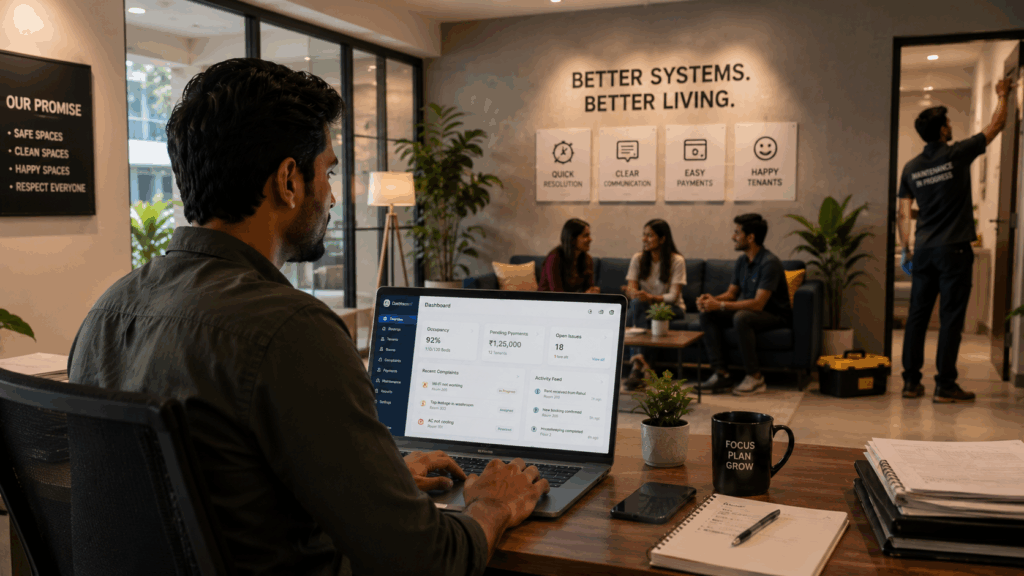
RentOK helps operators centralize day-to-day rental workflows by bringing:
- occupancy management,
- tenant tracking,
- payment visibility,
- complaint coordination,
- operational communication,
- and property management workflows
into one structured system.
This helps landlords reduce repetitive manual work while improving operational clarity across the business.
For growing rental operators, this creates several practical advantages:
- better remote monitoring without requiring constant physical supervision,
- faster coordination between staff, tenants, and management,
- clearer visibility into occupancy and payment status,
- and more organized workflows that support scalable property operations.
Instead of spending weekends handling scattered operational confusion, landlords can manage their properties more strategically through centralized systems designed specifically for modern rental businesses.
Final Thoughts
The most successful landlords are not necessarily the ones working the hardest every hour of the day.
They are often the ones who build the strongest operational systems underneath their business.
Because ultimately, a rental business should create:
- scalability,
- financial stability,
- operational visibility,
- and personal freedom,
not continuous exhaustion caused by repetitive coordination and constant interruptions.
Automation does not remove the human side of property management.
It removes unnecessary operational friction that slowly consumes time, focus, and energy over the long term.
And as rental businesses continue becoming more operationally complex, landlords who build structured systems early will create a significant advantage, both professionally and personally.
Explore RentOk to automate repetitive rental workflows, simplify tenant management, improve operational visibility, and build a more organized rental business without sacrificing your weekends to daily operational chaos.