How to Manage Multiple Rental Properties Without Spreadsheets
Managing one rental property is relatively straightforward. You know the tenants, the rooms, the rent cycle, the maintenance requirements, and the people responsible for keeping everything running.
Managing five properties is a completely different operational challenge.
The moment a rental business expands across multiple locations, information starts multiplying along with the properties. There are more tenants to track, more rent payments to reconcile, more rooms becoming available, more maintenance requests to follow up on, and more staff members involved in daily operations. What once fit comfortably into one Excel sheet can quickly turn into several files, WhatsApp conversations, payment screenshots, and manually updated records.
At that stage, the problem is no longer simply how to store information.
The real question is whether you can access the right information quickly enough to make decisions.
This is where many landlords and PG operators discover that their management process has grown faster than their systems. Excel may still contain everything, but finding the latest information across multiple properties can become an operational task in itself.
For a broader look at this transition, RentOk’s The Easiest Way to Manage 100+ Tenants Without Using Excel explains why growing rental businesses eventually start looking beyond spreadsheets.
Why Excel and WhatsApp Work at First, and Then Stop Working
There’s a reason most rental businesses start with Excel and WhatsApp: they’re familiar, flexible, and easy to use. For a few tenants, they work well enough.
The problem begins as the business grows across multiple properties. A tenant moves rooms, payments need to be matched correctly, and maintenance requests get buried in WhatsApp. Meanwhile, the owner struggles to see occupancy, outstanding rent, and property performance in one place.
The information exists somewhere.
But “somewhere” is not the same as visibility.
As the portfolio grows, operators commonly encounter problems such as:
- Multiple versions of the same information: Different employees may maintain different files or update records at different times, making it difficult to determine which version accurately reflects the current situation.
- Scattered tenant communication: Important conversations about payments, maintenance, move-outs, or room changes can remain buried inside individual WhatsApp chats instead of being connected to the tenant’s overall record.
- Increasing manual reconciliation: Owners and managers have to compare spreadsheets, payment records, and messages before they can understand what has actually happened.
- Greater dependence on individual employees: When one person knows where a particular file is maintained or how a complicated workbook works, the process becomes dependent on that person’s knowledge.
These problems emerge as rental operations scale and become interconnected.
A move-out affects occupancy and revenue. A vacant room triggers a new admission, documentation, and preparation.
A spreadsheet can record each event. The challenge is connecting them.
This is also why consolidation matters as operations expand. When tenant records, payments, communication, maintenance, and reporting sit across different tools, managers spend unnecessary time connecting information before they can act on it. RentOk explores this problem further in “All-in-One Property Management Software: Is It Worth It?”, which looks at how bringing fragmented workflows together can improve visibility and team coordination.

What Does Multi-Property Management Actually Need?
Managing multiple rental properties effectively isn’t about putting every tenant and transaction into one massive spreadsheet. That often creates information overload without enough structure.
A proper multi-property setup needs two levels of visibility: an overview of the entire portfolio and a detailed view of each property.
For example, an owner managing four PGs should be able to compare occupancy across properties at a glance and then quickly drill down into the property that needs attention.
A strong system should therefore connect areas such as:
- Occupancy and room availability: Managers need a clear understanding of which rooms or beds are occupied, vacant, reserved, or approaching availability so admissions can be planned instead of handled reactively.
- Tenant information: Tenant profiles, payment history, agreements, documents, and relevant records should remain organised and accessible without searching through multiple folders and conversations.
- Rent and outstanding dues: Collection status should be visible across properties, while still allowing managers to identify exactly which tenants or locations require follow-up.
- Property expenses: Expenses need to remain associated with the right property so owners can understand the financial performance of individual locations rather than relying only on a combined portfolio figure.
- Maintenance and operations: Complaints and operational tasks need a defined workflow so that issues do not disappear inside chats or depend entirely on someone’s memory.
- Reports and dashboards: Owners need information that supports decisions, not just records that have been entered into a system.
The purpose of centralisation is therefore not simply to make the business look more organised.
It is to make management more predictable.
A Centralised Dashboard Gives Owners the Bigger Picture
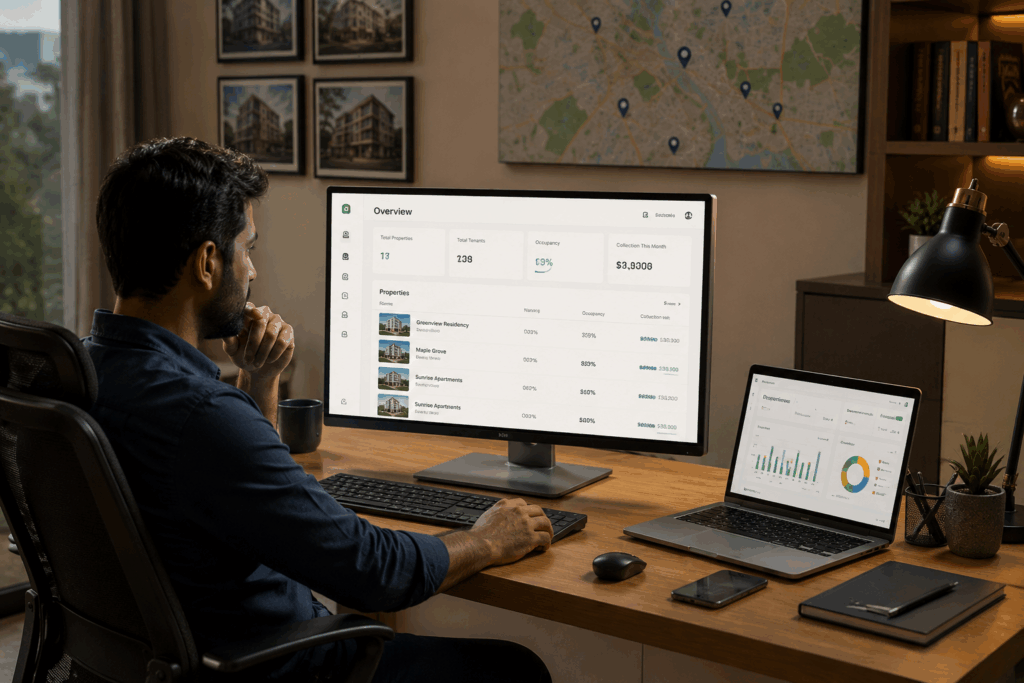
One of the biggest advantages of moving beyond spreadsheets is the ability to see the business through a centralised dashboard.
A dashboard becomes useful when it answers operational questions without requiring the owner to first collect information from several sources.
For a multi-property rental business, that could mean understanding:
Which property currently has the most vacant rooms?
Where are outstanding rents increasing?
Which location is performing better than the others?
Are upcoming move-outs likely to affect occupancy?
Which property has recurring maintenance issues?
These are not questions that require more data.
They require better access to existing data.
Consider a portfolio with three properties operating at 95%, 92%, and 76% occupancy. Looking only at the overall portfolio might suggest that the business is performing reasonably well. But the third property clearly requires attention.
Without property-wise visibility, that problem can remain hidden behind the portfolio average.
With a centralised dashboard, the owner can identify the difference immediately and investigate why it exists.
This is also why RentOk’s content around How to Monitor PG Business with Dashboard focuses on dashboards as a decision-making tool rather than simply another reporting feature.
The shift is subtle but important.
Instead of spending time asking “Where is the information?”, managers can spend that time asking “What should I do about it?”
Rent Tracking Becomes More Complicated With Every Property You Add
Rent collection is another area where the limitations of manual systems become increasingly visible.
When you manage one property, checking who has paid rent and who has not may take a few minutes. When you manage several properties with hundreds of tenants, the same process becomes a recurring operational workload.
The issue is not simply recording payments.
Managers may also need to account for different rent amounts, payment dates, partial payments, outstanding balances, late payments, and tenant-specific adjustments. If those details are being maintained manually, every transaction creates another opportunity for records to become inconsistent.
A proper rent tracking system should make it possible to move from a portfolio-level view to the exact details behind it.
For instance, an owner should be able to see that a particular property has ₹X in outstanding dues and then identify which tenants contribute to that figure without manually comparing several spreadsheets.
This becomes particularly valuable during monthly collections, because the team can focus its efforts where they are actually required rather than sending the same reminders to everyone.
Rent tracking also connects directly to financial visibility.
If you want to understand the wider role of structured financial management across rental properties, RentOk’s guide on Best Software for Tracking Rental Properties and Expenses explores property-wise expense tracking and why consolidated financial visibility becomes more important as portfolios grow.
The broader principle is simple: the larger the portfolio, the more important it becomes to know not only what money came in, but where it came from and what is still pending.
Property-Wise Data Matters as Much as Portfolio Data
Centralisation should not mean combining everything into one undifferentiated pool of information.
A multi-property business needs centralisation with separation.
You need to see the entire portfolio, but each property’s information should remain clearly identifiable.
This matters because averages can hide operational problems.
Suppose two properties generate similar revenue, but one has significantly higher maintenance expenses. A combined financial report may make both properties appear equally healthy. Property-wise reporting reveals that one location is consuming more resources and may require a closer review.
The same principle applies to occupancy, rent collection, tenant turnover, and operational workload.
A useful property management system should help owners compare properties while still retaining the details behind each number.
That allows questions such as:
- Where is occupancy falling? Instead of simply seeing the portfolio’s overall occupancy percentage, owners can identify the specific property or rooms contributing to vacancies and act before the issue becomes larger.
- Where are collections slowing down? Property-wise rent visibility can reveal whether outstanding dues are isolated incidents or a recurring issue at a particular location.
- Where are operating costs increasing? Separating expenses by property makes it easier to identify locations where maintenance, utilities, or other costs are affecting profitability.
- Where does management attention need to go? A central system helps owners prioritise properties based on actual operational signals rather than relying only on assumptions or informal updates.
That is the difference between having property data and actually using property data to manage the business.
Managing More Properties Shouldn’t Mean Managing More Spreadsheets
As a rental portfolio expands, the biggest operational mistake is often assuming that the solution to more properties is simply more tracking.
One property may require one occupancy sheet. Three properties may require three. Then separate sheets appear for rent collection, expenses, tenant information, deposits, and maintenance. Before long, the owner is spending more time maintaining the management system than using it to manage the properties.
This is where centralisation becomes more than a convenience.
A scalable property management system should reduce the number of places where information needs to be entered, checked, and updated. When the same tenant, payment, occupancy, or expense information is connected within one system, managers spend less time moving information between different tools.
That matters because manual coordination creates a hidden operational cost. Every additional spreadsheet, message, or handoff creates another point where information can become outdated.
The objective should not be to build a more complicated management process as the portfolio grows. It should be the opposite: the business should become easier to control even as the number of properties increases.

What Happens When Your Portfolio Keeps Growing?
Growth exposes weaknesses that may remain invisible when the operation is small.
A landlord managing two properties can probably remember which property has a vacancy or which tenant needs a reminder. Once the portfolio reaches several locations, relying on memory becomes impractical.
The same applies to staff coordination. A manager might initially know every tenant personally, but with hundreds of residents, that level of direct knowledge cannot be maintained. The business needs systems that preserve visibility without requiring the owner to personally coordinate every activity.
This is where a structured operating model becomes important.
As properties increase, managers need to standardise recurring processes such as:
- Move-ins and move-outs: Each property should follow a consistent process for onboarding, documentation, room allocation, and exit coordination while still allowing property-specific information to remain separate.
- Rent collection: Payment tracking and follow-ups should follow a defined workflow so that collection does not depend on individual managers remembering who needs to be contacted.
- Maintenance management: Complaints should have clear ownership and status, allowing teams to identify pending issues without searching through multiple conversations.
- Reporting: Owners should receive information in a consistent format across properties, making comparisons easier and reducing the time required to prepare reports manually.
This standardisation becomes particularly valuable when new properties or employees are added.
Instead of rebuilding the process every time the business grows, the existing system can continue supporting the additional operational load.
Why WhatsApp Cannot Be Your Property Management System
WhatsApp is extremely useful for communication. It allows managers to speak with tenants quickly, share documents, send reminders, and coordinate with staff.
But communication and management are not the same thing.
A WhatsApp conversation can tell you that a tenant reported a leaking tap. It does not automatically give you a complete operational picture of how many maintenance complaints are currently pending across all your properties, how long each issue has remained unresolved, or whether the same problem has occurred repeatedly.
The problem becomes more noticeable when multiple managers are involved.
One employee may communicate with the tenant. Another may contact the technician. The owner may receive an update separately. By the time someone needs to understand what happened, the information may be spread across several conversations.
That makes WhatsApp a useful communication layer, but a weak source of portfolio-wide operational visibility.
The same principle applies to payment conversations. A tenant may send a payment screenshot, but that screenshot alone does not create a reliable rent ledger. It still needs to be connected to the correct tenant, property, payment period, and outstanding balance.
For growing rental businesses, the goal should therefore be to connect communication with structured records, rather than expecting conversations to replace the records themselves.
WhatsApp still has an important place in rental operations—the difference lies in using it as the right communication channel rather than the entire management system. RentOk’s “Best Communication Channels for Property Management” explains how WhatsApp, SMS, and push notifications serve different operational purposes and why growing properties benefit from a more structured communication setup.
When Does Property Management Software Become Necessary?
There is no fixed number of properties at which every owner must adopt software.
For some operators, the need may become obvious with three properties. For others, a larger portfolio may still be manageable through manual systems for a while.
The better question is whether the current process is creating unnecessary operational effort.
If your team regularly spends time searching for information, reconciling records, preparing reports manually, or asking other employees for basic updates, the issue is no longer the size of the portfolio alone.
It is the lack of centralised visibility.
A growing business should consider moving toward dedicated property management software when:
- You are maintaining several separate spreadsheets and frequently cross-checking information between them.
- You need to contact staff members simply to understand occupancy, pending payments, or tenant status.
- Monthly rent collection requires repeated manual calculations and follow-ups.
- Preparing a property-wise report takes significant time because information comes from different sources.
- Adding another property would require creating an entirely new collection of files and workflows.
- You want to make decisions based on current information rather than updates collected manually from different team members.
These are signs that the management process has become more complicated than the business itself needs it to be.
The Real Advantage Is Better Decision-Making
The strongest reason to move beyond spreadsheets is not that a dashboard looks better.
It is that better visibility allows owners to make decisions earlier.
Consider vacancy management.
If a room is going to become available next month, that information has operational value today. It gives the team time to start marketing the room, prepare it for the next tenant, and plan the transition.
Similarly, if outstanding rent is increasing at one property, knowing this early gives the management team an opportunity to investigate the reason rather than discovering the problem after the monthly accounts are closed.
The same applies to expenses and maintenance.
A recurring expense pattern might indicate that a particular property requires attention. A rising number of complaints in one location might point to an underlying operational issue.
Without consolidated data, these patterns are much harder to identify.
With structured reporting, owners can move from simply recording events to identifying patterns across the portfolio.
That is where property management software starts creating strategic value.
Build a System That Can Grow With Your Portfolio
A rental business should not have to redesign its entire management process every time another property is added.
If managing property number six means creating another set of spreadsheets, another WhatsApp group, another payment tracker, and another reporting format, the business is adding operational complexity alongside its growth.
A scalable system works differently.
Each new property becomes part of the existing operating structure rather than a completely separate management exercise. The same systems, workflows, and processes can be extended across the portfolio without creating unnecessary administrative layers.
This becomes especially important for landlords and PG operators planning to expand. Building structured systems early ensures that future growth does not automatically result in more manual work.
Expansion also changes how much an owner can personally supervise. As properties are added across different locations, physical presence can no longer be the primary source of operational visibility. RentOk’s “How to Manage a PG Without Being On-Site Every Day” explores how owners can maintain visibility into payments, tenants, complaints, and staff activity without relying on constant on-site supervision.
A scalable system also brings greater consistency across the portfolio.
Core processes such as tenant onboarding, rent tracking, occupancy monitoring, reporting, and operational coordination can follow the same workflow across properties, while property-specific information remains clearly organized and separated.
That consistency benefits not only owners but also employees and management teams. When everyone follows the same processes, training becomes easier, handovers become smoother, and day-to-day operations become less dependent on individual working styles.
Ultimately, scalability is not just about managing more properties. It is about building an operating system where portfolio growth does not create the same amount of administrative growth.
A Better Alternative to Spreadsheet-Driven Property Management
Moving away from spreadsheets does not have to be a dramatic change. The first step is simply identifying the parts of property management that are repetitive, interconnected, and difficult to manage manually.
For most multi-property businesses, these include tenant records, occupancy, rent collection, dues, expenses, maintenance, communication, and reporting. When these functions operate separately, managers often spend valuable time entering the same information across multiple spreadsheets, systems, or communication channels.
Connecting these functions creates a much more efficient management process. Instead of constantly moving information from one system to another, property owners and managers can maintain a centralized view of their operations.
This shift is part of a broader move in rental management from manual record-keeping toward PropTech-driven operations. “Real Estate Property Management Software Explained” explores how digital tenant records, automated rent workflows, cloud-based documentation, maintenance tracking, and real-time dashboards are transforming the way growing rental portfolios are managed.
The result is a simpler and more connected management cycle:
Information is captured → operations are updated → the owner gains visibility → decisions are made → the team takes action.
With the right systems in place, managers spend less time maintaining scattered records and more time managing properties, supporting tenants, and making informed decisions.
Ultimately, replacing spreadsheets is not just about adopting new software. It is about creating a connected property management workflow that makes everyday operations more organized, visible, and scalable.
How RentOk Helps Manage Multiple Rental Properties
RentOk brings essential property management workflows into one centralised platform, helping landlords and property managers manage multiple properties without depending on disconnected spreadsheets and scattered communication.
With RentOk, operators can maintain visibility across properties, tenants, occupancy, rent payments, pending dues, expenses, and daily rental operations from a connected system. This makes it easier to understand what is happening at individual properties while also maintaining a broader view of the portfolio.
For an owner managing several PGs or rental properties, that means less time spent looking for information and more time spent acting on it. Instead of creating separate systems as the business grows, RentOk provides a structured foundation that can support a larger and more organised rental operation.
Conclusion
Managing multiple rental properties efficiently is not about becoming better at maintaining spreadsheets. It is about building a management system that can handle increasing operational complexity without creating more administrative work.
Excel and WhatsApp may be useful starting points, but as properties, tenants, payments, and teams increase, fragmented information becomes harder to control. Centralised property management brings those moving parts together, giving owners clearer visibility across occupancy, rent, expenses, tenants, and day-to-day operations.
The goal is simple: manage every property from one connected system, maintain control as your portfolio grows, and make decisions with confidence.
Manage All Properties in One App, Try RentOk.
FAQs
1. What is the best way to organize rental property records?
A centralized property management system is generally more practical than maintaining separate files for every property. It keeps tenant, occupancy, payment, expense, and operational records organized while making property-wise information easier to access.
2. Can property management software handle multiple properties at the same time?
Yes. Multi-property property management software is designed to let owners manage several properties from one system while keeping each property’s tenants, rooms, payments, and operational information separately organized.
3. How can landlords reduce manual work in rental property management?
Landlords can reduce repetitive administrative work by centralizing tenant records, rent tracking, occupancy information, maintenance workflows, and reporting instead of updating each area manually across different tools.
4. What information should landlords track for each rental property?
Important information includes occupancy, tenant details, rent and outstanding dues, security deposits, property expenses, maintenance requests, move-in and move-out records, and other operational activities specific to the property.
5. Is property management software useful for small rental portfolios?
It can be useful even with a smaller portfolio if the owner expects to expand or is already spending significant time managing records manually. Setting up structured processes early can make future properties easier to add and manage.
6. How does centralized property management improve portfolio visibility?
Centralized management gives owners a consolidated view of multiple properties while preserving property-level details. This makes it easier to compare occupancy, collections, expenses, and operational performance without manually combining information from separate files.