
What AI Can Actually Do for Your PG Business Today
AI is everywhere right now. From chatbots and content tools to predictive analytics and automated workflows, almost every industry is trying to figure out what artificial intelligence actually means for its business.
Property management is no different.
For PG and hostel owners, though, the conversation around AI can feel unnecessarily complicated. You may hear about machine learning, predictive models, intelligent automation, and AI-powered platforms and still be left wondering one simple thing: What can AI actually do for my PG today?
The answer is more practical than futuristic.
AI can help property operators reduce repetitive work, understand business data faster, identify patterns that are difficult to spot manually, and make everyday decisions with better information. It does not mean handing your entire property over to a machine. It means using technology to take some of the operational weight off your shoulders.
That distinction matters because running a PG involves far more than collecting rent. You are dealing with tenant records, occupancy, dues, complaints, expenses, staff, communication, bookings, and financial reporting at the same time. As the number of beds increases, the amount of information increases with it.
This is where AI starts becoming useful.
AI in PG Management Is Moving From Hype to Practical Use
The first thing to understand is that AI-powered PG management is not necessarily about introducing some dramatic new technology into your property.
A lot of its value comes from making existing processes smarter.
Traditional property management software already helps operators record information, automate certain tasks, and keep operations organised. AI adds another layer by helping systems analyse that information and make it more useful for decision-making. RentOk’s earlier comparison of AI property management software and traditional software explores this shift in more detail.
Consider the difference between these two situations.
In the first, your software tells you that rent collection this month is ₹X, there are Y pending dues, and occupancy is Z%.
In the second, an intelligent system helps you understand which numbers deserve attention, where patterns are changing, and what could potentially require action.
The first gives you information.
The second helps you work with that information.
For a property owner, that difference becomes increasingly important as operations grow.
Where Does AI Actually Fit Into a PG Business?
AI becomes most valuable when it is connected to problems that property owners already deal with every day.
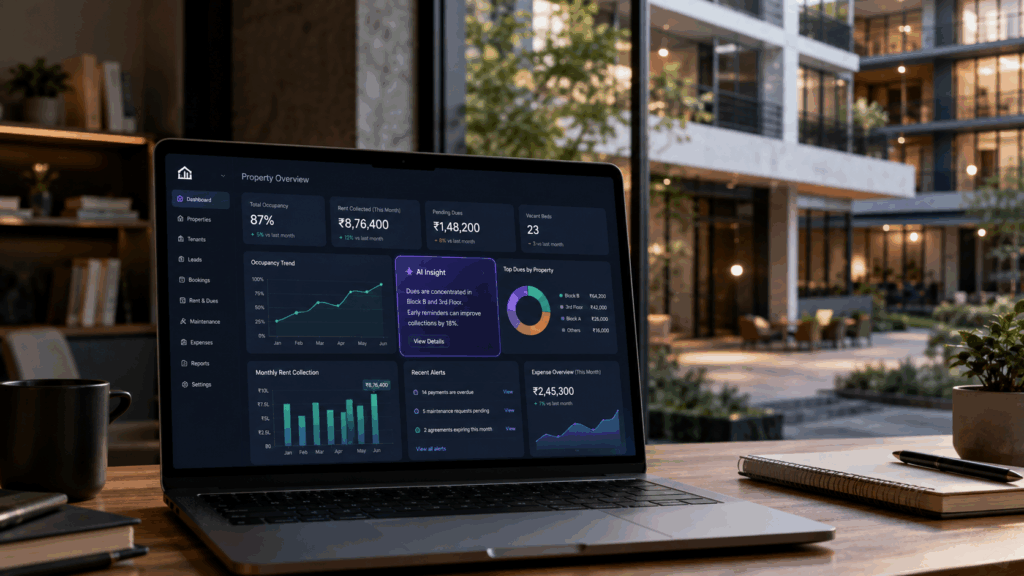
Think about the amount of information your PG generates. Every rent payment, move-in, move-out, complaint, expense, vacancy, booking, and tenant interaction creates another piece of operational data.
When that information is properly structured, AI can help you use it more effectively.
Some of the most practical areas include:
- Financial visibility: AI can make large amounts of payment, dues, expense, and collection information easier to interpret, helping owners understand where their business stands without manually going through multiple records.
- Operational decision-making: Instead of simply displaying reports, intelligent systems can help highlight patterns and areas that deserve closer attention, reducing the amount of time spent searching for important information.
- Repetitive workflows: Recurring processes such as reminders, notifications, reporting, and certain administrative activities can be automated so that staff do not have to restart the same process every month.
- Tenant management: When tenant records and interactions are organised centrally, teams can access relevant information faster and respond to requests with better context.
- Business analysis: Historical property data can help identify trends in occupancy, collections, expenses, or other operational metrics that may not be obvious from individual transactions.
None of these applications require a futuristic PG. They are simply smarter ways of handling information and repetitive work that already exists inside the business.
The value of these capabilities becomes clearer when the underlying property operations are already organised. If tenant information, rent records, occupancy, and complaints are still being managed across disconnected tools, intelligent features cannot deliver their full potential. How to Choose the Right PG Management Software is a useful starting point for understanding what a proper management system should actually solve.
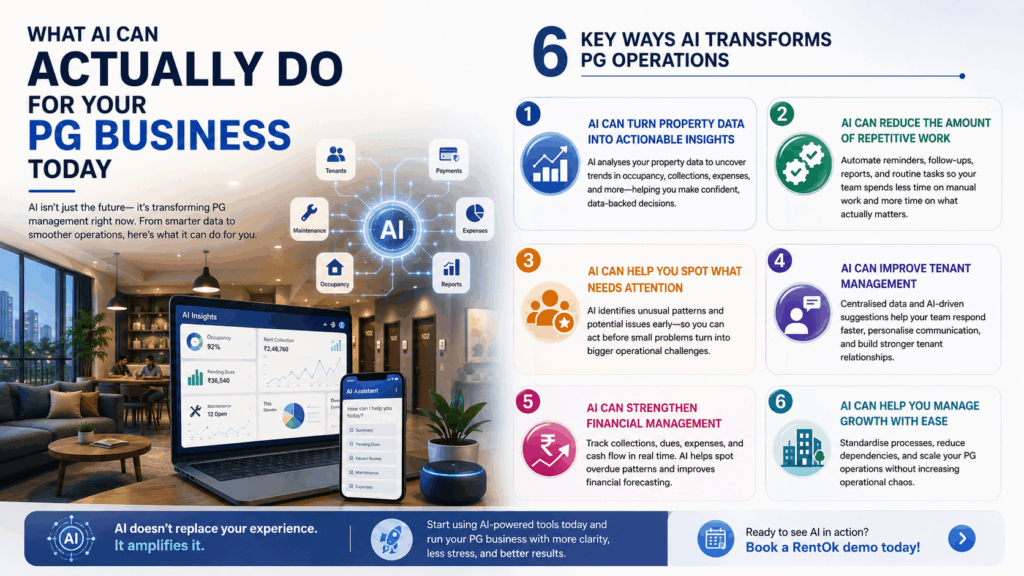
1. AI Can Turn Property Data Into Something You Can Actually Use
Most PG owners already have data.
The real problem is that the data often lives in different places.
One spreadsheet may contain tenant details. Another tracks expenses. Payment records may sit somewhere else, while occupancy information is updated manually whenever a tenant moves in or out. By the time the owner wants to answer a simple question, someone has to collect information from several sources first.
That is where AI can create a meaningful difference.
When property information is centralised, AI can help analyse larger amounts of data and make it easier for operators to understand what is happening across the business. Instead of treating reports as static documents, owners can start using them as decision-making tools.
For example, an operator may want to understand why profitability changed this month. Looking at revenue alone will not provide the answer. The operator may need to consider collections, occupancy, expenses, outstanding dues, and other operational changes together.
An intelligent system can help bring those relationships into focus.
This is also why dashboards and AI should not be viewed as competing technologies. A dashboard gives you visibility. AI can make that visibility more actionable.
RentOk’s guide on monitoring a PG business through a dashboard covers how occupancy, dues, expenses, and property-level information can be brought together to make business performance easier to understand.
2. AI Can Reduce the Amount of Repetitive Work
Ask any PG owner what takes up their time, and the answer is rarely one big task.
It is usually dozens of small ones.
Sending reminders. Checking payments. Answering repeated questions. Updating records. Following up on complaints. Preparing reports. Checking occupancy. Coordinating with staff.
Individually, these activities may seem manageable. Together, they consume a significant part of the owner’s day.
This is where automation, supported by AI, becomes particularly useful.
A process that happens every month should not require someone to remember every step every month. RentOk’s practical guide to automating PG management makes the same point: automation is fundamentally about creating structure around recurring processes rather than simply “going digital.”
For a growing property, that can mean automating or streamlining workflows such as:
- Rent reminders and dues follow-ups, so communication does not depend entirely on staff remembering which tenants need to be contacted and when.
- Payment and receipt workflows, giving tenants clearer records while reducing repetitive administrative work for the property team.
- Complaint coordination, where requests can be logged, assigned, updated, and tracked instead of remaining buried inside calls and WhatsApp conversations.
- Reporting and financial review, allowing operators to access organised information without spending hours consolidating different records manually.
The important point is that automation and AI are not exactly the same thing. Automation follows defined rules. AI can analyse information and support decisions beyond those fixed rules.
Together, they can make property operations significantly more efficient.
This becomes particularly important once a property moves beyond a small number of tenants. The Easiest Way to Manage 100+ Tenants Without Using Excel looks at why spreadsheets become increasingly difficult to rely on as tenant volume grows.
3. AI Can Help You Notice Problems Earlier
One of the biggest advantages of structured data is that it makes patterns easier to see.
A single late payment may not mean much. A recurring increase in delayed payments across a particular property could be worth investigating.
One vacant room is normal. A growing number of vacant beds over several weeks could indicate a larger occupancy problem.
One maintenance complaint is routine. The same complaint repeatedly appearing across rooms may point toward an underlying issue that needs to be fixed rather than repeatedly patched.
Humans are good at making decisions, but they are not always good at spotting patterns across hundreds or thousands of individual records.
AI can help with that.
Instead of asking the property manager to manually compare every report, an intelligent system can help surface unusual changes or recurring patterns that deserve attention.
This is where AI becomes more than a productivity tool. It starts becoming a decision-support tool.
The owner still decides what to do. AI simply helps make sure the owner is looking at the right information before making that decision.
4. AI Can Make Financial Management More Intelligent
Money is at the centre of every rental business, which makes financial visibility one of the most important applications of intelligent property management.
PG owners need to know more than whether rent was collected.
They need to understand how much is pending, where expenses are increasing, how collections compare across periods, what the property is actually earning, and where money may be getting lost through operational inefficiencies.
When financial information is scattered, these questions become difficult to answer quickly.
AI can help by making large amounts of financial data easier to analyse and interpret. Instead of treating accounting as a month-end exercise, operators can move toward continuous financial visibility.
This becomes even more important when managing multiple properties.
A small property may be manageable through a spreadsheet. A larger portfolio creates hundreds of additional transactions, expenses, tenant records, and payment events. At that point, the problem is no longer simply maintaining records. It is making sense of them quickly enough to act.
That is where intelligent financial tools can provide real operational value.
5. AI Can Improve Tenant Management Without Replacing the Human Touch
There is a common misconception that AI in property management means replacing people with chatbots.
That is not necessarily where its biggest value lies.
Tenant experience depends heavily on how efficiently the management team handles everyday issues. If staff can quickly find a tenant’s payment history, agreement, complaint status, or occupancy information, they can respond more effectively.
The technology works behind the scenes.
For example, instead of asking a tenant to explain their situation multiple times because information is scattered across different systems, the team can access the relevant records and understand the context immediately.
AI can also support repetitive tenant communication and help prioritise requests, but the human element remains important for situations that require judgement, empathy, or negotiation.
In fact, better technology can give teams more time for human interaction because they spend less time on administrative work.
That is the same principle behind modern PG apps: technology should reduce friction for both operators and residents rather than make the experience more complicated. RentOk’s guide to creating a better living experience with a PG app explores how digital systems can improve communication, payments, requests, and transparency for tenants.
6. AI Can Help Owners Manage Growth Without Adding the Same Amount of Work
The real test of any technology is not whether it works for 20 tenants.
It is whether the system continues to work when you have 200, 500, or 1,000.
Growth changes property management completely. More tenants mean more payments, more complaints, more staff coordination, more occupancy changes, and more information to monitor.
Without structured systems, owners often become the central point for every decision.
That creates a dangerous dependency.
If the owner has to personally check every payment, answer every operational question, approve every update, and review every report, growth eventually becomes limited by the owner’s time.
AI and automation can help remove some of that dependency.
The system handles information and recurring workflows while the owner focuses on decisions that actually require their attention.
RentOk’s article on scaling a PG business from 50 to 300 beds discusses this operational shift and why structured systems become increasingly important as the number of beds grows.
AI Does Not Mean Letting a Machine Run Your PG
This is probably the most important point for property owners considering AI.
AI should not be treated as an independent property manager.
It does not understand your business in exactly the same way you do. It does not know every tenant relationship, every local market nuance, or every operational decision that requires human judgement.
The strongest use of AI is collaborative.
The technology handles the information-heavy and repetitive parts of the operation, while the owner or property manager remains responsible for decisions.
A useful way to think about it is:
AI can tell you what deserves attention. You decide what to do about it.
That approach is much more realistic than expecting technology to completely automate property ownership.
It also explains why having clean, structured operational data is so important. AI can only provide useful insights when the underlying information is organised and reliable.
What Should a PG Owner Automate First?
If you are just beginning to explore AI and automation, you do not need to transform every process at once.
Start with the areas where manual work is already creating friction.
Look at your business and ask:
- Which tasks are repeated every week or month even though the process rarely changes?
- Which reports take too long to prepare because information has to be collected from multiple places?
- Which questions does your staff answer repeatedly because tenants cannot access the information themselves?
- Which operational numbers do you check regularly but struggle to interpret quickly?
- Where are delays, missed follow-ups, or manual errors creating unnecessary revenue or service problems?
These questions will usually reveal where technology can create the fastest improvement.
The goal is not to add AI simply because everyone is talking about it. The goal is to identify operational problems where intelligent technology can actually make a measurable difference.
If rent collection is one of those areas, it is worth looking at the process separately. What Is Autopay for Rent Collection? explains how recurring payments can be structured to reduce the manual effort involved in monthly collections.
The Next Stage of Property Management Is About Smarter Decisions
AI is only one part of a much larger change happening in property management.
The industry is moving from basic digitisation toward systems that can understand information, automate workflows, and support better decisions. RentOk’s look at five technology trends shaping property management toward 2030 explores how AI automation, connected systems, and experience-driven operations are expected to influence the rental industry.
This shift is important because the competitive advantage will not simply come from owning more beds.
It will increasingly come from operating those beds more efficiently.
A property with strong occupancy but poor operational control can still lose money through missed collections, inefficient expenses, delayed maintenance, staff dependency, and inconsistent tenant experiences.
AI cannot solve all of those problems by itself.
But when it is connected to a well-structured property management system, it can help owners understand those problems earlier and respond more effectively.
You can also explore RentOk’s YouTube channel for practical property-management content and product explainers that show how technology can fit into everyday rental operations.
How RentOk Helps PG Owners Use Smarter Property Management
AI becomes genuinely useful when it is connected to the actual operations of your property rather than functioning as a separate technology layer.
RentOk brings core PG management processes together in one platform, including tenant management, rent and dues tracking, occupancy, expenses, complaints, team management, reporting, and communication. This gives operators a structured foundation on which automation and intelligent tools can actually work.
Instead of keeping tenant information in one place, payments in another, expenses in a spreadsheet, and operational conversations across different chats, owners can manage their property through a connected system.
RentOk also continues to bring AI into practical property-management workflows, including tools that help owners work with their financial and operational information more efficiently. The objective is not to make property management unnecessarily technical. It is to reduce the amount of manual effort required to understand and operate the business.
For a growing PG, that distinction matters.
You do not need technology for the sake of technology. You need a system that helps you spend less time chasing information, repeating tasks, and putting out operational fires, and more time improving the property, supporting tenants, and growing the business.
Conclusion
AI in PG management is not about futuristic robots or handing control of your property to a machine. The real opportunity is much more practical.
It is about using intelligent technology to make sense of property data, reduce repetitive work, identify patterns, improve financial visibility, support tenant management, and help owners make faster, better-informed decisions.
The operators who benefit most will not necessarily be the ones adopting the most AI features. They will be the ones who identify the right operational problems and use technology to solve them properly.
So, instead of asking whether your PG is “ready for AI,” start with a more useful question:
What is taking up your time today that technology could handle better tomorrow?
If you are ready to make your PG operations smarter, more organised, and easier to scale, book a RentOk demo and explore how AI-powered property management can work for your business.
FAQ’S
1. What are the benefits of AI for small PG businesses?
AI can help small PG operators reduce repetitive administrative work, organise property data, and get faster insights without needing a large management team. It can make everyday operations more efficient as the business grows.
2. Is AI useful for managing multiple PG properties?
Yes. AI can help operators handle larger volumes of tenant, payment, occupancy, and expense data across properties. This makes it easier to monitor different properties without manually reviewing every record.
3. Does AI require technical knowledge to use?
Not necessarily. Modern AI-powered property management platforms are designed to work through simple interfaces and natural interactions, so owners do not need to understand how AI systems are built to benefit from them.
4. Can AI help reduce errors in PG management?
AI and automation can reduce errors caused by repetitive manual processes such as data entry, payment tracking, reminders, and reporting. However, the quality of the results still depends on having accurate and well-maintained property data.
5. Is AI expensive for a PG owner to implement?
The cost depends on the platform and the features being used. For many PG businesses, starting with an integrated property management platform can be more practical than investing in separate AI tools for different operational functions.
6. Will AI replace PG property managers?
AI is more likely to support property managers than replace them entirely. It can handle repetitive information-based work and surface useful insights, while people continue to manage relationships, resolve complex situations, and make important business decisions.