

How Much of My Security Deposit Is Actually Refundable?
Moving out of a rented home often comes with one big question: how much of your security deposit will you actually get back? You may have paid several months’ rent upfront, kept the property in good condition, and settled your bills. Yet, when it is time to move, the landlord may propose deductions for repairs, cleaning, or other expenses.
The answer depends on your rental agreement, the condition of the property, and the laws applicable to your tenancy. A landlord may be able to deduct certain unpaid dues or the cost of damage beyond normal wear and tear. However, a security deposit is not meant to be a source of extra income. Understanding security deposit refund rules in India can help you identify reasonable deductions, question unfair charges, and prepare for a smoother handover.
What a Security Deposit Is Meant to Cover
A security deposit is an amount paid by a tenant and held by the landlord as protection against certain liabilities during the tenancy. It is not an additional rent payment that the landlord can automatically keep when the tenant moves out. Once the tenancy ends, the remaining deposit should be returned after accounting for deductions permitted under the agreement and applicable law.
For a broader overview of how deposits work, how much landlords may ask for, and what can affect a refund, read Security Deposits in India: Everything You Need to Know.
A security deposit may cover expenses such as:
- Unpaid rent: Rent that remains due at the end of the tenancy may be adjusted against the deposit, where permitted by the agreement and applicable law.
- Outstanding utility bills: Electricity, water, or other agreed charges that the tenant was responsible for paying may be deducted if they remain unpaid.
- Damage beyond normal wear and tear: Reasonable repair costs may be deducted for damage caused by the tenant, rather than deterioration from ordinary use.
- Other agreed liabilities: Certain unpaid charges or missing items may be considered if the tenant is responsible for them under the agreement and applicable law.
For example, if you paid ₹40,000 as a security deposit and have ₹5,000 in outstanding rent, the landlord may be entitled to adjust that unpaid amount if the agreement and applicable law permit it. The remaining ₹35,000 should not simply be withheld without a valid reason.
Before paying a deposit, make sure your rental agreement records the amount paid, the circumstances in which deductions may be made, and the expected refund process. It should also clarify the responsibilities of both parties for repairs and maintenance. A written agreement and payment receipt can help prevent disagreements when you move out.

Difference between Security Deposit and Advance Rent
A security deposit and advance rent are both payments made at the beginning of a tenancy, but they serve different purposes. A security deposit is money held by the landlord as protection against certain unpaid dues or damage to the property. It is generally refundable when the tenancy ends, after accounting for legitimate deductions.
Advance rent, on the other hand, is rent paid before the period it covers. For example, if you pay November’s rent in October, that payment covers your occupancy for November. It is not automatically a refundable deposit.
The main differences are:
- Purpose: A security deposit protects against certain liabilities, while advance rent pays for a specified period of occupancy.
- Refundability: The security deposit is generally refundable after permitted deductions. Advance rent is usually adjusted against the rent for the period it covers.
- Settlement: The security deposit is settled at the end of the tenancy, while advance rent should be accounted for in the relevant rent period.
Before making either payment, check your rental agreement to confirm the purpose of the payment, the refund terms, and the rent period covered. Ensure that advance rent is adjusted against the correct month rather than treated as an additional deposit. Keeping receipts and written confirmation of the payment’s purpose can help avoid confusion when the tenancy ends.
What Can Be Deducted from a Security Deposit?
The landlord may be able to deduct expenses that are genuinely the tenant’s responsibility. The exact position depends on the rental agreement and applicable law, so not every charge is automatically valid.
Common examples of deductions that may be reasonable include unpaid rent, outstanding utility bills, damage beyond normal wear and tear, and missing items or fixtures provided with the property. If furniture, appliances, or fixtures are missing or damaged beyond ordinary use, the landlord may seek a deduction supported by the agreement and evidence.
The landlord should be able to explain the reason for each deduction. Where possible, ask for photographs, repair bills, or other supporting records. A deduction should reflect the actual liability or reasonable cost involved. For example, the cost of repairing a damaged cupboard door is different from charging for an entirely new cupboard without considering the extent of the damage.
For more on the responsibilities involved in handling deposits, see Handling Security Deposits: Legal Norms and Best Practices.
What Cannot Be Deducted from a Security Deposit?
A landlord should not treat the security deposit as an unrestricted amount that can be retained for any reason. Deductions that are not supported by the agreement, applicable law, or a genuine tenant liability can be disputed.
Some common concerns include:
- Normal wear and tear: Faded paint, minor scuffs, or deterioration from ordinary use should not automatically be treated as tenant damage.
- Routine maintenance: General upkeep and repairs that are the landlord’s responsibility should not simply be passed on to the tenant.
- Pre-existing damage: Damage that was present before the tenant moved in should not be charged to the tenant without evidence that they caused or worsened it.
- Arbitrary fees: Unexplained cleaning, repainting, or administrative charges that have no valid basis in the agreement or applicable law can be disputed.
If the landlord proposes a deduction, ask what it covers and how the amount was calculated. A written explanation can help both parties distinguish genuine expenses from disputed charges.
Normal Wear and Tear Versus Actual Damage
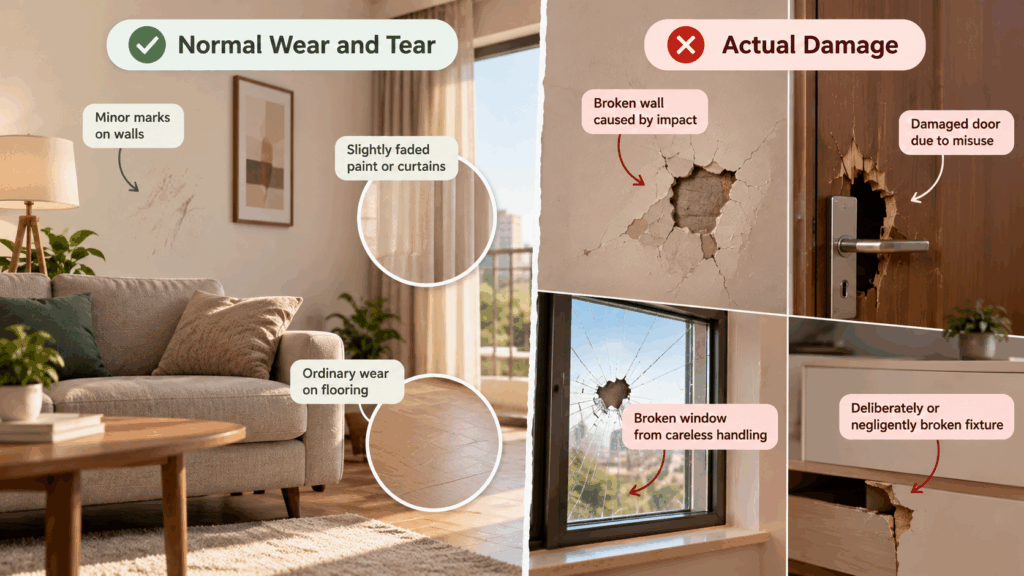
One of the most common security deposit disputes involves the difference between normal wear and tear and actual damage. Normal wear and tear refers to the gradual deterioration of a property through ordinary use over time. It can happen even when a tenant takes reasonable care of the premises. Examples include minor marks on walls, slight fading of paint or curtains, ordinary wear on flooring, and small changes that occur through regular occupancy.
Actual damage is different. It may involve negligence, misuse, or an incident that causes damage beyond what would reasonably be expected from ordinary living. Examples include a broken window caused by careless handling, a damaged door, or a fixture that has been deliberately or negligently broken.
The condition of the property at the start of the tenancy is important. Dated photographs, videos, and written communication can help establish whether damage existed before the tenant moved in. Tenants should document the property when taking possession and report issues during the tenancy. Landlords should also record the condition during handover and explain any proposed deductions with supporting evidence.
Security Deposit Laws under the Model Tenancy Act
The Model Tenancy Act, 2021 provides a framework for regulating rental agreements and security deposits in India. However, it is a model law for states and union territories to adopt or adapt. Its provisions do not automatically apply throughout India, so tenants should check the rental laws applicable in their state or union territory.
Under the Model Tenancy Act framework, the security deposit is capped at up to two months’ rent for residential properties and up to six months’ rent for non-residential properties. The framework also provides for a written tenancy agreement that records the security deposit and relevant payment terms. It states that the deposit should be refunded when the landlord takes back vacant possession, after making due deductions for the tenant’s liabilities.
These limits and procedures should not be treated as universal rules for every rental arrangement in India. The protections and obligations depend on the state or union territory’s laws, the rental agreement, and the type of tenancy. Tenants should review their agreement and check whether their jurisdiction has adopted the relevant provisions. This is important before relying on a specific deposit limit or refund procedure.
For a state-specific overview, read The Security Deposit Amount: What Is Legal in Your State?. You can also refer to the Model Tenancy Act, 2021 from the Ministry of Housing and Urban Affairs.
When Should a Security Deposit Be Refunded?
The refund timeline depends on the rental agreement and the law applicable to the tenancy. There is no single nationwide deadline that can safely be assumed for every rental arrangement. In practice, 15–30 days is often used as a reasonable timeframe to discuss or agree upon, but it should not be presented as a universal statutory deadline. Some jurisdictions or agreements may require a different process or timeline.
Under the Model Tenancy Act framework, the security deposit is refundable when the landlord takes back vacant possession, after permitted deductions. This applies where the framework has been adopted and is relevant to the tenancy.
To avoid confusion, check the refund timeline in your rental agreement and confirm whether any rent or utility bills remain outstanding. Also, ask whether the landlord has identified any damage or proposed deductions. Confirm the handover date in writing and share your bank details for the refund. If a deduction is proposed, request the amount, reason, and supporting evidence rather than relying on a verbal explanation.
For practical steps to follow during move-out, see How to Get Your Security Deposit Back When Vacating a Rental Property.
How Is a Security Deposit Refund Calculated?
The refundable amount is generally the original security deposit minus deductions that are valid under the rental agreement and applicable law. The calculation should be based on actual outstanding dues or reasonable costs, not arbitrary charges.
Consider a tenant who paid a ₹40,000 security deposit. At the end of the tenancy, the landlord identifies outstanding rent, an unpaid utility bill, and damage beyond normal wear and tear. The calculation might look like this:
| Particulars | Amount |
|---|---|
| Security deposit paid | ₹40,000 |
| Less: Outstanding rent | ₹5,000 |
| Less: Unpaid utility bill | ₹2,000 |
| Less: Reasonable repair cost for tenant-caused damage | ₹3,000 |
| Total deductions | ₹10,000 |
| Estimated refundable amount | ₹30,000 |
In this example, the estimated refund is ₹40,000 minus ₹10,000, which leaves ₹30,000. The figures are illustrative and do not represent fixed deduction rates or standard repair charges.
The landlord should be able to explain and support the proposed deductions. If the ₹3,000 repair charge is disputed or relates to normal wear and tear, it may need to be reconsidered. In that case, the refundable amount could be higher.
How Can Tenants Protect Their Security Deposit?
Protecting a security deposit starts before moving into the property. A few practical steps can help tenants establish what they paid, the condition of the premises, and what they agreed to with the landlord.
- Read the rental agreement carefully: Check the deposit amount, refund conditions, permitted deductions, and handover requirements before signing.
- Document the property’s condition: Take dated photographs or videos of existing damage, stains, broken fixtures, and other issues when moving in. Share them with the landlord and retain the communication.
- Keep payment records: Save receipts, bank transfers, and written acknowledgements showing the amount paid and whether it was security deposit or advance rent.
- Report repairs in writing: Inform the landlord about maintenance issues promptly. Keep messages or emails that establish when the issue was reported and how it was addressed.
- Follow the handover process: Before leaving, settle agreed dues, return keys, and document the property’s condition. Request written confirmation that possession has been handed over.
- Ask for a deduction breakdown: If the landlord proposes deductions, request the amount and reason for each one, along with supporting bills or evidence where available.
These records can make it easier to resolve disagreements and support a refund claim if the deposit is withheld unfairly. Property owners managing multiple tenants may also find How to Track Security Deposits in PG useful for understanding how deposit records can be organised.
What to Do If Your Security Deposit Is Delayed
If your landlord has not returned your security deposit within the agreed or applicable timeframe, start by checking whether any dues or handover formalities remain unresolved.
First, send a polite written reminder. Mention the deposit amount, the date you vacated the property, and the refund you are expecting. If the landlord has proposed deductions, request a written breakdown with the reasons and supporting evidence.
If the issue remains unresolved, consider sending a formal notice. Clearly state the amount you believe is refundable, the basis for your claim, and a reasonable response deadline. Keep the rental agreement, payment receipts, handover confirmation, photographs, and messages with the landlord.
The appropriate dispute-resolution route depends on the applicable law and tenancy. It may involve a Rent Authority, Rent Court, another competent authority, or civil legal remedies. Seek local legal advice if the amount is significant or the dispute is complex. Written communication is preferable to phone calls alone, as it helps establish what you requested and how the landlord responded.
If a landlord refuses to return the deposit or makes deductions without a clear explanation, read What to Do If Your Landlord Refuses to Return Your Security Deposit for further guidance.

How RentOk Helps
A clear record of payments, agreements, and property handover can make rental transactions easier to manage. RentOk helps property owners organise rental operations and track tenant payments and agreements. It reduces confusion about payments received and outstanding dues.
For tenants, it is still important to retain their own copy of the rental agreement, payment receipts, and handover records. Clear documentation from both sides can make security deposit discussions more straightforward when a tenancy ends.
You can explore more rental management insights on the RentOk blog or watch practical rental management videos on the RentOk YouTube channel.
Make Your Security Deposit Refund Easier to Track
A security deposit refund should not turn into a guessing game at the end of your tenancy. Knowing what your agreement says, documenting the property’s condition, and keeping payment records can help you understand what is genuinely refundable and challenge deductions that lack a valid basis.
When it is time to move, having a clear record of the deposit, outstanding dues, and handover can make the conversation with your landlord much easier. Track deposits transparently on RentOk and keep your rental records organised for a smoother move-out and a clearer refund process.
FAQ’S
1. Can a landlord deduct painting costs from a security deposit?
A landlord may seek to deduct reasonable painting or repair costs if the tenant caused damage beyond normal wear and tear. Routine repainting due to ageing or ordinary use may not automatically justify a deduction.
2. Should I take photos before moving out of a rental property?
Yes, take dated photos or videos of the property’s condition, including walls, floors, fixtures, and appliances. These records can help establish whether any damage existed before or during your tenancy.
3. Can a landlord keep the entire security deposit for minor damage?
Minor damage or ordinary wear does not automatically justify withholding the entire deposit. Any deduction should be reasonable, supported by the circumstances, and consistent with the rental agreement and applicable law.
4. What documents should I keep to claim my security deposit?
Keep your rental agreement, deposit payment receipt, rent and utility payment records, move-in and move-out photos, and written communication about the handover. These documents can help support your refund claim if a dispute arises.
5. Can I use my security deposit to pay the last month’s rent?
Do not assume you can use the deposit as your final month’s rent. This should be agreed upon with the landlord in writing and must be consistent with the rental agreement and applicable law.
6. What should I do if my landlord proposes a deduction I disagree with?
Ask the landlord for a written explanation of the deduction, including the reason and supporting evidence such as repair estimates or bills. Compare it with your move-in records and rental agreement before agreeing to the adjustment.