

Mumbai Has the Highest Rent, but Is It the Best City to Live In?
Mumbai has a reputation for big opportunities, a fast-paced lifestyle and some of the highest rental costs in India. For many people, moving to the city is a career decision. For others, it is a chance to experience a different way of life. But with a significant portion of monthly income going towards rent, an important question arises: Is living in Mumbai actually worth the price?
The answer is not as straightforward as comparing rental figures. A city that costs more to live in may also offer better opportunities in a particular industry, shorter commutes for some professionals or a lifestyle that suits their priorities. Meanwhile, Bengaluru, Delhi NCR, Pune and Hyderabad offer their own advantages, often with different housing and everyday expense trade-offs.
To understand whether Mumbai is the best city to live in, we need to look beyond its rent prices and consider what people get in return: career opportunities, housing, connectivity, daily expenses and quality of life.
Why Is Rent So High in Mumbai?
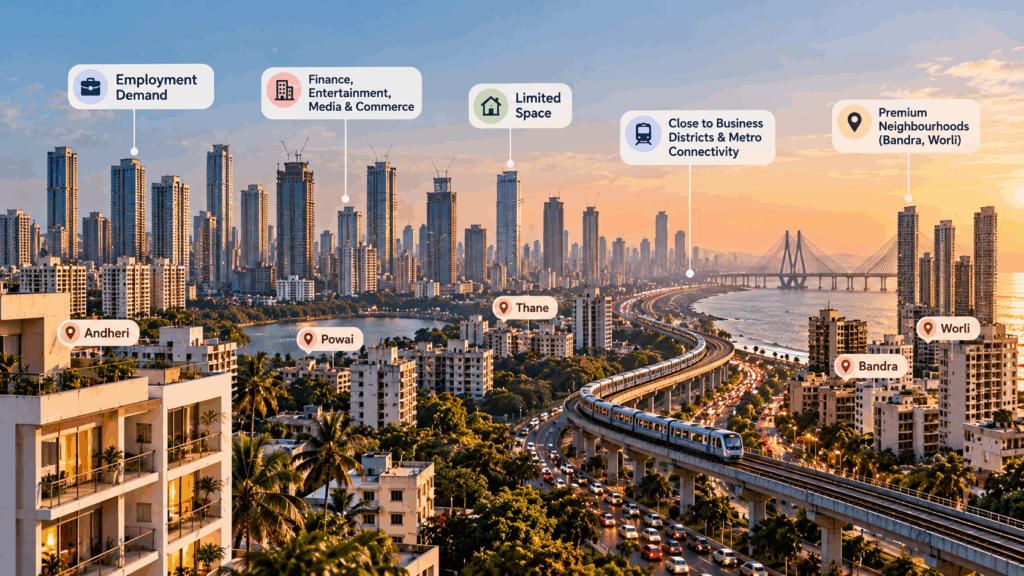
Mumbai’s rental market is shaped by a combination of employment demand, limited space and the concentration of commercial activity in particular parts of the city. Finance, entertainment, media, commerce and several other industries attract professionals from across India. Many renters want to live close to their workplaces, which puts pressure on housing in established business and residential neighbourhoods.
Geography also plays a role. Mumbai is a densely developed coastal city, and expanding housing options in well-connected locations can be challenging. As a result, rental prices can vary sharply depending on how close a property is to a business district, railway station or metro connection.
However, Mumbai does not have one fixed rent level. The amount a tenant pays depends heavily on the locality, apartment size, furnishing and building amenities.
For example, premium neighbourhoods such as Bandra and Worli can command much higher rents than more distant or comparatively affordable residential areas. Areas such as Andheri, Powai and Thane offer different combinations of connectivity, employment access and housing costs.
This is why looking at a single citywide rental figure can be misleading. Someone renting a compact apartment near a workplace may have a very different experience from someone sharing a larger home farther away.
What Are You Actually Paying For?
Rent is not simply the price of four walls and a roof. In a city such as Mumbai, a tenant may also be paying for convenience, access and the time saved by living in a particular location.
Consider two professionals working in the same business district. One chooses a smaller apartment close to work, while the other rents a larger home farther away. The second person may pay less in monthly rent, but the savings need to be weighed against travel expenses and time spent commuting.
For some renters, proximity to work, restaurants, healthcare, public transport and social spaces makes a higher rent worthwhile. For others, those advantages may not justify the additional expense.
The same principle applies when comparing neighbourhoods within Mumbai. A property with a higher monthly rent might reduce the need for frequent cab rides or long journeys. But that does not automatically make it the better financial choice.
The important question is not simply, “How much does this apartment cost?“
It is, “How much does living here cost me in total, and what do I gain from it?“
The Cost of Living Goes Beyond Rent
Housing may be the biggest expense for many renters, but it is not the only one. Groceries, electricity, transport, meals outside the home, domestic help and entertainment all contribute to the monthly budget.
Mumbai’s cost of living can add up quickly, particularly for people who rely on cabs, eat out regularly or live in neighbourhoods where everyday services are expensive. A tenant who spends less on rent but travels long distances may also find that transport takes up a substantial share of their savings.
The same expenses exist in other cities, but the balance can differ. A professional living in Bengaluru may spend more on transport because of a long commute. Someone in Delhi NCR may choose a location with lower rent but need to account for travel between cities or business districts. In Pune or Hyderabad, the cost of housing and commuting can vary significantly depending on where the person works.
A practical monthly budget should therefore account for:
- Housing: Rent, maintenance charges, security deposits and any furnishing costs.
- Transport: Metro or bus fares, fuel, parking and app-based cab rides.
- Household expenses: Groceries, electricity, internet, cooking gas and other essentials.
- Lifestyle: Eating out, shopping, fitness, entertainment and social activities.
- Savings: The amount left after essential and discretionary spending.
A city may appear affordable when rent is considered alone, but the picture can change once all these expenses are included.
For renters looking to organise their payments, RentOk’s guide on how to collect rent online from tenants in India provides related information about digital rent payments.
Career Opportunities vs. Quality of Life
Mumbai remains an important professional destination, particularly for people working in finance, media, entertainment, advertising, commerce and corporate services. For someone whose industry is concentrated in the city, being physically present may help with networking, professional exposure and access to opportunities.
That does not mean every person will experience the same career advantage. The value of living in Mumbai depends on the role, employer, salary and the opportunities available elsewhere.
Bengaluru, for example, has a strong technology and startup ecosystem. Delhi NCR offers a broad mix of corporate, consulting, government-related and commercial opportunities across Delhi, Gurugram and Noida. Pune has established automotive, technology and education sectors, while Hyderabad has grown as a major destination for technology, pharmaceutical and business services roles.
Quality of life is equally personal. One renter may prefer Mumbai’s energy and professional network. Another may value a larger home, a quieter neighbourhood or more money left over each month.
A higher salary in Mumbai does not necessarily translate into greater financial comfort if rent and daily expenses consume most of it. Equally, a lower salary elsewhere may not be a better deal if the role offers limited growth or requires costly travel.
The better comparison is between the job and the life it supports, not just the city and its rent.

Mumbai vs. Bengaluru, Delhi NCR, Pune and Hyderabad
Comparing major Indian cities requires more than placing rental figures side by side. Housing costs change by neighbourhood, apartment size, furnishing and proximity to work. Even within the same city, two renters can face very different budgets.
The following comparison is a broad guide to the trade-offs. It is not a ranking of the cheapest or best city for every renter.
| City | What may make it attractive | What renters should consider |
|---|---|---|
| Mumbai | Finance, media, entertainment and commerce; established transport networks in many areas | High housing costs in sought-after localities; smaller homes or longer commutes may be necessary |
| Bengaluru | Technology, startups and a large professional ecosystem | Rental demand in job hubs and commute times can affect the overall cost |
| Delhi NCR | Diverse corporate, consulting, commercial and public-sector opportunities across several cities | Housing and travel costs vary widely between Delhi, Gurugram and Noida |
| Pune | Technology, automotive, education and professional services; a range of residential neighbourhoods | Costs depend on the job location, housing choices and daily commute |
| Hyderabad | Technology, pharmaceutical and business services sectors; expanding residential areas | The cost and convenience of living depend on proximity to employment hubs and transport |
Published rental reports and cost-of-living indices can help establish broad differences, but their figures should be read carefully. For instance, asking rents in premium localities are not the same as average rents across an entire city. Similarly, a crowdsourced cost-of-living index may indicate relative price levels without representing every household’s actual monthly expenses.
For anyone comparing offers in these cities, the most useful exercise is to estimate the same lifestyle in each location: similar housing needs, commute, food habits and savings goals. That makes the comparison more meaningful than relying on a headline about which city has the highest rent.
Can You Live Comfortably in Mumbai on a Budget?
Living in Mumbai on a budget is possible, but it requires making deliberate choices about housing and everyday spending. The aim should not be to find the cheapest possible apartment at any cost. It should be to find a home that fits your income without making work, travel or daily life unnecessarily difficult.
A few practical decisions can make a difference:
- Compare rent with take-home salary: Look at the amount remaining after rent and essential expenses, rather than deciding on a home based on salary alone.
- Consider shared accommodation: Sharing a flat or choosing a PG can reduce the individual housing expense, particularly for students and early-career professionals.
- Calculate commute costs: A cheaper home farther from work may involve higher transport costs and several extra hours of travel each week.
- Explore different neighbourhoods: Compare localities based on your workplace, transport access, grocery options and everyday needs, not just the advertised rent.
- Plan for upfront expenses: Security deposits, brokerage where applicable, moving costs and furnishing can make the first month substantially more expensive than a regular month.
Renters can also benefit from understanding their payment obligations and keeping a clear record of transactions. For more on this, explore RentOk’s guide to automatic rent collection with Autopay and e-NACH.
Ultimately, affordability is not about squeezing every expense to its lowest possible level. It is about maintaining a reasonable balance between housing, convenience, savings and quality of life.
Who Is Mumbai Really Worth It For?
Mumbai may be a strong choice for someone whose career opportunities, professional network or personal preferences are closely tied to the city. A higher housing expense can be a reasonable trade-off if the job offers meaningful growth and the person can still meet their financial goals.
It may be less attractive for someone who has a similar opportunity in another city, values more living space or finds that rent leaves very little room for savings.
Before relocating, consider these questions:
- Does the city offer opportunities that are difficult to access elsewhere in your field?
- Will your expected salary comfortably cover housing and everyday expenses?
- How much time will you spend commuting?
- Can you maintain your preferred lifestyle and savings goals?
- Would another city offer a better combination of career growth and personal comfort?
These questions matter because the best city can change over time. A fresh graduate may prioritise professional exposure, while someone with a family may focus more on housing space, schools, commute and long-term financial stability.

How RentOk Helps
The city a renter chooses is only one part of the rental market. Property owners and PG operators also need to manage tenant payments, occupancy and day-to-day property operations as housing demand changes.
RentOk helps property owners and accommodation operators organise rental management through tools designed for tasks such as:
- Rent collection and payment tracking: Keep rental payments organised and make it easier to follow up on dues.
- Occupancy visibility: Access property and occupancy information to understand how accommodation is being utilised.
- Property operations: Manage rental activities in a more structured way instead of relying entirely on scattered records and manual follow-ups.
For owners and operators managing multiple rooms or properties, having rental information organised can make everyday decisions easier. Explore how property management software helps you collect rent on time to understand how a more structured approach can support rental operations.
You can also read how to track rent collection performance to learn more about keeping rental payments and property finances organised.
Conclusion: Is Mumbai Worth the Price?
Mumbai offers a compelling combination of professional opportunities, cultural energy and access to established business networks. But its high rent can make it difficult for some people to achieve the financial comfort or living space they want.
Bengaluru, Delhi NCR, Pune and Hyderabad each offer different career ecosystems and housing choices. None is automatically the better city for everyone. The right decision depends on how much a person earns, where they work, what they spend and what they want their everyday life to look like.
Before choosing a city, compare the life your salary can support, not just the rent you will pay. And for property owners navigating changing rental demand, explore RentOk to see how organised rental management can help make property operations easier to handle.
FAQ’S
1. Is it possible to live in Mumbai without owning a car?
Yes. Mumbai has local trains, metro services, buses, and other public transport options that can help residents commute without a car. However, choosing a home close to your workplace or a convenient transport connection can make a significant difference to your daily commute.
2. Which areas in Mumbai are suitable for people working on a budget?
Areas such as Thane, Navi Mumbai, and parts of the eastern and western suburbs may offer more affordable rental options than some premium neighbourhoods. The right choice depends on your workplace, commute time, and the type of accommodation you need.
3. Does living with roommates make Mumbai more affordable?
Sharing a flat or renting a room in a shared apartment can reduce your individual rent and utility expenses. It can also help you access a better-connected neighbourhood without bearing the full cost of a home on your own.
4. What should I check before renting a home in Mumbai?
Check the total monthly cost, including rent, maintenance, utilities, and any additional charges. Also consider water supply, building conditions, public transport access, commute time, and the rental agreement’s terms before making a decision.
5. Is a higher salary in Mumbai always worth the higher rent?
Not necessarily. A higher salary may be offset by increased housing, commuting, and everyday expenses, so compare your expected monthly savings rather than salary alone. Your career growth, work location, and quality of life should also factor into the decision.
6. How can I estimate my monthly expenses before moving to Mumbai?
Start by calculating your expected rent, food, transport, utilities, and other regular expenses. Add a buffer for unexpected costs and compare the total with your take-home salary to understand how much you could realistically save each month.