
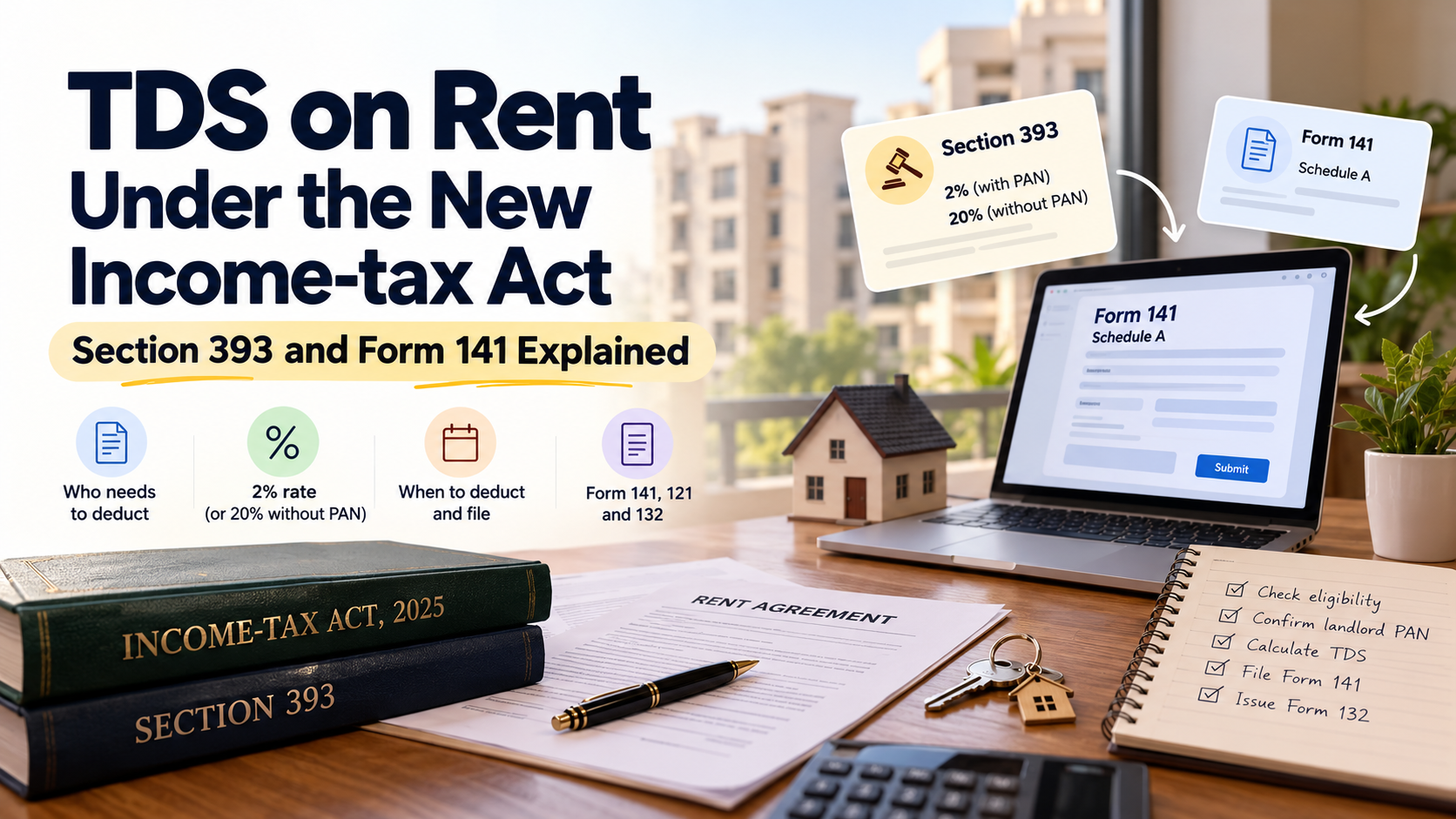
TDS on Rent Under the New Income-tax Act: Section 393 and Form 141 Explained
Paying ₹60,000 a month for a flat means there is more to settle than the landlord’s bank transfer. If you are an eligible individual tenant paying a resident landlord, TDS on rent under the new Income-tax Act involves Section 393, a deduction linked to the final month, and reporting through Form 141. Knowing the rate is only the beginning; the timing determines how much you transfer at the end of the tenancy or tax year.
For transactions governed by the Income-tax Act, 2025, Section 393(1), Table Serial No. 2(i) takes over the role of Section 194-IB, while Form 141, Schedule A, replaces Form 26QC. This guide explains who uses that route, how the ₹50,000 threshold works, and what happens when the landlord has no valid PAN or asks for a no-deduction declaration.
194-IB is gone: what replaced it?
The Income-tax Act, 2025 came into force on 1 April 2026. Earlier tax years and related compliance continue under the transition rules, so an old filing or correction does not automatically move to the new forms simply because you submit it after that date. The department’s explanation of the transition distinguishes these periods.
For the eligible individual/HUF rent category, the working references are now Section 393(1), Table Serial No. 2(i), Form 141 Schedule A for reporting and payment, and Form 132 for the certificate. Keep these references together when discussing the deduction with your landlord; mixing an old form name with a current transaction can create avoidable confusion.

Who has to deduct TDS on rent now?
The tenant or rent payer makes the deduction. Schedule A is for eligible individuals and Hindu Undivided Families (HUFs) paying resident landlords. Companies, LLPs and individuals/HUFs falling within the statutory “specified person” definition use the relevant business TDS route instead.
Do not decide eligibility solely by asking whether someone undergoes a tax audit. Under Section 402(37), an individual/HUF is a specified person when the preceding tax year’s business turnover exceeds ₹1 crore or professional receipts exceed ₹50 lakh. Other persons, including companies and LLPs, are specified persons too.
Before applying Schedule A, check three things:
- Who pays the rent: Establish the tenant’s legal category and, where relevant, preceding-year business or professional receipts. A business owner renting a home should still check this classification.
- Who receives it: Confirm the landlord’s tax residential status. Rent paid to a non-resident requires a separate analysis; Schedule A’s resident-landlord treatment should not be carried across.
- What the agreement covers: This category concerns land, buildings and land appurtenant to buildings. Section 402(29) does not extend it to a standalone furniture or equipment rental merely because the payment is called rent.
Clear rental agreement terms help establish the property, payment obligations, tenancy dates and separate charges before you calculate anything.
Does rent of exactly ₹50,000 qualify?
This category applies when rent exceeds ₹50,000 for a month or part of a month. Exactly ₹50,000 does not cross the threshold. Once applicable, the deduction is calculated on the relevant rent, rather than just the amount exceeding ₹50,000. The rate and threshold appear in Section 393’s rent provisions.
2% rate, or 20% without PAN
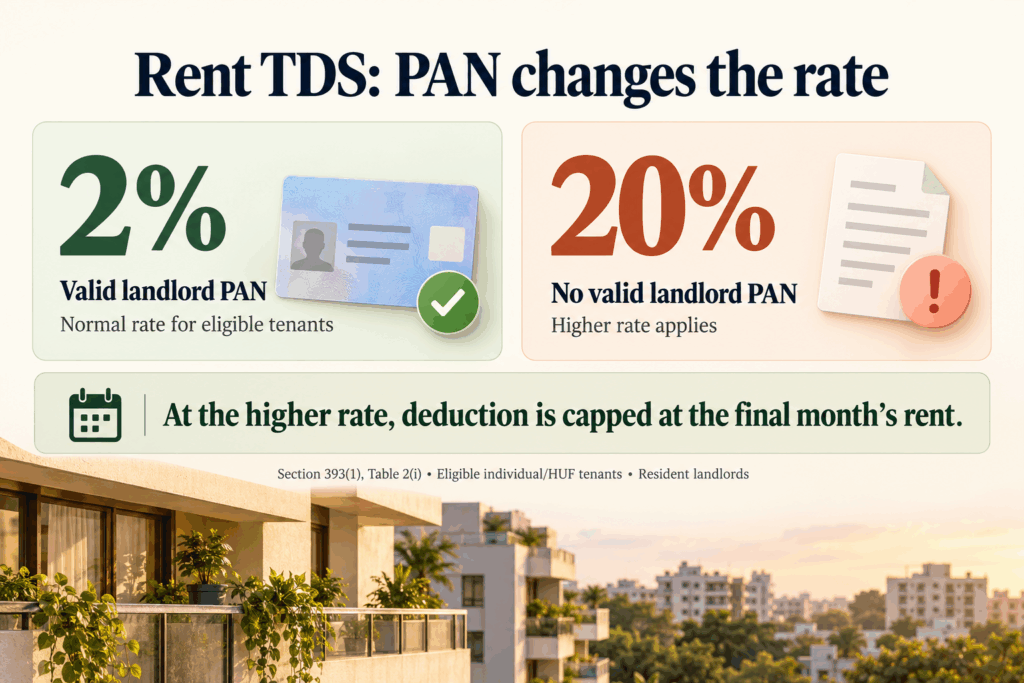
For the eligible Schedule A arrangement, the rate is 2% with a valid landlord PAN. If the landlord fails to furnish a valid PAN, the higher-rate rule ordinarily means 20%, subject to a crucial limit: the deduction under this rent category cannot exceed the rent payable for the final month of the tax year or tenancy. These PAN rules and the cap are in Section 397.
For example, 20% of ₹7,20,000 is ₹1,44,000, but a final-month rent of ₹60,000 limits the deduction to ₹60,000 under that rule. This makes collecting and checking PAN details early particularly important. Do not wait until the last payment to discover that the normal calculation cannot be used.
TDS is part of the agreed rent withheld for tax. It is not an additional payment on top of rent, and the landlord’s final tax liability is determined separately when their income is assessed.
When to deduct and file Form 141
Under this category, deduction is linked to the last month of the tax year or tenancy, at credit or payment of that month’s rent, whichever is earlier. A continuing full-year tenancy normally reaches this point in March; a tenancy ending earlier brings the deduction forward. Do not turn the general “credit or payment” wording into an automatic monthly deduction rule.
Filing and payment deadline
Rule 218(3) requires payment within 30 days from the end of the deduction month, accompanied by Form 141. Rule 219(5) gives the same 30-day period for furnishing the statement. Count days from month-end rather than assuming the deadline is always the last day of the following month.
For a deduction made in April, that gives 30 May. For a deduction made in March, it gives 30 April. Keep the deduction month distinct from the months of rent included in the calculation, especially when the tenancy ends partway through the year.
How to complete Schedule A
Form 141 consolidates several earlier challan-cum-statements, including Forms 26QB, 26QC, 26QD and 26QE. Choosing the correct schedule remains essential. The department’s Form 141 guidance confirms that eligible rent reporting belongs in Schedule A and that filing uses the deductor’s PAN, without requiring TAN for this category.
Prepare the agreement, tenancy dates, property address, PAN details, total rent and deduction calculation before opening the form. Then follow the official portal instructions:
- Open Form 141: Log in using PAN credentials and go to e-File → e-Pay Tax → Income Tax Act, 2025 → New Payment → Form 141.
- Choose Schedule A: Enter the rental transaction and deductee details, checking the actual month of deduction and the amounts against your records.
- Complete submission and payment: Retain the acknowledgement and challan, then check processing status so that errors can be addressed promptly.
Joint landlords and the TDS certificate
For jointly owned property, document each landlord’s genuine entitlement and PAN. Do not assume that multiple owners always require separate statements: current portal guidance permits multiple deductees in one Form 141 when they share the same corporate/non-corporate category and deduction month. Different deduction months require separate filings. Check ownership shares and threshold treatment against the actual arrangement rather than splitting payments informally to claim an exemption.
After processing, obtain Form 132 from TRACES and provide the signed certificate to the landlord. The official Form 132 FAQs require issue within 15 days of the Form 141 filing due date. A payment acknowledgement alone does not replace this certificate.
Form 121 for landlords with no tax due
Form 121 replaces Forms 15G and 15H for specified no-deduction declarations. However, a landlord’s statement that their tax liability is nil does not automatically remove a Schedule A tenant’s obligation. The rent entry covered by the declaration provisions is Section 393(1), Table Serial No. 2(ii), concerning payment by a specified person, rather than the individual/HUF route in 2(i).
The department’s Form 121 guidance note identifies eligible recipients and conditions. These include nil tax on estimated total income; younger declarants also face an additional limit on the relevant aggregate income. A valid PAN is necessary. For eligible landlords receiving rent from a specified person, the declaration can matter, but it must satisfy the applicable conditions.
If your landlord hands you Form 121, first establish which rent provision applies. Treat the declaration as something to validate, rather than a general instruction to pay the full rent without TDS.
Worked example: rent of ₹60,000 a month
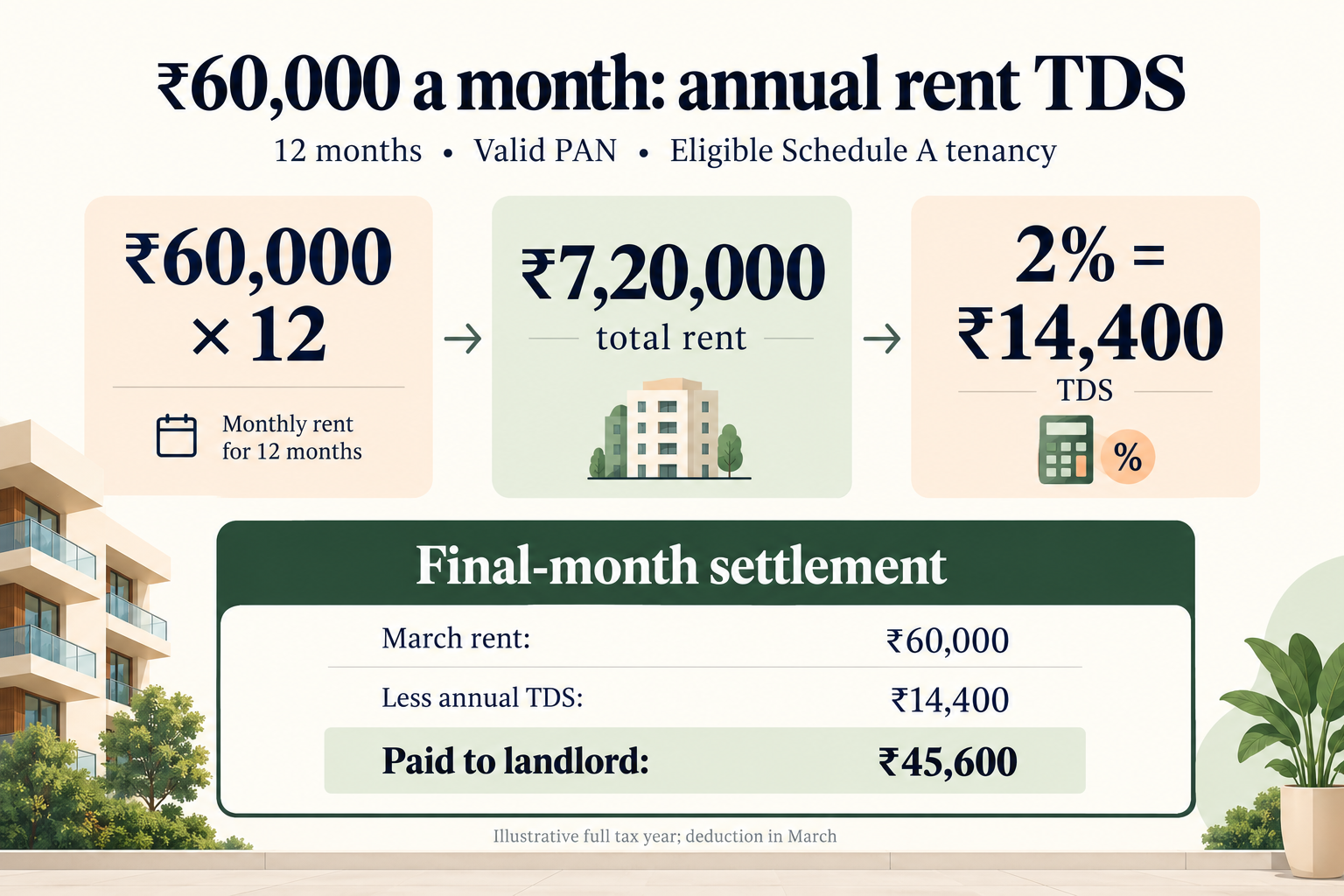
Assume an eligible individual tenant rents from one resident landlord for April 2026 to March 2027, pays ₹60,000 monthly and has a valid landlord PAN. Rent is unchanged, there are no separate adjustments, and the March payment triggers the deduction. This illustrative calculation shows how an annual deduction affects the final settlement.
| Particulars | Calculation | Amount |
|---|---|---|
| Total rent for 12 months | ₹60,000 × 12 | ₹7,20,000 |
| TDS on total rent | ₹7,20,000 × 2% | ₹14,400 |
| April to February rent paid to landlord | ₹60,000 × 11 | ₹6,60,000 |
| March payment to landlord | ₹60,000 − ₹14,400 | ₹45,600 |
| Total paid directly to landlord | ₹6,60,000 + ₹45,600 | ₹7,05,600 |
The tenant deposits ₹14,400 through Form 141 by 30 April 2027 and issues Form 132 within 15 days of that due date. The total remains ₹7,20,000: ₹7,05,600 paid to the landlord plus ₹14,400 deposited as TDS. Deducting only ₹1,200 in March would account for one month’s tax, not the full year in this example.
Your ledger should explain the difference between gross rent and bank receipts. Consistent rent tracking and tenant ledgers help identify that difference; retain the tax documents alongside the payment history. Keep security deposit records distinct so that a refundable deposit does not become an unexplained rent adjustment.
How RentOK helps organise rent and TDS records
RentOK’s tenant ledgers and financial reports can support the rental records behind your calculation. When a net payment differs from contractual rent, those records provide a starting point for reconciliation and a clearer discussion between tenant and landlord.
- Track rent and receipts: Review charges, payments and pending dues so that a difference can be investigated rather than automatically treated as unpaid rent.
- Keep payment documentation consistent: Organised rent receipts help connect transactions to rental periods. Keep the TDS certificate with the relevant tax records too.
- Download financial reports: RentOK’s money report instructions explain the download workflow. For managed properties, clear owner reports also help explain collection differences.
These features support record-keeping. Calculation, Form 141 submission, tax payment and certificate issue still require the responsible tenant’s attention.
Section 393 rent compliance starts with the correct tenant category and ends with a reconciled payment record and certificate. Confirm the landlord’s PAN early and plan the final-month settlement before transferring rent.
Download rent ledgers from RentOk to organise the rental figures behind your TDS review, and retain the challan and Form 132 with your tax records.
Conclusion
Getting TDS on rent right starts with confirming your tenant category, checking the landlord’s PAN and planning the final-month deduction. Keep your rent records, Form 141 acknowledgement and Form 132 together so the rent paid and tax deducted can be reconciled clearly.
Download rent ledgers from RentOk to organise the rental figures behind your TDS calculation and make your next tax review easier.
FAQ
1. Has Form 26QC been replaced for all old rent transactions?
Form 141 Schedule A replaces it for transactions governed by the new provisions. Earlier periods and corrections remain subject to the transition rules, so check the transaction period before selecting the form.
2. Do I need a TAN to file Form 141 Schedule A?
An eligible tenant uses PAN credentials for this filing and does not need to obtain TAN for that transaction. This exception should not be applied automatically to a company’s or another specified person’s rental payments.
3. Does a six-month tenancy mean TDS applies only to the final month’s rent?
No. The final month determines when deduction takes place; it does not limit the calculation to that month. For six eligible months at ₹60,000 with a valid PAN, 2% of ₹3,60,000 is ₹7,200.
4. Can a resident landlord use Form 121 to stop my Schedule A deduction?
Form 121’s rent declaration category concerns payment by a specified person under Table Serial No. 2(ii). Nil tax liability alone does not make the declaration available for the Schedule A route under 2(i).
5. Must I file a separate Form 141 for each co-owner?
Not always. Current portal guidance permits multiple deductees in one filing when the deductee category and deduction month match. Record each owner’s details accurately and check whether your arrangement meets the filing conditions.
6. Does a rent receipt replace Form 132?
No. A rent receipt documents the rental payment, while Form 132 certifies the tax deduction. Keep both where relevant, together with the filing acknowledgement and challan, so rent payments and TDS can be reconciled.